
Celje, 24 September 2026 – As part of the CE-VITA project, the international development conference “Regions 2030+: Building Resilient, Competitive and Investment-Ready Communities?” was held in Celje, Slovenia, on 23 and 24 September 2026. The conference provided an opportunity to bring together more than 150 participants from Slovenia and abroad and to address broader questions of regional development, while also highlighting healthcare and quality of life as important elements of resilient and future-ready regions.
The event represented this year’s international CE-VITA event, providing an opportunity to present the project to stakeholders and the wider public, discuss current challenges and opportunities in healthcare, and explore how stronger cooperation between healthcare institutions, local communities, technology providers and other stakeholders can contribute to more accessible and sustainable healthcare.
The CE-VITA project focuses on improving stroke rehabilitation and patient care by supporting better coordination, practical solutions and stronger healthcare systems. It seeks to help hospitals and healthcare providers address the challenges of rehabilitation after stroke and explore how digital solutions and stronger connections between different actors can contribute to more effective and patient-centred care.
CE-VITA Perspective on Regional Development
The CE-VITA perspective was in particular highlighted in the conference panel “From Strategy to Action: How Are the Best Getting Future-Ready?”, where Tanja Antonič, Assistant Director for General and Business Affairs at Jesenice General Hospital, project’s lead partner, presented the CE-VITA project and shared experiences from the healthcare sector.
She highlighted the added value that local and regional actors can bring by connecting different stakeholders and areas of expertise. In Slovenia, healthcare digitalisation is increasingly being explored as a way to support healthcare professionals and reduce their workload. However, there is still a need for clearer guidance on how such projects should be developed and connected with the wider healthcare and regional ecosystem.
In this context, CE-VITA provides an example of how a project can bring together healthcare institutions, local communities and other stakeholders and create space for broader cooperation. Such an approach can also open up opportunities for connecting institutions, faculties, simulation centres, local communities and older citizens, and for considering how similar models of cooperation could be applied in other areas.
The discussion underlined that healthcare innovation is not only a question of introducing new technologies. It is also about creating the conditions for institutions and people to work together, share knowledge and develop solutions that respond to real needs.
Strengthening the Healthcare Innovation Ecosystem
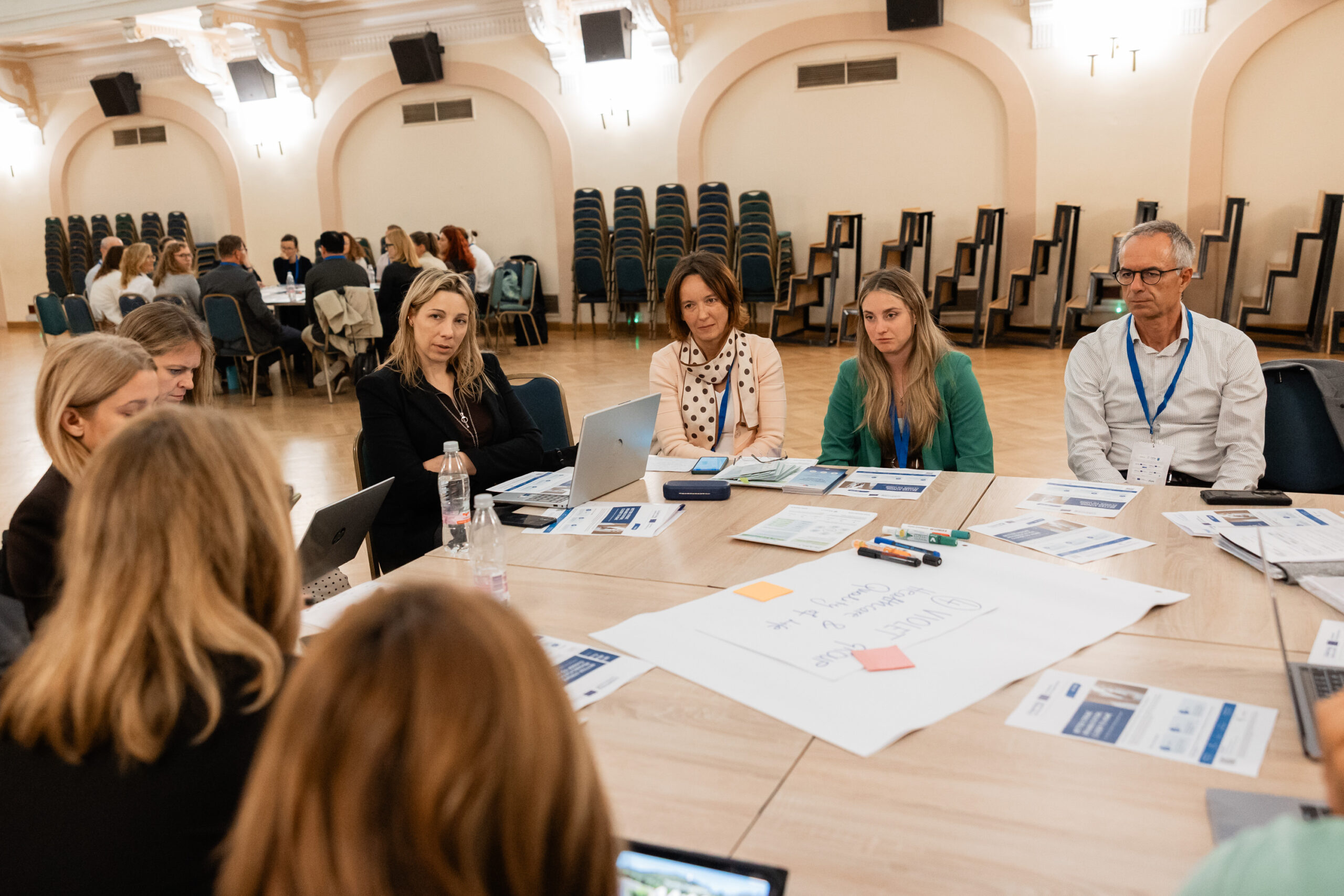
As part of the conference, CE-VITA organised an interactive workshop within the session “Co-Creating Solutions: Turning Development Challenges into Breakthrough Projects.” The workshop brought together around 15 participants from different fields, including members of the Health Innovation Hub (HIH), creating a space for exchange between healthcare, innovation and other relevant stakeholders. The discussion focused on how digital health solutions can move from development into real-life healthcare settings. Participants emphasised that digitalisation should create clear added value for patients, families and carers and respond to real needs, while preserving the human dimension of healthcare. At the same time, successful adoption depends on the involvement of healthcare professionals, who can play an important role in building trust in new solutions but often have limited time to engage in innovation activities. The discussion also highlighted wider systemic challenges, including limited innovation capacity within healthcare institutions, regulatory and data-related requirements, the gap between technology development and implementation, and the need for stronger cooperation between healthcare professionals, patients and families, technology providers, institutions, investors, insurers and public authorities.
The workshop also explored what is needed to move beyond individual pilot projects towards wider adoption and replication. Key priorities included strengthening innovation and project-management capacities within healthcare institutions, improving digital literacy among patients and families, involving users in co-design and testing, and bringing technology developers and healthcare experts together from the early stages of development. Participants also discussed the need for dedicated and longer-term funding, validated and transferable digital health solutions, and implementation support combining technology, services, training and user support. Stronger mechanisms for transferring successful solutions between hospitals, regions and countries were also identified as important. Overall, the discussion highlighted the need to approach healthcare innovation as a continuous process — pilot → validation → adoption → replication → scale — supported by strong partnerships and an ecosystem capable of connecting the different actors involved.
Creating Space for Cooperation
The CE-VITA event demonstrated the value of connecting regional development with healthcare innovation and of creating opportunities for stakeholders to discuss challenges together. The combination of the development conference, the CE-VITA presentation and interactive workshop, and the HIH meeting created a broader space for exchanging experiences and exploring potential cooperation.