
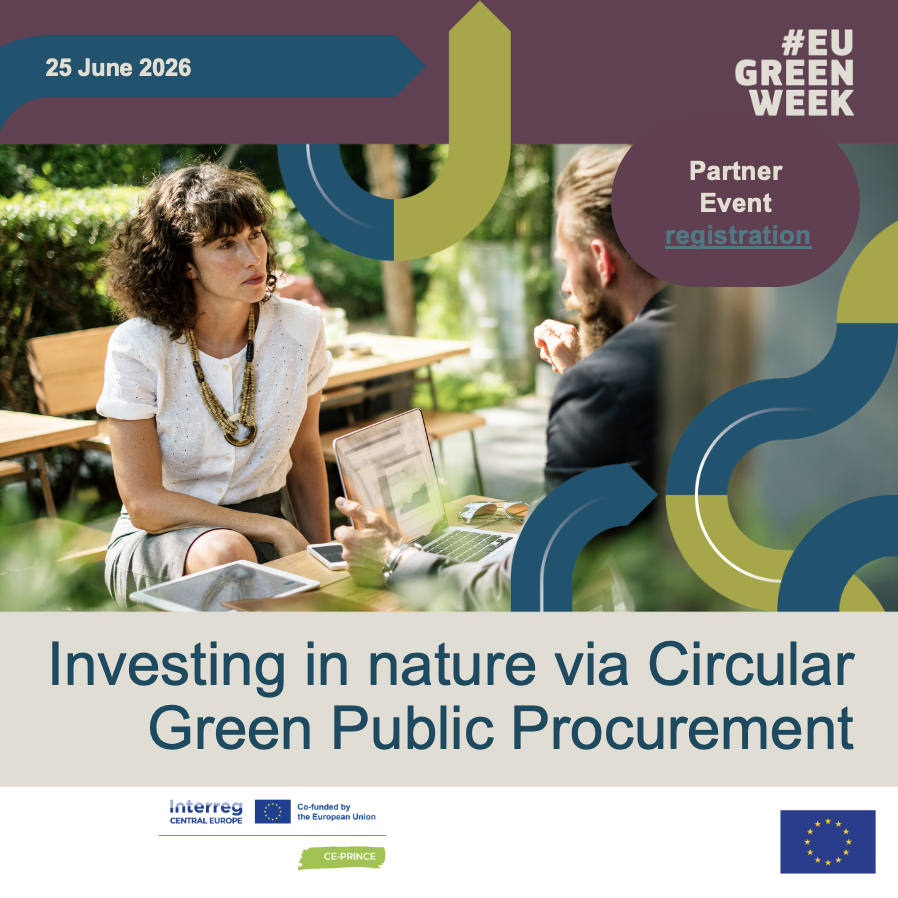
The webinar opened with an overview of the project’s objectives and activities by project coordinator Sara Piana who highlighted the importance of transnational cooperation in addressing common procurement challenges across Central Europe. Through capacity-building activities tailored to national needs, the development of common circular procurement criteria, pilot actions and peer-to-peer exchanges, CE-PRINCE is creating practical tools that support both public buyers and companies.
A key focus of the event was the presentation of the project’s Upgraded Common Circular Criteria, developed to help contracting authorities integrate circularity into procurement procedures. Serena Mancini presented the methodology behind the criteria and the main findings from the analysis of existing procurement practices. The Upgraded common criteria will be tested within the pilots of the project but can also be tested by other contracting authorities from other Member States. The analysis also revealed a fascinating ‘cost paradox’: while both public authorities and enterprises perceive circular products as expensive, both cite cost savings as a major motivation. The assessment highlighted a clear bottleneck on the public side: while 36% of enterprises have already implemented circular practices, only 22% of public authorities include circular criteria in their tenders.
Emőke Takács emphasised the need to move away from the traditional linear economic model towards a regenerative framework based on collaboration between public authorities and businesses. Rather than focusing solely on the lowest purchase price, procurement decisions should consider total economic, environmental and social value throughout the entire life cycle of products and services.
Complementing this perspective, Omar Salha highlighted that the main barriers to circular procurement are often linked to limited knowledge and capacity rather than financial constraints. Strengthening the skills of procurement professionals and creating opportunities for dialogue between buyers and suppliers therefore remain essential to accelerating implementation.
Strengthening the skills of procurement professionals and creating opportunities for dialogue between buyers and suppliers therefore remain essential to accelerating implementation. To aid this, the project highlighted a free online audit tool designed to help companies identify and formalize their ‘invisible circularity’ – practices they do anyway but often fail to leverage in formal tenders
The webinar also showcased the City of Lund (Sweden) as one of the project’s good practices. Presented by Elin Dalaryd, the case demonstrated how a reuse inventory carried out during a school demolition project evolved into a long-term municipal strategy, introducing standardised reuse inventories and new procurement criteria for circular construction. Notably, a single reuse inventory for a demolished school yielded €30,000–€40,000 in economic savings, demonstrating that circularity is highly cost-effective.
The discussion also highlighted the growing importance of Life Cycle Costing (LCC) in public procurement. While the EU Public Procurement Directive already provides for its use, speakers agreed that wider implementation will require better data, practical guidance and continued capacity building.
The event concluded by reaffirming that the transition towards circular procurement depends not only on new criteria, but also on stronger cooperation, knowledge sharing and practical tools. As the European Commission prepares new proposals on public procurement and the circular economy, and as EU GPP criteria rapidly transition from voluntary to mandatory by the end of the decade, CE-PRINCE is demonstrating how European cooperation can help turn policy ambitions into concrete action. Building readiness now through training and pilot criteria is the most cost-effective strategy for public authorities.
Those who have missed the event can watch it back here.