
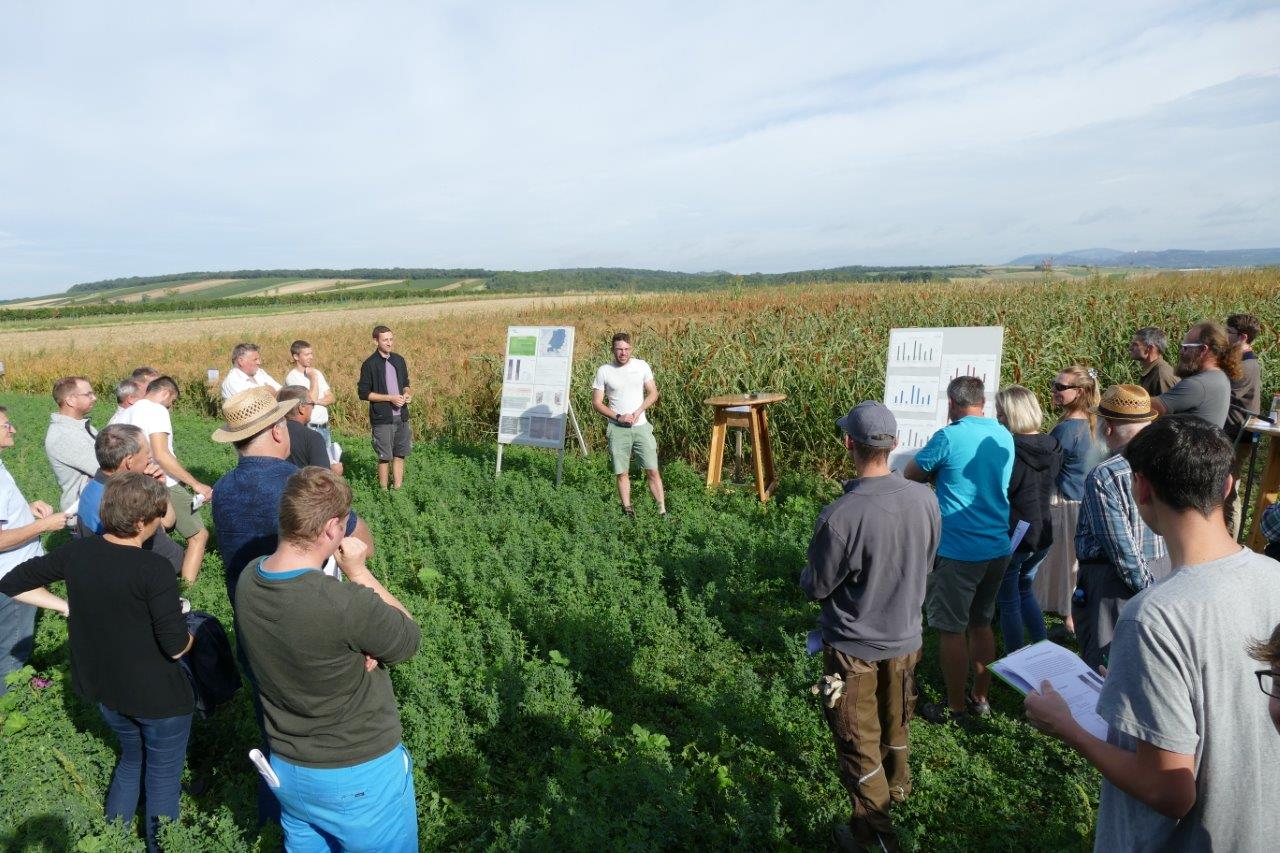
A field workshop in Poysbrunn, Lower Austria, brought together around 50 farmers to explore crop diversification as a carbon farming technique and discuss practical experiences from the Carbon Farming CE field trial.
Participants learned about the cultivation and potential benefits of drought-tolerant C4 millet crops from the Panicum, Sorghum and Setaria genera and discussed their role in diversifying crop rotations.
The workshop highlighted several practical opportunities and barriers to wider implementation:
- Market access: limited sales opportunities for additional crops can discourage farmers from diversifying crop rotations. Participants identified farmer cooperation as one possible way to improve market access and aggregate supply.
- Water and soil: discussions addressed agricultural water efficiency and the role of plant roots and soil microorganisms in long-term carbon sequestration.
- Monitoring carbon sequestration: participants discussed the challenges of measuring changes in soil organic carbon (SOC) and approaches for analysing different SOC fractions.
- Business model risks: farmers raised concerns about potential financial and contractual liabilities when correctly implemented carbon farming practices do not result in measurable increases in SOC during a contract period.
The workshop provided practical insights into the agronomic, market, monitoring and financial conditions that need to be considered when introducing carbon farming practices and developing viable business models.