
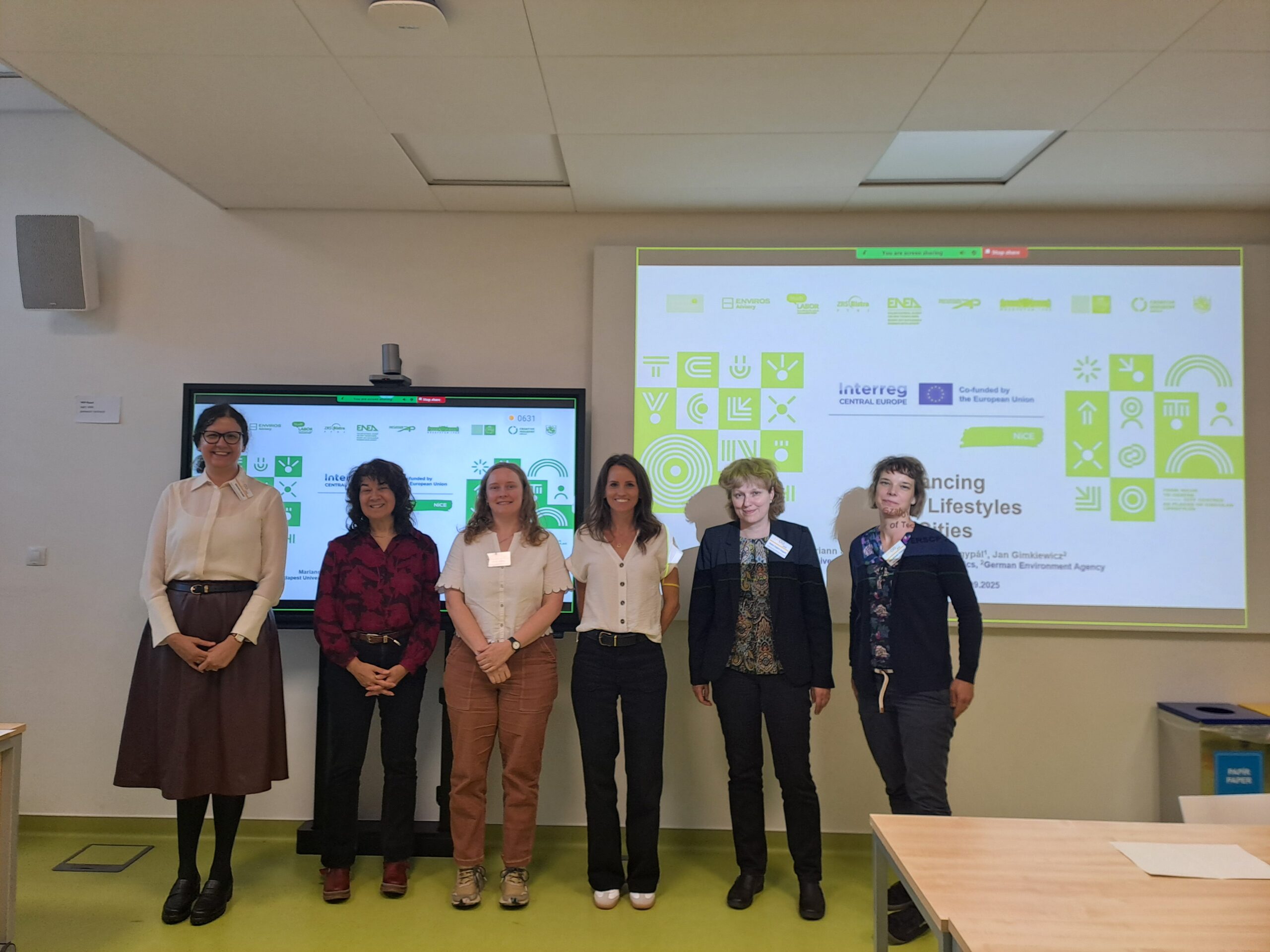
Prague, Czech Republic — September 17, 2025 — The Interreg CENTRAL EUROPE NiCE Project successfully hosted a pivotal workshop titled “Advancing Circular Lifestyles in Cities” at the 22nd European Roundtable on Sustainable Consumption and Production (ERSCP 2025) conference, held at the Czech University of Life Sciences.
Organized by the BME Department of Environmental Economics & the German Environment Agency (UBA), the session directly addressed the conference theme, “Sustainable Consumption and Lifestyles for a Circular Society.” The core challenge explored was why circular lifestyles often remain in a niche, hindered by fragmented policy, economic fragility, and social exclusivity.
Focus and Dialogue
The session, attended by seven international participants representing policy, research, and practice from Austria, Czechia, Hungary, and the UK (including representatives from organizations like AK Wien, Czech University of Life Sciences Prague, ReLondon and The Manchester Metropolitan University), sought to answer the central question: “What political and practical conditions are necessary for circular urban lifestyles to become mainstream?”
Facilitated by Mariann Szabó and Noémi Csigéné Nagypál (BME), the workshop moved the discussion beyond mere recycling to emphasize broader value retention strategies focused on resource efficiency, reuse, and environmental sustainability.
The session began with presentations by Mariann Szabó, introducing the NiCE project and its approach for mainstreaming circular lifestyles, and Noémi Csigéné Nagypál, outlining the policy framework conditions. This was followed by a moderated group discussion focused on identifying successful local policies, potential business models for broad adoption, and strategies for making circular offers more accessible to various groups.
Key Insights and Solutions
The dialogue established that while no “one-fits-all” solution exists—underscoring the importance of local specialties and expert knowledge — municipalities have much to learn from each other (citing Utrecht as an example).
Barriers and Challenges: Participants highlighted common barriers, including poor communication, low public awareness, and the unique difficulty of scaling circularity in large population centers. They noted that marginalized groups, while often having a lower ecological footprint, frequently have less access to innovative circular solutions (e.g., due to digital literacy issues).
Endogenous Solutions: Several practical solutions were proposed:
- Mass Media and Culture: Utilizing mass media, such as TV shows promoting DIY/repair, can significantly boost public engagement.
- Infrastructure: Making physical infrastructure available is indispensable. Circular practices must be made popular by “making it a nice experience.”
- Digital Tools: Match-maker platforms and “maps of circular solutions” were seen as crucial for providing information and are expected to spread rapidly.
- Community Support: Services like free repair or “libraries of things” and community hubs associated with circular solutions play an important social and community development role.
The constructive atmosphere concluded with a strong consensus that the knowledge exchange was beneficial for all attendees and opened doors for potential future cooperation with key organizations like AK Wien, ReLondon, and The Manchester Metropolitan University, significantly boosting the NiCE project’s multiplier effect.