
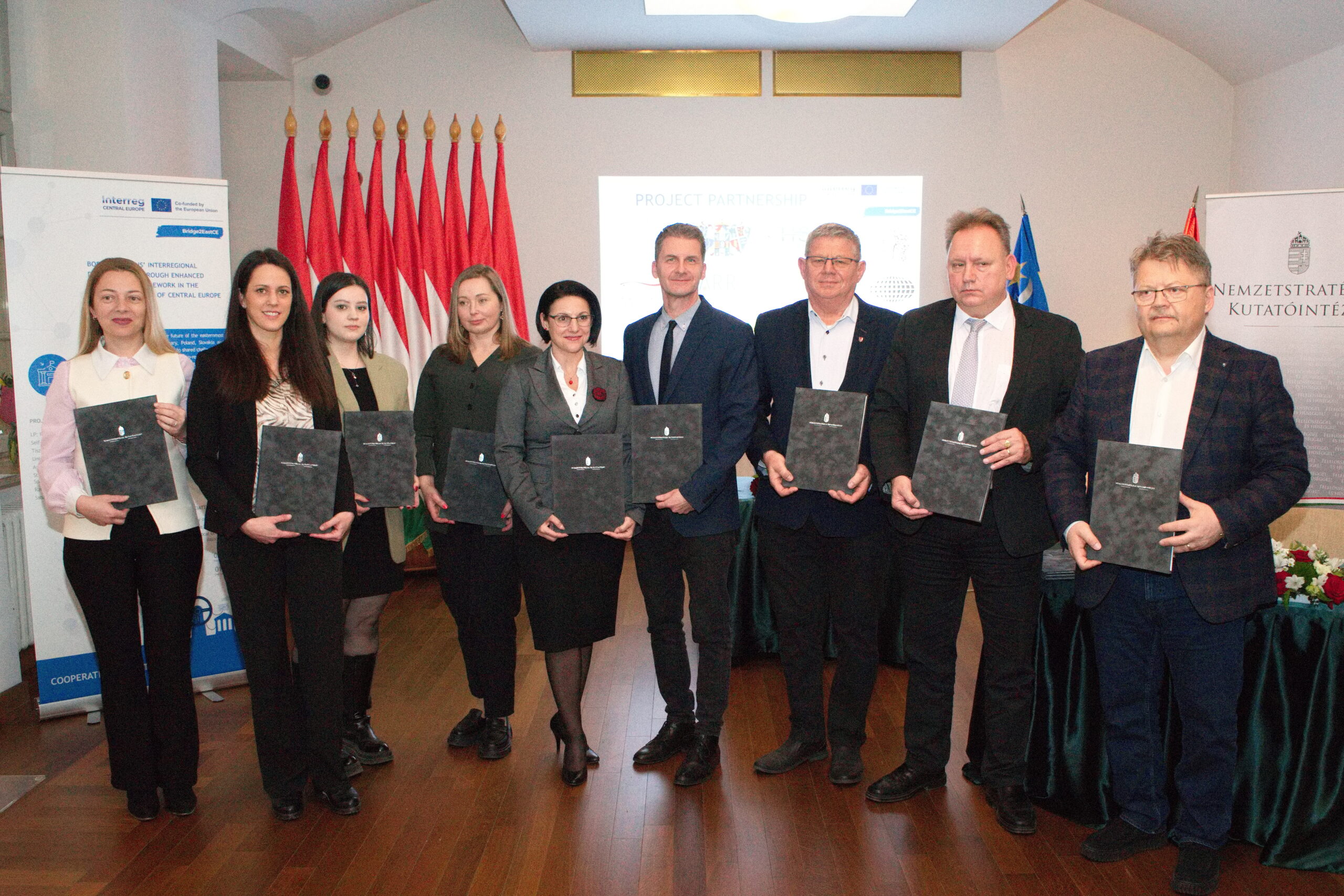
The Bridge2EastCE international project – co-financed by the Interreg Central Europe Programme – was officially launched on 24 March 2026 at a ceremonial event in Budapest, hosted at the headquarters of the Research Institute for National Strategy. The kick-off event brought together a wide range of domestic and international partners, policymakers, and representatives of scientific institutions, highlighting the initiative’s broad support and strategic importance.
The Bridge2EastCE project aims to rethink the future of Central Europe’s peripheral regions bordering Ukraine. The initiative seeks to address the social and economic challenges intensified by the Russian–Ukrainian war, while placing strong emphasis on harnessing the strategic opportunities arising from the region’s role as a “bridge.”
A key component of the two-year cooperation is the establishment of an Interregional Territorial Planning Cooperation (ITPC) framework, designed to support coordinated planning and strengthen collaboration among Central European regions bordering Ukraine.
The project is led by the Research Institute for National Strategy (RINS) and brings together a partnership of 11 organisations from Poland, Slovakia, Romania, Hungary, and Ukraine.
The regional partners – Tisza EGTC (HU), Self-government of Szabolcs-Szatmár-Bereg County (HU), Rzeszów Regional Development Agency (PL), Satu Mare County Intercommunity Development Association (RO), and Association Velke Kapusany and Surrounding (SK) – are deeply rooted in the areas where development interventions are most needed. Their local experience helps to better understand the challenges and opportunities of the regions.
The knowledge partners – RINS (HU), University of Prešov (SK), and the Stanisław Leszczycki Institute of Geography and Spatial Organization of the Polish Academy of Sciences (PL) – provide methodological and professional support, contributing to the development of innovative solutions.
The project is also supported by three associated partners: University of Pannonia (HU), Podkarpackie Voivodeship (PL), and Association of Border Municipalities of Transcarpathia (UA).
At the project’s opening event, Jenő Szász, Ministerial Commissioner and President of the Research Institute for National Strategy, emphasized that the initiative forms part of a broader strategic thinking process built on strengthening cooperation within the Carpathian Basin. “We must think in interconnected systems which, beyond our own natural and human resources, enable sustainable, planned and orderly management in the Carpathian Basin through the inclusion of additional European Union resources,” he underlined, highlighting the Institute’s mission. Mr Szász also pointed out that the region’s challenges – whether economic, demographic, or social – can only be effectively addressed on at least a Carpathian Basin scale and through Central European cooperation.
In her opening remarks, Viktorija Dobravec, Programme Officer at the Joint Secretariat of the Interreg Central Europe Programme, highlighted the importance and timeliness of the project, alongside providing a brief overview of the EU programme.
Endre Baracsi, Vice-President of the General Assembly of Szabolcs-Szatmár-Bereg County Council and member of the Supervisory Board of the Tisza European Grouping of Territorial Cooperation, highlighted how the partner organisations he represents are connected to the project. He stressed that the Bridge2EastCE initiative will create an opportunity to extend planning and joint strategic thinking across the entire European Union border section with Ukraine, while also fostering the exchange of experience among partners.
Prof. Dr. Péter Kónya, Rector of the University of Prešov, placed the initiative in a historical perspective. He pointed out that the peoples of Central and Eastern Europe have maintained close cultural and economic ties for centuries, and that the region today is bound by more connections than divisions. He emphasized that the region’s shared challenges – including issues related to higher education, the economy, and social development – can be addressed more effectively through cooperation, knowledge sharing, and joint planning. The project offers a new platform and opportunity to facilitate precisely this.
One of the highlights of the event was the signing of the Partnership Agreement, which provides an official framework for cooperation among the participating institutions.
The kick-off event continued with a series of professional presentations. First, Norbert Pál, Government Commissioner for Persons Fleeing the Russian-Ukrainian War to Hungary, spoke about the refugee situation caused by the conflict and its relationship with the Hungarian labour market. He was followed by Gábor Mayer, Government Commissioner Responsible for the Complex Development of the Northwest Hungarian Economic Development Zone, who delivered a presentation entitled “A functional approach to reviewing Hungarian territorial development frameworks.” The scientific segment concluded with Dr. Márton Péti, Vice-President of the Research Institute for National Strategy, and Dr. Gábor Mozga, Head of Department at the Institute, presenting the Bridge2EastCE project.
Following the introduction of the project partners, the day continued with a closed-door workshop organized for the participating organisations.
One of the key messages of the Bridge2EastCE project is that the regions along Europe’s eastern border are not merely peripheral areas, but can play a central role in the continent’s future. The initiative aims to strengthen these regions, enhance their resilience, and enable them to actively contribute to Europe’s economic and social development. The Budapest project launch clearly demonstrated that the participating countries and institutions are ready to work together toward this goal, building bridges not only between regions but also between communities and visions for the future.
The total budget of the Bridge2EastCE project exceeds EUR 772,000.