
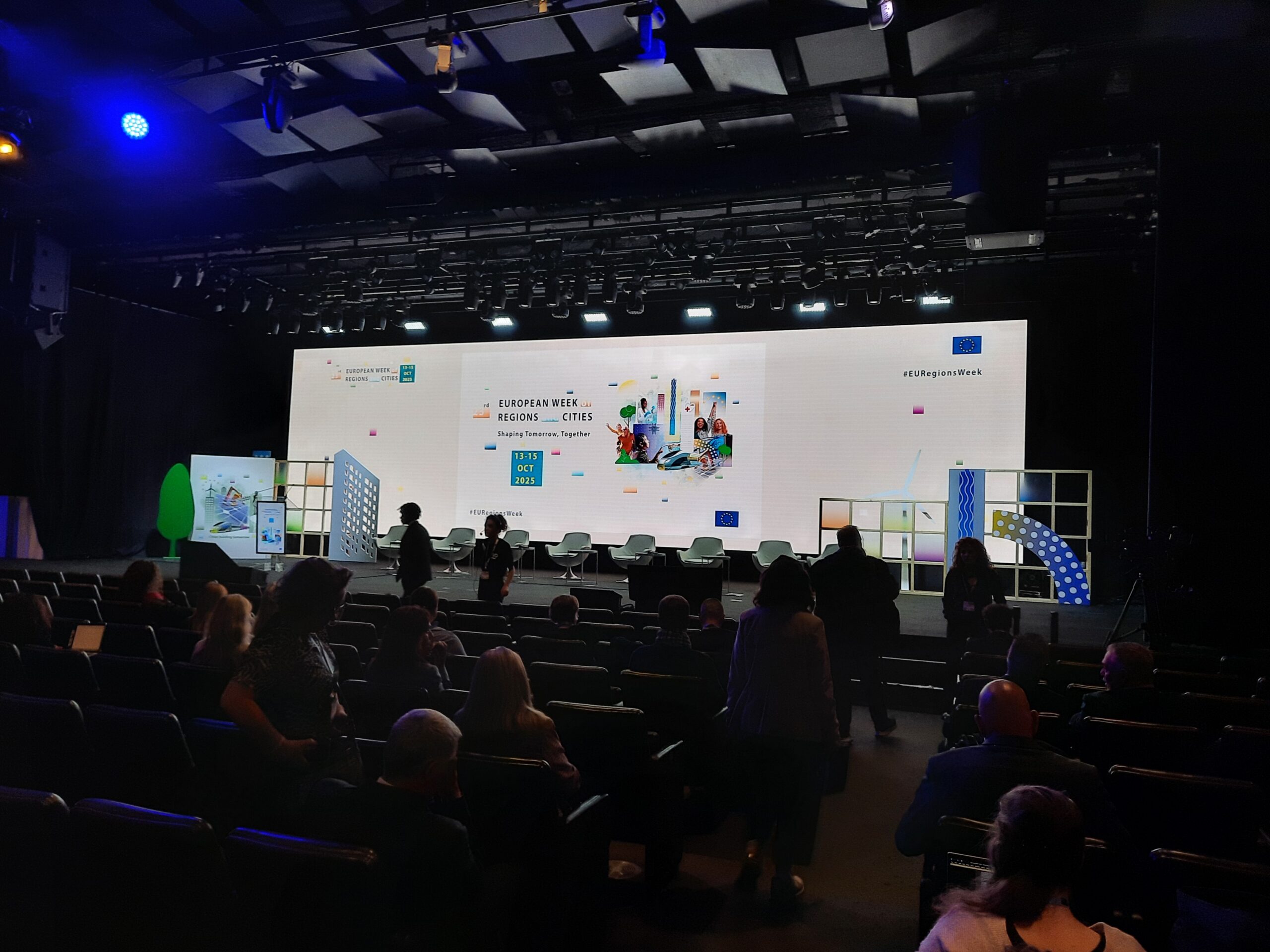
On 15 October 2025 the European Week of Regions and Cities 2025 in Brussels featured a participatory lab session titled “Advancing and monitoring circular lifestyles and policies in cities and regions.” The session was co-organized by the German Environment Agency/ Umweltbundesamt (UBA) and the Budapest University of Technology and Economics (BME) through the Interreg CENTRAL EUROPE Programme project NiCE, in collaboration with VITO and the Circular Cities and Regions Initiative (CCRI).
The event centred on the critical question: “What is needed for mainstreaming urban circular lifestyles; and what tools do we have to monitor them?” As interest in circular economy governance grows, effective policymaking increasingly depends on the development and continuous monitoring of circular policies that promote sustainable consumption and circular lifestyles. This participatory lab brought together around 45 policymakers, urban practitioners, and experts to explore both the political and practical conditions needed to mainstream circular urban lifestyles, as well as the tools and indicators required to track their adoption and impact. After four inputs from two speakers and two commentators, the session hosted collaborative workshops to the topics ‘circular lifestyle needs and best practices’ and ‘indicators for circular lifestyles’ where participants shared experiences and discussed challenges.
The NiCE Project: Context and Methodology
The session commenced with a presentation by Mariann Szabo (BME, representing the NiCE project). She outlined NiCE’s core objective: transforming central urban spaces to facilitate the adoption of sustainable, circular lifestyles by inhabitants, thereby integrating circular economy principles into urban development. The project has implemented eight pilot actions across eight European cities to test and validate practical approaches, generating data and findings. These insights have been compiled into a diverse set of outputs for local authorities and citizen engagement, including Solution Guides, Action Plans, and a Virtual Exhibition showcasing best practices. The project’s definition of circular lifestyles is structured along the R-Framework: Short Loops (refuse, reduce, reuse); Medium-Long Loops (refurbish, remanufacture, repurpose); and Long Loops (recycling).
Monitoring Implementation: Perspectives from Turku
The City of Turku, Finland, provided an overview of its approach to measuring and monitoring the circular transition. Iris Kriikkula (Circular Economy Project Manager) detailed Turku’s commitment to sustainable resource use and achieving climate positivity by 2029. Key instruments utilized by Turku include Climate Budgeting, used to track progress against climate targets, and Comprehensive Emissions Tracking, which calculates both consumption-based and sector-based emissions to inform policymaking with a complete knowledge base. Turku’s participation in the FISU (Finnish Sustainable Municipality Network) further underscores the utility of shared indicators for monitoring collective goals such as zero emissions, zero waste, and reduced overconsumption.
Expert Commentary: Policy Conditions and Metric Development
Commentators Agnes Schönfelder (City of Mannheim) and Luc Alaerts (Circular Economy Center in Flanders) offered focused insights into citizen behaviour and indicator development. Ms. Schönfelder emphasized that successful transformation requires structural change. Cities must move beyond awareness campaigns to actively modify the operating environment by creating attractive pathways for sustainable choices. Mr. Alaerts highlighted the necessity of developing indicators tailored to the diverse information needs of decision-makers. He noted the potential of data sources like household budget surveys and stressed that indicators must reflect deeper outcomes such as reduced consumption and social acceptance.
Outcomes from Collaborative Workshops
The session concluded with interactive workshops to the topics ‘circular lifestyle needs and best practices’ and ‘indicators for circular lifestyles’ that generated specific recommendations for policy and practice.
For the first topic of needs, challenges, and best practice of circular lifestyles, participants prioritized actions to promote circularity. The need for strong political commitment and for public institutions to serve as role models was consistently emphasized, with public procurement identified as a powerful lever. Participants affirmed that circular lifestyles extend beyond waste management to encompass food, water, and sharing. Recommended best practices included tax incentives for circular economy businesses and the establishment of repair cafés to facilitate skill-sharing and social interaction. Furthermore, the importance of using inclusive language and fostering community engagement for mutual support was deemed crucial for reaching diverse citizen groups.
On the second topic about indicators for circular lifestyles, three groups focused on the metrics cities use or need to guide circular economy decisions, specifically across the areas of consumer goods, housing, and mobility. A central debate concerned whether indicators should prioritize desired outcomes (like waste reduction and higher R-strategies) or also capture intermediate goals (such as social acceptance and the proliferation of circular business models). Participants also discussed the necessary ambition level for measuring transformative changes like shifts in dietary or mobility habits. The consensus was that meaningful progress requires both supportive policies and indicators that reflect deeper cultural and behavioural shifts to ensure widespread policy acceptance and effectiveness. The session successfully demonstrated that the transition to circularity requires aligning policy tools with clear, measurable outcomes and robust stakeholder engagement.