
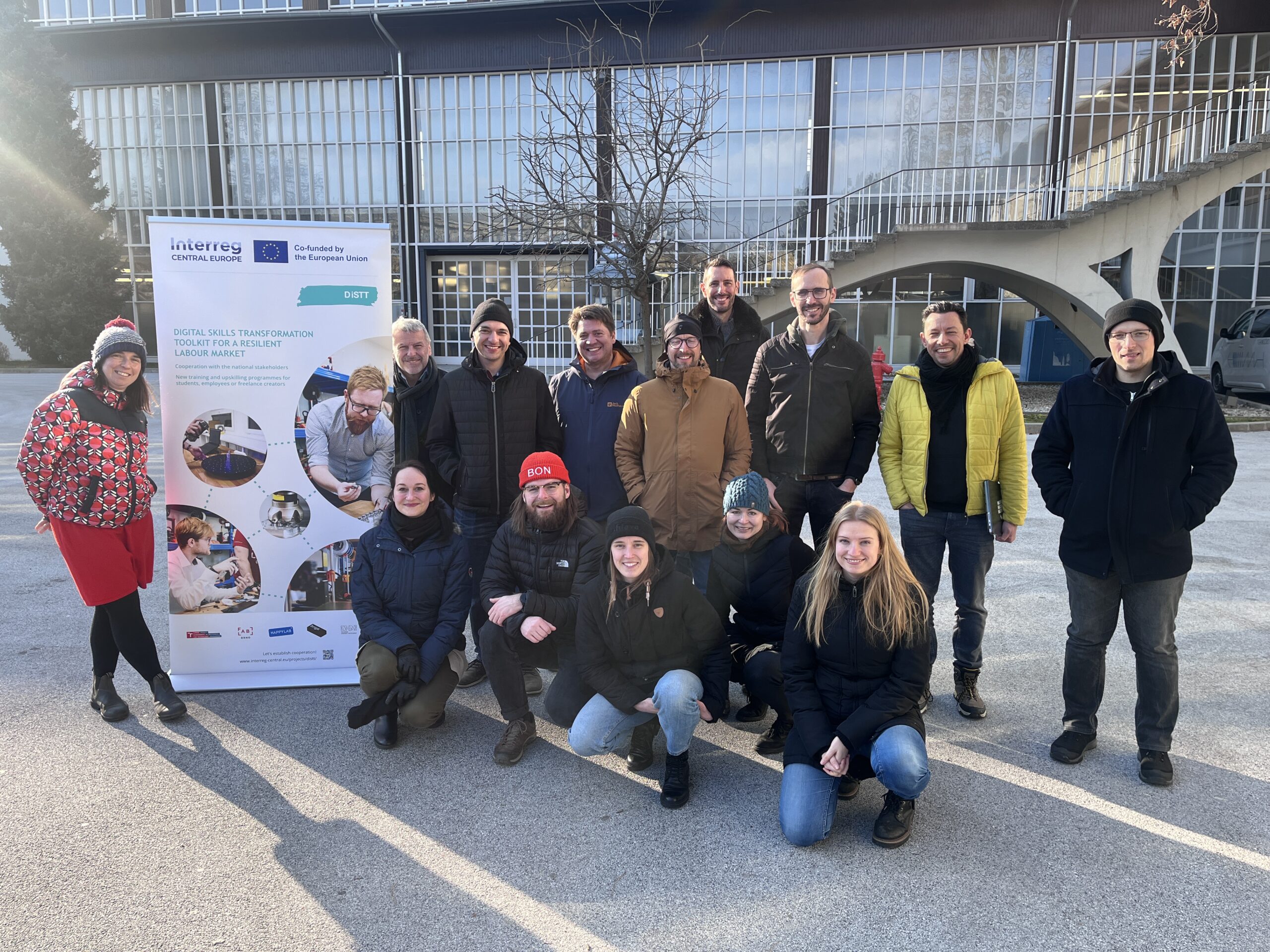
On 18 and 19 February 2025, a working meeting of the DiSTT project partners—Digital Skills Transformation Toolkit for a Resilient Labour Market—was held in Zagreb. The two-day programme brought together representatives of Brno University of Technology, FabLab Brno, Happylab Wien, brigk, NOI Techpark and FabLab Zagreb. The meeting aimed to review the project’s progress, coordinate the preparation of the pilot training programmes and further develop key project deliverables.
The first day began with a discussion on project management, reporting, the project timeline and State aid rules for cooperating companies. The partners then presented their proposed pilot activities. They focused on the format and duration of the programmes, target groups, participant numbers and cooperation within partner tandems. The aim is to develop practical upskilling and reskilling programmes that can be adapted to the needs of different regions.
A significant part of the meeting was dedicated to the Joint Blueprint. This document is intended to guide the design of high-quality upskilling and reskilling programmes and define their objectives, target skills, pedagogical approaches, formats and evaluation methods. The partners worked on a common structure for the pilots and a set of questions to facilitate their planning and comparison.
The next session focused on the project’s transformation strategy, its long-term objectives and cooperation with strategic partners. The partners also discussed the preparation of a Digital Skills Transformation Schedule linking milestones, individual steps, expected impacts and stakeholder meetings. The final session of the day was dedicated to planning the project’s participation in the FAB25 conference, where the partners were scheduled to present their pilot activities and the results of DiSTT on 7 July.
On the second day, the Steering Committee met in the presence of a representative of the Joint Secretariat. Its members reviewed progress against the project timeline, the feasibility of planned milestones and deliverables, and potential risks. They also discussed project management, support and communication among the partners. The meeting confirmed that open cooperation and a clear division of responsibilities are essential for the successful implementation of the pilots and the project’s long-term impact.