
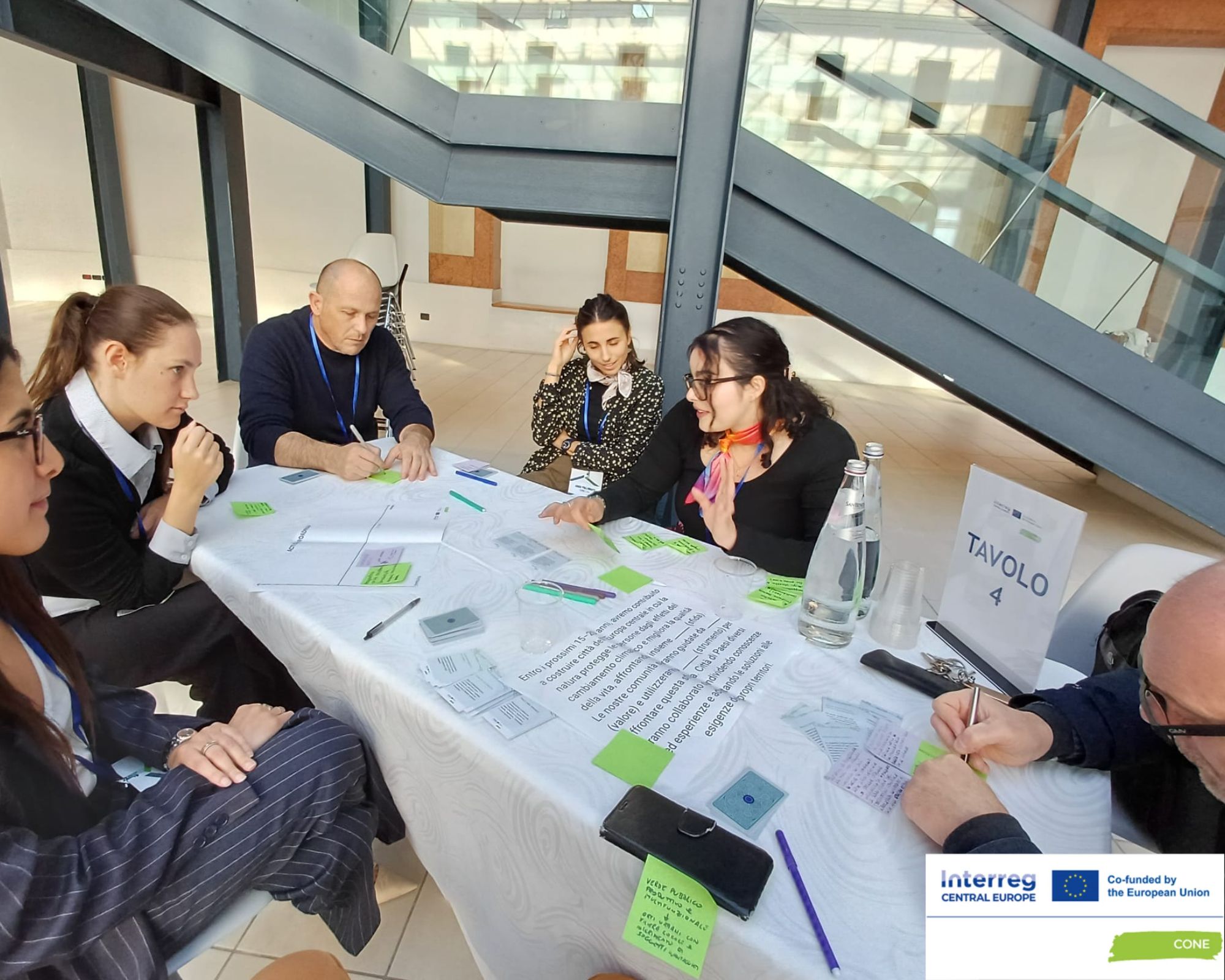
The final event of the CONE – Cities of Nature project took place in Padua, Italy, on 22 October 2026. Project partners, representatives of local authorities, researchers and practitioners came together to review the project’s achievements, exchange experiences from pilot activities and explore opportunities for the wider application of Nature-Based Solutions in urban environments.
Bringing project experience together
Hosted at Centro San Gaetano in Padua, the final event provided an opportunity to consolidate the knowledge and experience developed throughout the CONE project. The programme brought together representatives of partner organisations, municipalities and other stakeholders to discuss the project’s results, the practical implementation of Nature-Based Solutions (NBS) and their potential transfer to other urban contexts.
The event opened with welcome remarks from the Municipality of Padua, followed by institutional greetings from the Interreg Central Europe Joint Secretariat and a presentation of the CONE project.
From pilot actions to transferable solutions
The first roundtable focused on the project’s main results and their transferability. Representatives of BURST, the Municipality of Wejherowo, APC ERB and JAIP discussed the Urban Living Lab methodology and the practical tools developed within CONE, including the training package and the NBS Toolbox.
Particular attention was paid to the role of citizens and local stakeholders in identifying climate-related challenges and designing suitable Nature-Based Solutions. The discussion also highlighted the importance of the project’s pilot actions as practical examples of how the CONE approach can be applied in different local contexts.
Beyond the physical interventions themselves, the pilot actions generated valuable experience in planning, stakeholder involvement, implementation and maintenance. Their environmental and social benefits, as well as the challenges encountered during their preparation and delivery, provide useful insights for other municipalities.
The partners also discussed the transferability of project results. Rather than simply reproducing individual interventions, replication requires adapting tested approaches to local conditions and needs. The Replicability Protocol and the Joint Strategy for Urban Greening Plans were presented as complementary tools supporting this process.
European Nature Restoration Regulation and its implications for cities
An important contribution to the event was the presentation by ISPRA on the European Nature Restoration Regulation.
The presentation addressed the growing importance of restoring degraded ecosystems, including in urban environments. For cities and local authorities, this creates new opportunities and responsibilities related to urban greening, depaving and the restoration of ecological functions.
The discussion highlighted the need for reliable data and monitoring to assess progress and support the implementation of restoration measures. It also underlined the importance of integrating nature restoration objectives into local planning and long-term urban development strategies.
From European framework to local action
The second roundtable explored how urban nature restoration can be translated into practical action at the local level.
The City of Padua presented its ongoing work on depaving and urban nature restoration, highlighting the need to balance environmental priorities, technical feasibility and local needs when identifying suitable intervention sites.
The City of Reggio Emilia contributed the experience of Parco del Legno, demonstrating how citizens can participate in the regeneration of public spaces. Through an open public call and exploratory co-design activities, residents were directly involved in discussing the future use of the area.
The exchange highlighted the importance of moving beyond one-off consultations towards more structured citizen involvement in local transformation processes, including shared responsibility for public spaces.
Experiencing collaborative planning: the afternoon workshop
The afternoon workshop provided a practical opportunity for participants to experience a collaborative co-design process.
Divided into three groups and supported by facilitators, participants worked on simulated urban challenges related to climate change. They exchanged perspectives, discussed priorities and explored possible responses to the challenges presented.
The exercise demonstrated the importance of facilitation and inclusive discussion in bringing together different types of knowledge and experience. It also highlighted that successful collaborative planning is not only about finding a final technical solution, but also about building a shared understanding of the problem and developing a common proposal.
The three groups presented the main outcomes of their discussions in a joint plenary session.
Building on CONE results beyond the project
The final event confirmed the value of the integrated CONE approach, connecting pilot actions, Urban Living Labs, practical tools and policy-related work within a common framework for testing, learning and transferring solutions.
A key message was the importance of ensuring that the knowledge generated throughout the project remains accessible and useful beyond its lifetime. The CONE website, technical documentation, training materials, pilot outputs and demonstration videos provide resources for municipalities, practitioners and community organisations interested in advancing Nature-Based Solutions.
The event in Padua marked an important milestone in consolidating the project’s experience and strengthening the exchange of knowledge between cities and organisations. It also highlighted the potential of CONE results to support the wider uptake of Nature-Based Solutions and contribute to greener, more resilient urban environments across Europe.
CONE – Cities of Nature is implemented within the Interreg Central Europe Programme and co-funded by the European Union.