
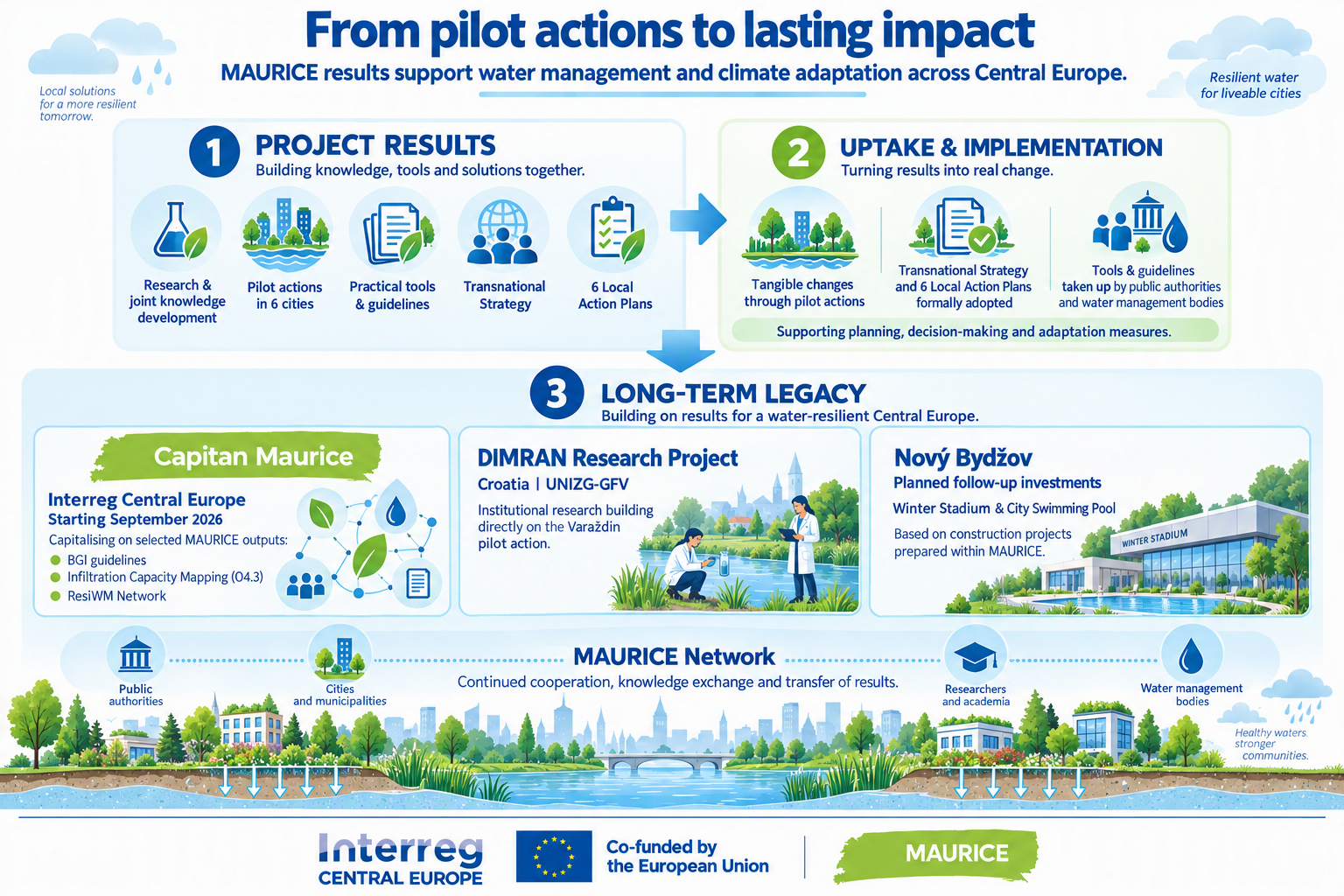
The MAURICE project has come to an end, but its results are designed to support cities, regions and water management authorities well beyond the project period. From groundwater monitoring and forecasting tools to rainwater management guidelines and blue-green infrastructure, the project leaves a practical set of resources, tested approaches and cooperation networks for strengthening water resilience across Central Europe.
Climate change is putting increasing pressure on water resources across Central Europe. Falling groundwater levels, periods of water scarcity and more intense rainfall require cities and regions to rethink how water is managed — not only through individual infrastructure investments, but also through better planning, reliable data and cooperation between the organisations responsible for water, land use and urban development.
Between April 2023 and June 2026, the MAURICE project – Management of Urban Water Resources in Central Europe Facing Climate Change – brought together 11 organisations from six countries to address these challenges. Through six pilot actions, the partnership tested approaches adapted to different local conditions and developed eight practical solutions, alongside a transnational water management strategy and six local and regional action plans.
Now that the project has ended, the key question is how these results can continue to support decision-making and implementation.
From pilot actions to practical solutions
The six pilot actions addressed a diverse range of water management challenges: groundwater depletion and quality, excessive stormwater runoff, the potential for rainwater reuse, and the role of infiltration in strengthening climate resilience.
The pilots provided opportunities to test and demonstrate approaches in real-life settings. In Jaworzno (Poland) blue-green infrastructure was constructed and monitored in a post-mining area to assess how different surfaces can support rainwater retention and infiltration. In Nový Bydžov (Czechia) technical documentation was prepared for rainwater-based solutions at the winter stadium and municipal swimming pool, including a solution expected to reduce drinking water consumption for pool water renewal by up to 70%.
Other pilots focused on improving the evidence base for water management. Groundwater monitoring and modelling in Stuttgart (Germany) and Varaždin (Croatia) supported the assessment of pressures on groundwater resources, while work in Milan (Lombardy) explored the use of existing irrigation canals for winter irrigation and managed aquifer recharge. In Ljubljana (Slovenia), a retention and infiltration facility provided a testing ground for assessing stormwater infiltration under local soil conditions.
Together, these activities generated knowledge that can inform future investments, planning decisions and the adaptation of water management practices to local conditions.
What can be used after MAURICE?
The project developed a set of tools and guidance documents for public authorities, water management bodies, planners and technical practitioners. These resources address different stages of the decision-making and implementation process:
- Groundwater assessment and forecasting: numerical models and tools for exploring groundwater behaviour and analysing potential effects of adaptation measures, including “what-if” scenarios.
- Groundwater protection and climate adaptation: technical guidelines presenting adaptation measures to support groundwater availability and resilience to climate change.
- Sustainable rainwater management: guidance for public administrations on integrating rainwater management and reuse into urban water cycles, spatial planning and investment processes.
- Rainwater treatment and reuse: criteria for selecting suitable technologies to treat rainwater collected from different sources and intended for different non-potable uses.
- Blue-green infrastructure: design guidance and a structured catalogue of BGI technologies, complemented by a tool supporting the selection of suitable solutions for rainwater retention and groundwater recharge.
- Planning and drainage management: technical resources on the use of infiltration capacity mapping in planning and permitting, as well as on surveying urban water mass flows and contaminants to improve drainage and protect groundwater quality.
The resources are intended to be useful beyond the six pilot locations. They provide methods, criteria and examples that can be adapted to other urban and regional contexts, taking account of local hydrogeological conditions, institutional responsibilities and development priorities.
Results already informing local practice
An important part of the MAURICE legacy is the uptake of project results by local institutions and practitioners.
In Ljubljana, the infiltration capacity map developed through the project provides a technical basis for planning, spatial regulation and decision-making on urban drainage interventions. The related technical document has been adopted for use by planners and consenting bodies. In the field of urban drainage and groundwater protection, a project-developed concept for surveying water mass flows and contaminants has also been taken up as the basis for a focused study by relevant practitioners.
In Nový Bydžov, the preparation and approval of technical documentation means that the proposed rainwater solutions are ready for implementation, subject to securing the necessary funding. In Jaworzno, the constructed blue-green infrastructure test site offers not only a basis for evaluating the performance of different surfaces, but also a demonstration and learning space for sustainable rainwater management in post-mining areas.
At the strategic level, the transnational water management strategy and six local and regional action plans bring together the lessons from the pilot activities and translate them into context-specific directions for further action. They provide a framework for public authorities and water management organisations seeking to integrate climate adaptation into water management and spatial planning.
Keeping the knowledge and cooperation alive
MAURICE also invested in cooperation beyond the project partnership. The MAURICE Network for climate resilience in urban and regional water management (ResiWM) connected project partners and associated organisations, while the Sponge City Talks series opened the exchange to external experts, practitioners and stakeholders. These activities helped share experience across countries and connect research findings with practical water management challenges.
The cooperation and knowledge developed through MAURICE can now be taken further through new initiatives. One of them is CAPITAN MAURICE, a follow-up capitalisation project that will build on results and experience from MAURICE and other European cooperation projects, adapting and transferring innovative approaches to rainwater management to new contexts. See more here: https://www.interreg-central.eu/projects/capitan-maurice/
The end of the MAURICE project therefore marks not the end of its work, but a transition from joint development and testing towards continued use, adaptation and transfer of its results. The tools, guidelines, pilot experiences and cooperation networks remain available to support cities and regions in making water management more resilient to climate change