
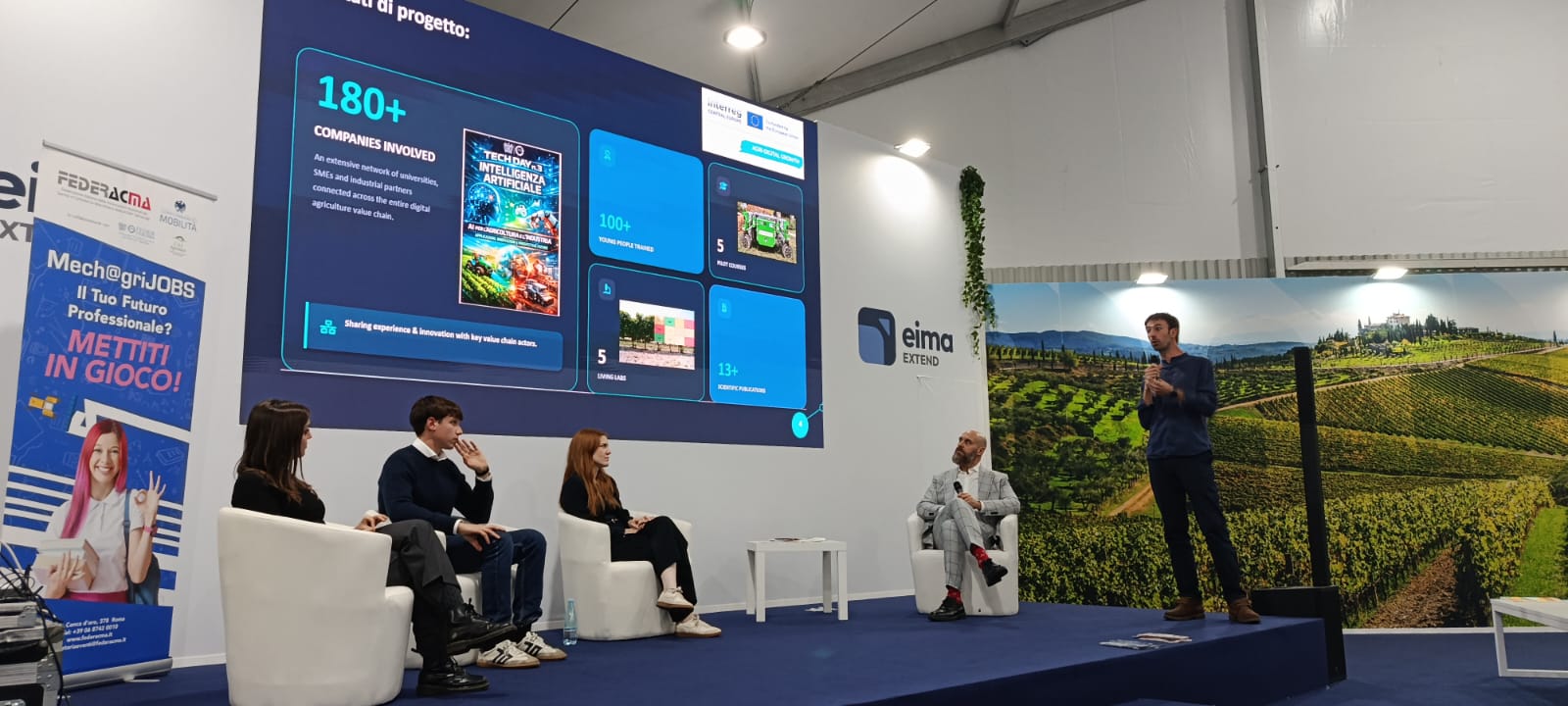
EIMA International 2026 marked a significant milestone for Agri-Digital Growth, as the project approaches its conclusion after thirty months of cooperation across Central Europe. From 11 to 13 November, all project partners gathered at BolognaFiere to present the results of their work, exchange experiences with agricultural stakeholders and discuss opportunities for future collaboration.
The programme brought together research organisations, agricultural machinery manufacturers, technology providers, educational institutions and regional representatives. Their discussions reflected a central objective of Agri-Digital Growth: strengthening the competences required to introduce and apply precision farming technologies across the agricultural sector.
Thirty months of cooperation, shared results
Launched in June 2024 and coordinated by CREA, Agri-Digital Growth has worked to connect technological development with professional training and knowledge transfer.
The partnership developed a Precision Farming Specialist competence profile, identifying the combination of agronomic, technical and digital expertise required by agricultural professionals and machinery manufacturers. The profile also provided a reference for the development of five online pilot courses, covering precision farming fundamentals, precision viticulture, arable agriculture, agricultural robotics, and data processing and artificial intelligence.
The project’s five Living Labs offered opportunities to investigate technologies in agricultural contexts, with activities involving research centres, businesses and young professionals. Their work addressed applications ranging from vineyard monitoring and agricultural data interoperability to geospatial artificial intelligence, computer vision and robotics.
Complementing the technical activities, the partnership established a Precision Farming Knowledge Transfer Ecosystem to support exchanges between organisations involved in agricultural innovation. Regional Action Plans and recommendations for educational institutions were also developed to facilitate the use of project results beyond the participating organisations.
Agri-Digital Growth has involved more than 180 companies and over 100 young people, producing training resources, technological solutions and scientific publications.
Bringing research, industry and education together
The EIMA programme offered an opportunity to present the project’s achievements to the agricultural sector and examine their practical relevance.
At the Press Conference on 11 November, the participation of Mariateresa Maschio, President of FederUnacoma, reinforced the connection between the project and the agricultural machinery industry.
The programme also included two Living Lab sessions at the EIMA Digital Terrace, where partners presented technologies explored during the project and discussed the experience gained through practical experimentation.
A round table on digital irrigation management brought representatives of the University of Padua, CREA, VAIMEE and PlantBit into the discussion, addressing agricultural water management and opportunities for cooperation between research and technology providers.
The Final Conference, “Harvesting Regional Growth,” held on 12 November, provided the central occasion to examine the project’s achievements in relation to regional innovation priorities. Contributions from project partners and institutional representatives addressed professional competences, educational resources, Regional Action Plans and the potential contribution of transnational cooperation to future agricultural innovation initiatives.
Practical training and the next generation of agricultural professionals
The final session of the EIMA programme, “Agri-Digital Growth for Education,” held on 13 November, focused on the relationship between educational opportunities and the skills required by the agricultural sector.
The discussion included testimony from Tommaso Tumiotto, a University of Padua student who participated in the Agri-Digital Growth Hackathon and subsequently joined practical training activities at CREA.
Through his involvement in the Italian Living Lab, Tumiotto gained experience in precision viticulture and vineyard water management. His contribution highlighted the value of field-based training and direct participation in agricultural research, providing a concrete example of how the project connected academic learning with professional experience.
Building on the project’s results
As Agri-Digital Growth approaches its formal conclusion, attention turns to the opportunities for continued cooperation among the organisations involved and the wider agricultural sector.
The experience gained over thirty months has demonstrated the value of transnational collaboration in addressing the technological and professional challenges of precision farming. Maintaining the connections established during the project will be essential to support further exchanges between research, industry and education.
EIMA International 2026 marked the conclusion of a shared journey and opened a discussion on how its achievements can contribute to the future development of digital agriculture in Central Europe.