
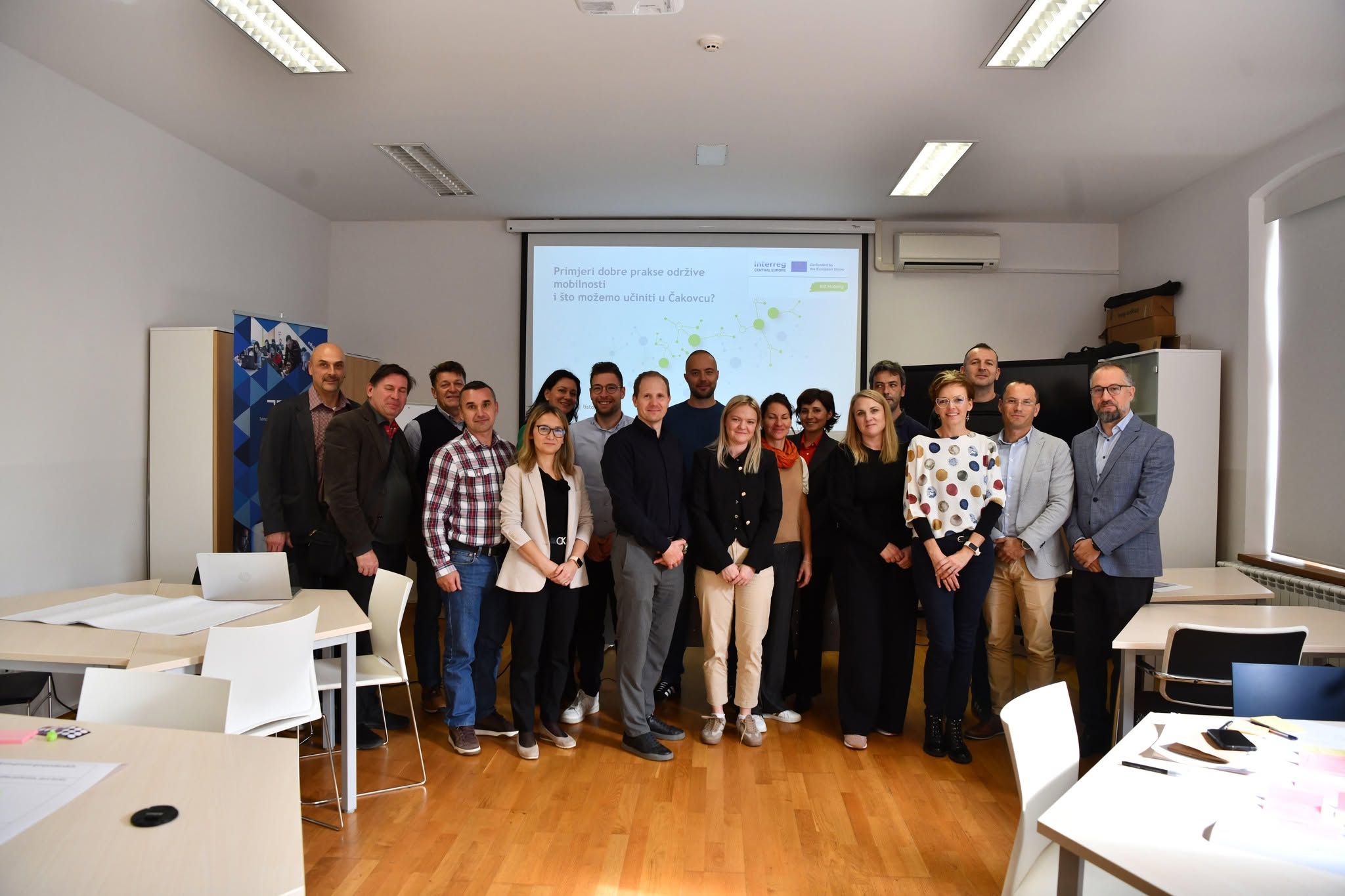
This time, the partnership was hosted by Technology Innovation Centre Međimurje (TICM) with the support of project partner Međimurje County. As Lead Partner Development Agency Sora brought the project partnership together to look back at the first reporting period, align the next steps and most importantly connect project work with real mobility challenges on the ground.
From the meeting room to the business park
The first day started at TICM where our hosts welcomed the project partners, presented their work and showed us their premises. This was followed by a project meeting focused on progress, upcoming tasks and coordination between the three pilot areas: Škofja Loka, Čakovec and Nagykanizsa.
But BIZ Mobility is not only about plans and documents.
The programme continued in Međimurje Business Park, where we met representatives of LTH Castings and CWS. We discussed how employees travel to work, what mobility barriers companies see in practice and where there may be room for improvement. At CWS we also visited the production facilities, adding another practical perspective to the discussion.
Good practices travel — but they need to fit the place
The second day shifted the focus to the local context.
Together with representatives of the City of Čakovec and Međimurje County we explored the main mobility challenges affecting the city, the wider region and Međimurje Business Park. Local and regional representatives also presented relevant mobility policies, initiatives and measures currently being planned.
The discussion then moved from challenges to possible solutions.
IPoP – Institute for Spatial Policies led a stakeholder workshop focused on one key question:
How can good mobility practices from elsewhere be transferred into the local context?
The workshop brought together representatives of local and regional authorities, companies, tourism organisations, spatial planning institutions and other stakeholders. Rather than simply presenting examples from abroad, the aim was to discuss which approaches could realistically work in Čakovec and Međimurje — and how they would need to be adapted.
Public transport, cycling and walking connections, carpooling and other sustainable commuting options were all part of the conversation.
Transfer, adapt, test
This is one of the central ideas behind BIZ Mobility: good practices are useful only when they respond to local needs.
The project connects knowledge from different Central European regions with the everyday reality of business and industrial zones in rural and lagging areas. Its broader aim is to improve sustainable commuting options, strengthen cooperation between municipalities and businesses, and make these areas more accessible for employees.
The exchange in Čakovec was another step in that process — learning from each other, adapting what works and turning good examples into locally relevant solutions.