
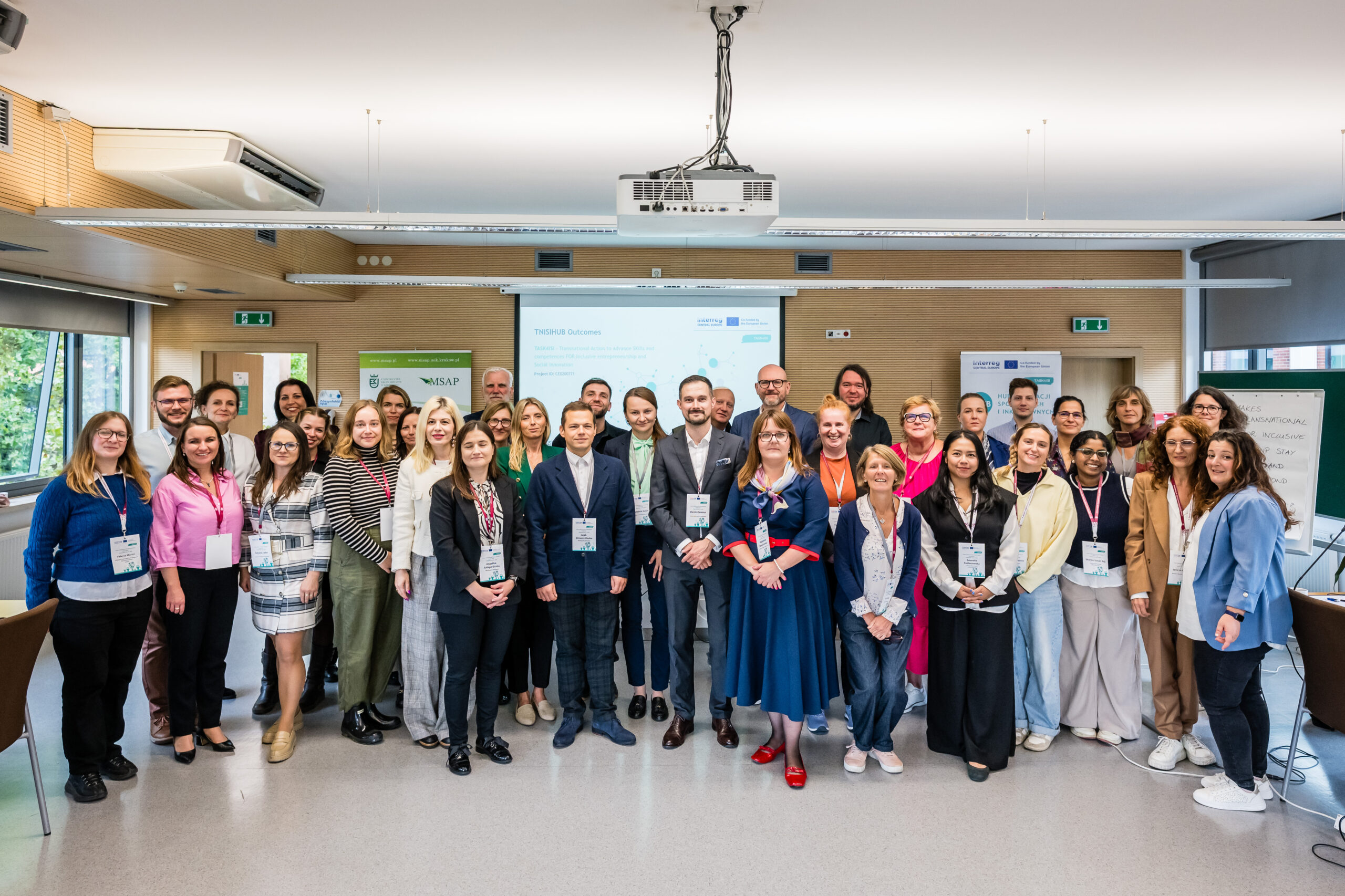
The two-day meeting provided an opportunity to reflect on the project’s achievements, present its key results and discuss how the knowledge, tools and partnerships developed within TASK4ISI can continue to support inclusive entrepreneurship and social innovation after the formal end of the project.
Day 1: results, strategic cooperation and transferability
The first day of the conference took place at the Krakow University of Economics, Lead Partner of the TASK4ISI project.
The opening session set the broader context for the final meeting and highlighted the importance of cooperation in building more inclusive entrepreneurial ecosystems across Central Europe. An important contribution was made by Jana Habjan Coudoré from the Interreg CENTRAL EUROPE Joint Secretariat, who addressed the participants from the programme perspective and accompanied the project partnership at this important final stage of implementation.
The conference also included a presentation by Filip Kołodziejski, Head of the Social Economy Development Unit at the Department of Social Economy of the Polish Ministry of Family, Labour and Social Policy. His contribution focused on the development of the social economy in Poland and on the links between social inclusion, inclusive entrepreneurship and innovation. The presentation provided an important national policy perspective and created a strong point of reference for the discussions that followed.
A central part of the programme was dedicated to the official presentation of some of the project’s key strategic results. Participants discussed the Joint Networking Strategy, the Memorandum for Sustainable Cooperation and the TASK4ISI Joint Strategy Agenda, all of which are intended to support the continuation of cooperation beyond the project lifetime.
The first day also featured the presentation of the SteelCityZen project, implemented within the Interreg Danube Region Programme, providing an additional opportunity for exchange between European cooperation initiatives.
In the afternoon, participants took part in the Transferability Workshop: TASK4ISI Model, Processes & Experiences. The session focused on the practical implementation of the TASK4ISI model, experiences gained while working with different groups of entrepreneurs and sectors, and the role of the regional and transnational ISIHUB network. Particular attention was given to the question of how the project’s solutions can be transferred beyond the participating regions and adapted to different local contexts.
The day concluded with a discussion on the next steps and future cooperation, followed by a guided tour of Krakow and an informal networking dinner for project partners.
Day 2: cooperation in practice during the Transnational Study Visit
The second day combined project governance, communication activities and practical examples of innovation and urban development in Krakow.
The day began with the final TASK4ISI Steering Committee Meeting, during which project partners discussed the remaining implementation and reporting tasks, project closure and the continuation of cooperation after the end of TASK4ISI.
This was followed by a press conference at Klaster Innowacji Społeczno-Gospodarczych Zabłocie 20.22, where representatives of the Municipality of Krakow, Krakow University of Economics and social organisations discussed the significance of inclusive entrepreneurship and social innovation for local and regional development.
The press conference featured, among others, Justyna Habrajska, Wojciech Łaptaś, Agata Machnik-Pado and Dr Magdalena Zajączkowska, who highlighted different dimensions of inclusion, cooperation and the practical value of the project’s results.
The Transnational Study Visit then continued with visits to Klaster Zabłocie, the Krakow Technology Park and the Nowa Huta district. Participants had the opportunity to learn more about local approaches to innovation, entrepreneurship, international cooperation and urban regeneration, while also exchanging experiences with Krakow-based institutions and practitioners.
From project results to lasting cooperation
The TASK4ISI Final Conference was not only a summary of the project’s achievements, but also a space to discuss what should continue after the project formally ends.
Over the course of the project, partners developed strategic documents, local action plans, pilot activities, toolkits and cooperation mechanisms supporting inclusive entrepreneurship. Yet one of the most important outcomes of TASK4ISI is also the network itself: the relationships established between public authorities, universities, business support organisations, NGOs and other actors working to create more inclusive entrepreneurial ecosystems.
The final meeting in Krakow therefore closed one stage of cooperation while opening another. The experience gained within TASK4ISI, together with the ISIHUB and TNISIHUB networks and the Memorandum for Sustainable Cooperation, provides a foundation for further joint initiatives, knowledge exchange and continued work on inclusive entrepreneurship and social innovation across Central Europe.
The TASK4ISI partnership would like to thank all project partners, associated organisations, speakers, stakeholders and participants who contributed to the Final Conference and to the project as a whole.
This publication has been developed within the CE0200771 TASK4ISI project, supported by the Interreg CENTRAL EUROPE Programme with co-financing from the European Union. Its content is the sole responsibility of the authors and the project partnership and does not necessarily reflect the views or positions of the Interreg CENTRAL EUROPE Programme, its programme bodies or the European Union. Neither the programme authorities nor the European Union can be held responsible for any use that may be made of the information contained herein.