
The FERRYTALES partner meeting brought together project partners to discuss the further development of the pilot actions and to examine the regional, economic, technical and regulatory conditions required for more sustainable ferry services. Particular attention was given to the two pilot regions – Ipoly/Ipeľ and the Upper Elbe – and to how their different territorial contexts can contribute to solutions that are transferable to other regions.
A key topic was the Regional Connectivity Report, which examined the connectivity challenges and opportunities in both pilot areas. In the Ipoly/Ipeľ region, the focus is on identifying missing local and cross-border connections between Pest and Nógrád counties and neighbouring Slovak territories. The assessment also considers the specific characteristics of the river, including variable water levels, riverbed and bank conditions, water depth and vessel draught, all of which influence the feasibility and reliability of potential new crossings.
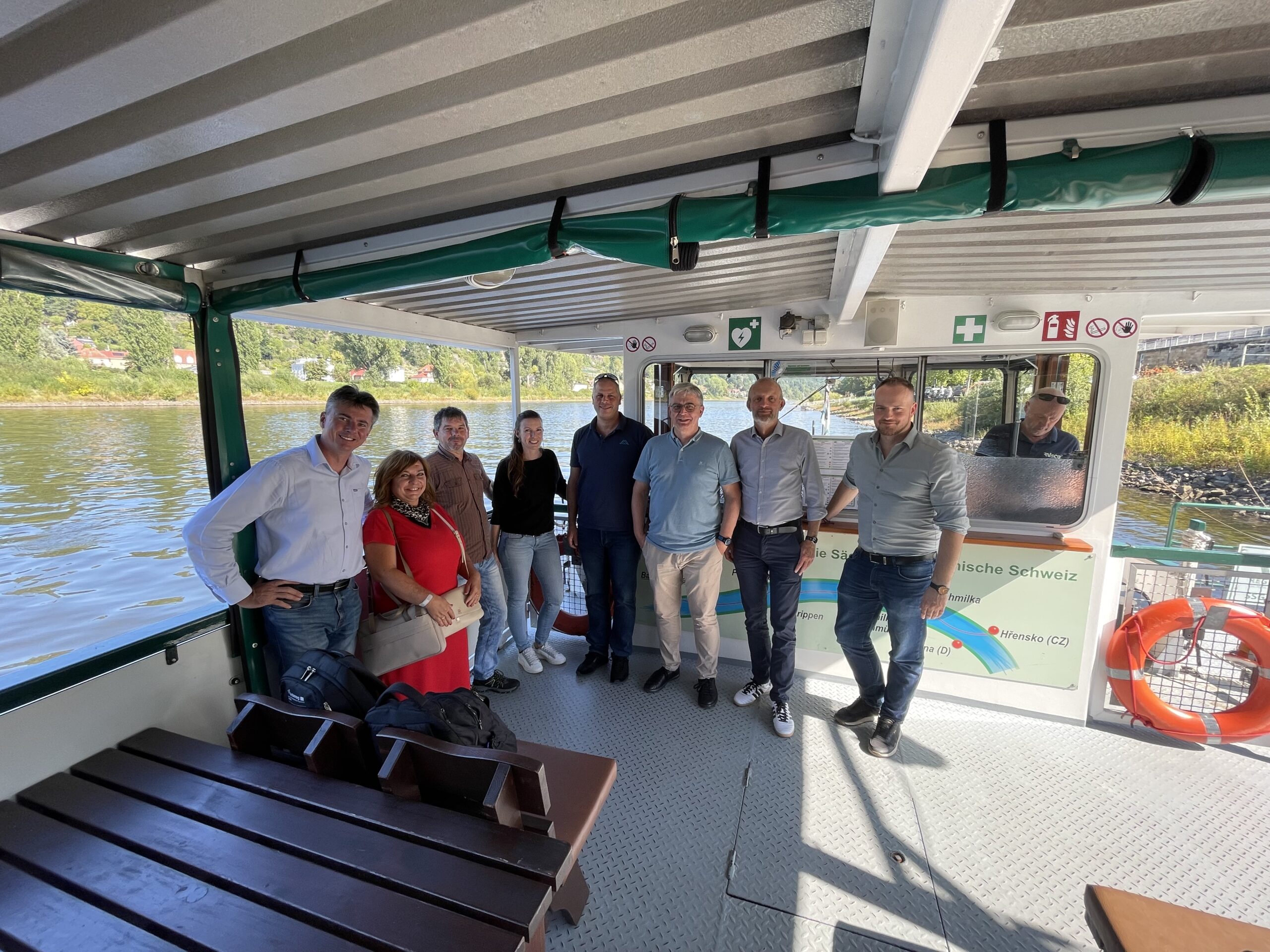
In the Upper Elbe region, the F5 Bad Schandau connection was identified as having critical connectivity relevance within a particularly sensitive part of the corridor. The connection provides direct access between Bad Schandau and Pirna, supporting local as well as tourism-related mobility. F5 was confirmed as the German pilot location for subsequent FERRYTALES work, with its planned electrification providing an important basis for the project’s work on zero-emission ferry solutions. Since the first half of the partner meeting was held F5 ferry operated by RVSOE (associated partner of LUB Consulting GmbH), the project partners had a chance to gain first-hand insight into the regional ferry operation and the feasibility study context. RVSOE operates 11 vessels across 8 ferry connections, covering approximately 37 river kilometres. Its fleet is currently diesel-powered, while F5 is planned for electrification, making it a relevant case for the FERRYTALES feasibility work.
The economic dimension of the pilot actions was addressed through the Feasibility Study. The study will assess economic feasibility, cost-effectiveness and financial sustainability, including investment costs, business sustainability and potential funding and revenue models. It will support informed investment decisions while distinguishing between transferable findings and principles and those specific to the F5 Bad Schandau case, helping assess the potential replication of the approach in other regions.
The partners also discussed the regulatory framework for innovative ferry solutions. For electric ferries, the main challenges often extend beyond vessel certification to the coordination of charging infrastructure, grid connections, environmental permits, waterway regulations and public procurement requirements. Battery lifecycle management is also emerging as an important regulatory issue. For autonomous and remotely operated ferries, additional challenges include crew and remote-master requirements, liability, certification of AI and control systems, cybersecurity, data governance, passenger safety and cross-border regulatory harmonisation.
The Ferry Pilot Concept Notes were discussed to establish a clear direction for the planned pilot actions, align partners on their scope and objectives, and define the next steps for their development. At the strategic level, partners also worked on the first draft of the Transnational Strategy for Sustainable Ferry Solutions, which sets out preliminary objectives, governance structures and key action areas for developing sustainable ferry solutions in peripheral regions.
A second-day site visit to the Niederlommatzsch–Diesbar-Seußlitz electric ferry, supported by technical and operational guidance from Verkehrsgesellschaft Meißen (VGM), provided a practical example of an electric ferry already in operation. Partners learned about the Klarisse and the associated terminal and charging infrastructure. The visit highlighted an important lesson for the FERRYTALES pilots: successful ferry electrification requires the vessel and shore-side charging infrastructure to be developed as an integrated system.
Overall, the meeting strengthened the common understanding of the pilot actions and connected regional connectivity needs, economic feasibility, regulatory conditions and practical experience. The exchange between partners will support the further development of the Ipoly/Ipeľ and Upper Elbe pilots.