
Understanding when a vineyard needs water is essential for efficient irrigation, but measuring vine water status across an entire field remains a complex task. Traditional methods can provide accurate information, yet they are often time-consuming, labour-intensive and limited to individual measurements.
The Italian Living Lab of Agri-Digital Growth explored the use of computer vision, artificial intelligence and proximity sensors for vineyard water status monitoring. Led by the Research Centre for Viticulture and Oenology of CREA in collaboration with CET Electronics, the Living Lab focused on the development and testing of an innovative system able to collect information directly from the grapevine canopy.
The work started in early 2025 with an analysis of existing monitoring methods and the definition of the experimental approach. The system combines stereo cameras with thermal imaging to collect information from the plants. Stereo images are used to reconstruct the canopy in 3D and estimate parameters such as total leaf area and average leaf inclination. Thermal images provide information for calculating the Crop Water Stress Index (CWSI).
Leaf inclination was one of the main parameters investigated during the Living Lab. Changes in leaf angle can reflect variations in plant water status and turgor. The trials examined whether measurements collected automatically through imaging technologies could support the assessment of vine water needs and contribute to irrigation management.
From June to August 2025, the system was tested in experimental vineyards. Camera-based observations were compared with measurements obtained through established methods, including stem water potential measured with a Scholander chamber, as well as stomatal conductance and photosynthesis measurements collected with an IRGA instrument. Soil water status and micrometeorological conditions were also monitored during the trials.
The first results showed a moderate relationship between stem water potential estimated through the camera system and measurements obtained with the Scholander chamber. Depending on the vineyard parcel, the highest R² values ranged approximately between 0.52 and 0.61. Thermal imaging produced more variable results, with relationships based on CWSI reaching an R² of approximately 0.78 in the strongest case.
The results indicate the potential of leaf inclination as an additional parameter for assessing vine water status, although further trials are needed to validate and improve the method. The research team is also working on a Decision Support System designed to use physiological information from the plants to support irrigation scheduling and vineyard management.
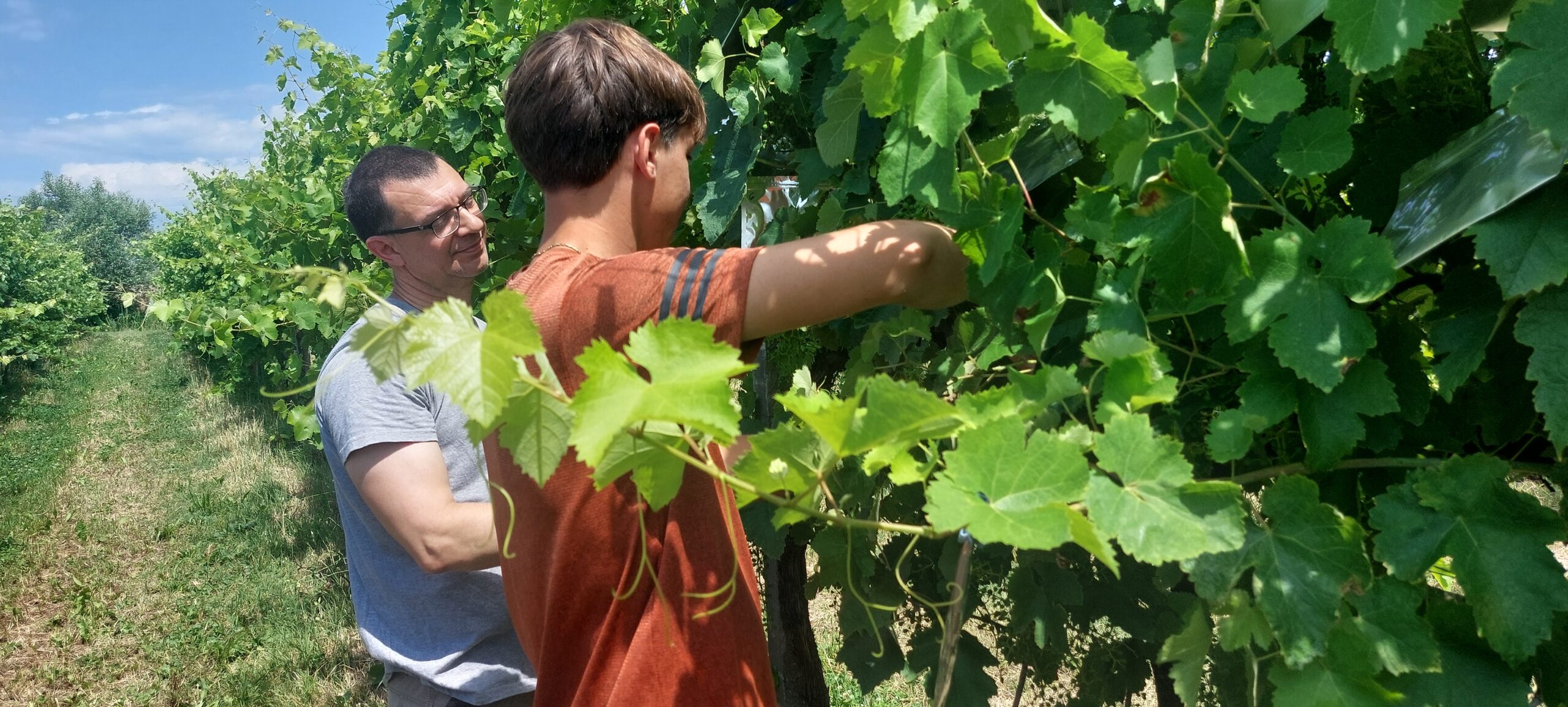
Training was included in the Living Lab activities. A young participant selected following the Agri-Digital Growth Hackathon received practical training in plant water status assessment, including the use of the Scholander chamber and IRGA instrumentation, as well as an introduction to Decision Support Systems. The first classroom training took place in April 2025, followed by involvement in the experimental activities carried out in the vineyard.
The Living Labs represent the practical dimension of the Agri-Digital Growth training programme. Five transnational experiences were established across Central Europe, giving SMEs and young professionals the opportunity to work alongside researchers and technology providers, test precision farming solutions and develop digital competences through practical activities. At CREA, experimental work in the vineyard was accompanied by the training of a young talent selected through the project Hackathon, linking technology testing with the development of practical skills in precision farming.