
As the DiSTT project moves from piloting to dissemination, its partners can build on a rich set of practical experiences from six regions. Across different target groups and learning environments, one message stood out clearly: digital and advanced manufacturing skills are learned best through hands-on challenges, visible results and real-world projects.
The pilots also showed that there is no single format that works for everyone. Short workshops can spark interest, modular programmes can reach diverse learners, and mentoring or longer project-based activities can deepen both technical and soft skills.
Together, these experiences provide a strong foundation for sharing approaches that can inspire educators, makerspaces, companies and training providers well beyond the project partnership. You can find our workshop offerings at Skillnest.app.
What can you learn or use in your own FabLab thanks to DiSTT?
BUT/strojLAB, South Moravia, Czech Republic tested a wide range of hands-on activities in digital and advanced manufacturing, including CAD, 3D printing, CNC, robotics and electronics. The pilots showed that participants learn particularly well when technical skills are connected to real projects and practical engineering challenges. The experience also highlighted the value of modular formats, mentoring and links with industry. strojLAB created 26 types of workshops.
The pilots of FabLab Brno / JINTEK, South Moravia, Czech Republic focused on secondary-school learners through competitions and short TechSprints combining digital design, 3D printing, electronics and programming. Challenge-based teamwork proved highly effective for building both technical and soft skills. Clear team roles, differentiated tasks and good facilitation were important for ensuring active participation. FabLab Brno created developed two types of workshops.
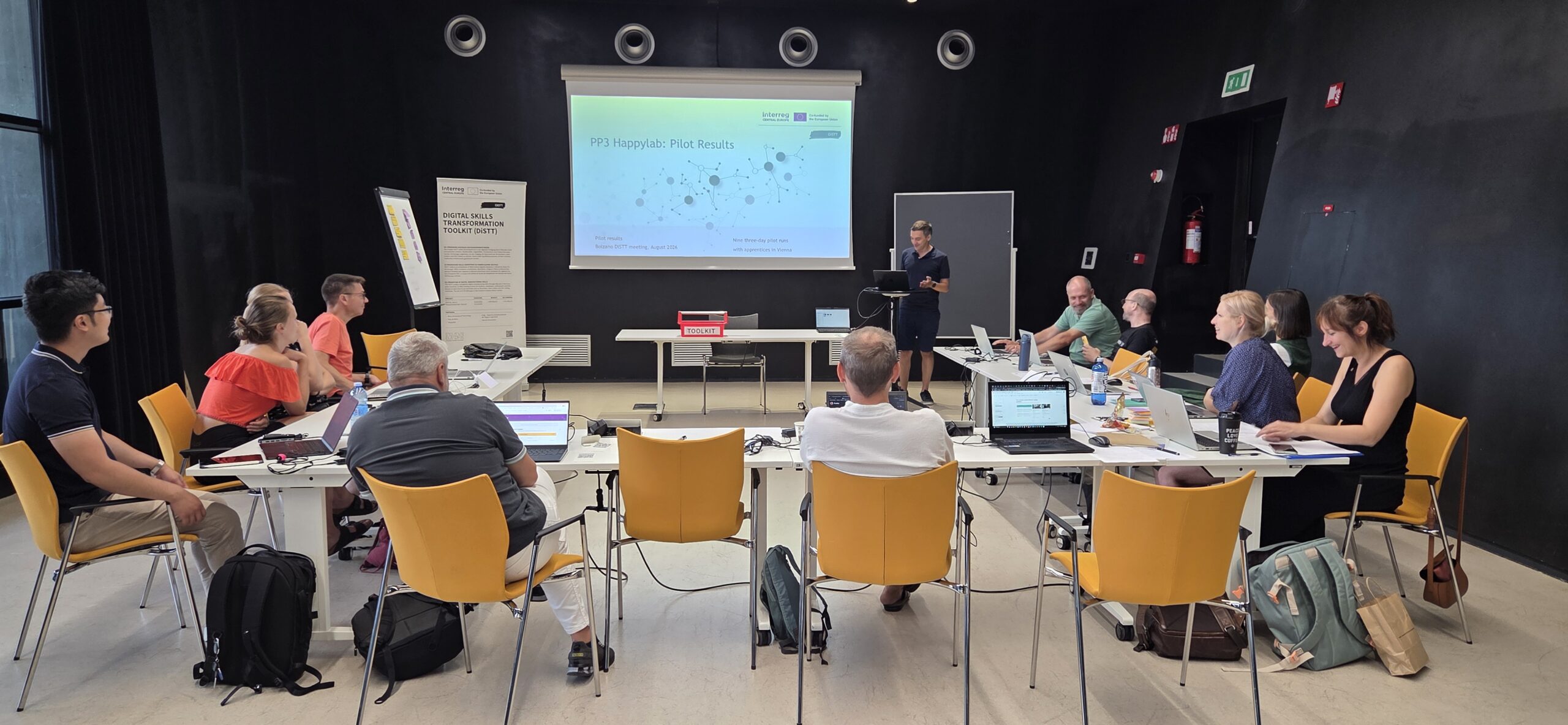
Happylab, Vienna, Austria delivered a repeatable three-day programme for apprentices, combining CAD, digital fabrication, robotics and programming. The pilots showed strong improvements in practical technical skills, particularly in 3D printing, laser cutting and robot programming. A compact core programme with flexible difficulty levels worked well across different learner groups. Happylab Wien created workshop Digital Tools in Vocational Training: Empowering Tomorrow’s Workforce.
brigk, Ingolstadt, Germany tested short technology workshops, mentoring activities and longer project-based formats for employees, students and apprentices. Participants made strong progress in technical skills, especially when learning was connected to practical business challenges. The pilots showed that short workshops work best as entry points and should be complemented by mentoring or longer project activities. Brigk developed one workshop focused on AI.
NOI Techpark Maker Space, South Tyrol, Italy delivered bilingual maker and skills courses covering areas such as CAD, CNC, electronics and digital fabrication. Object-based, practical workshops were particularly successful because participants could immediately see the results of their learning. The experience also highlighted the importance of verifying prerequisites and keeping projects realistic in scope. NOI Techpark developed two workshops.
FabLab Zagreb, Croatia delivered modular activities for secondary-school learners covering digital fabrication, electronics, materials and project development, including communities outside Zagreb. Hands-on activities with visible results helped build learners’ confidence, motivation and practical skills. The pilots also demonstrated the potential of modular training to bring digital fabrication opportunities to geographically dispersed communities. Their workshop focuses on Desing Thinking.