
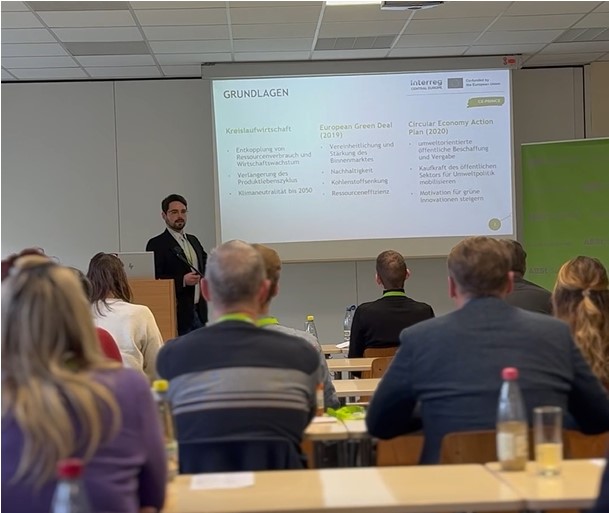
The 2nd Sustainability Summit Saxony took place on 15 January 2025 in Plauen and brought together around 50 participants from public administration, companies, chambers and specialist organisations. Hosted in the context of the Competence Centre for Sustainable Procurement of the Auftragsberatungsstelle Sachsen e.V., the event focused on practical ways to strengthen sustainable public procurement and support the green transformation.
The summit received positive feedback and showed strong interest in the further development of sustainable procurement practices. Across the programme, speakers presented legal, strategic and practical perspectives, ranging from public procurement law and circular economy to sustainable catering, online marketplaces, sustainable construction and life-cycle assessment tools.
In his welcome address, Thomas Kralinski, State Secretary at the Saxon State Ministry for Economic Affairs, Labour, Energy and Climate Action, underlined the importance of sustainability for Saxony’s future and highlighted the role of public authorities as key actors in this transition. He stressed that sustainable procurement is no longer simply an option, but increasingly a central basis for future-oriented public tendering.
The event also provided an important platform for the Interreg Central Europe project CE-PRINCE, in which Aufbauwerk Region Leipzig GmbH has been involved since mid-2024. Roman Hillebrand presented preliminary findings from the project’s stocktaking on circular economy in procurement across eight Central European countries. Around 400 companies and 230 public administration stakeholders contributed to the survey between summer and autumn 2024. Initial results show that public procurers see a need for clearer and more transparent regulations as well as further training. Companies, in turn, expressed interest in more exchange with contracting authorities and better feedback on rejected bids. These findings will feed into the development of transnational action plans, strategies and practical recommendations for administrations and businesses between 2024 and 2026.
Several contributions offered concrete examples and tools for implementation. Kristina Franke gave an overview of the legal framework for sustainability in procurement, showing how sustainability criteria have moved from being considered “external to procurement” towards becoming a strategic element of public tendering. Paula Pour presented examples from the City of Plauen, including sustainable office supplies, recycled paper, photovoltaic lighting for cycle paths and chemical-free weed control.
Further sessions addressed sustainability in companies and higher education, community catering, B2B online marketplaces and sustainable building certification. Anja Erhart from FiBL explained how health, social, ecological and economic dimensions can be integrated into tenders for community catering. André Schwarz and René Heinrich from Unite discussed how product, supplier, service and marketplace criteria can support more sustainable purchasing decisions. Markus Kelzenberg from DGNB introduced certification approaches based on life-cycle thinking and balanced ecological, social and economic criteria.
Additional contributions presented federal support structures, training initiatives and the HILCSA method for integrated sustainability assessment. These inputs highlighted that sustainable procurement requires clear criteria, practical tools, institutional support and continuous exchange between public authorities and market actors.