
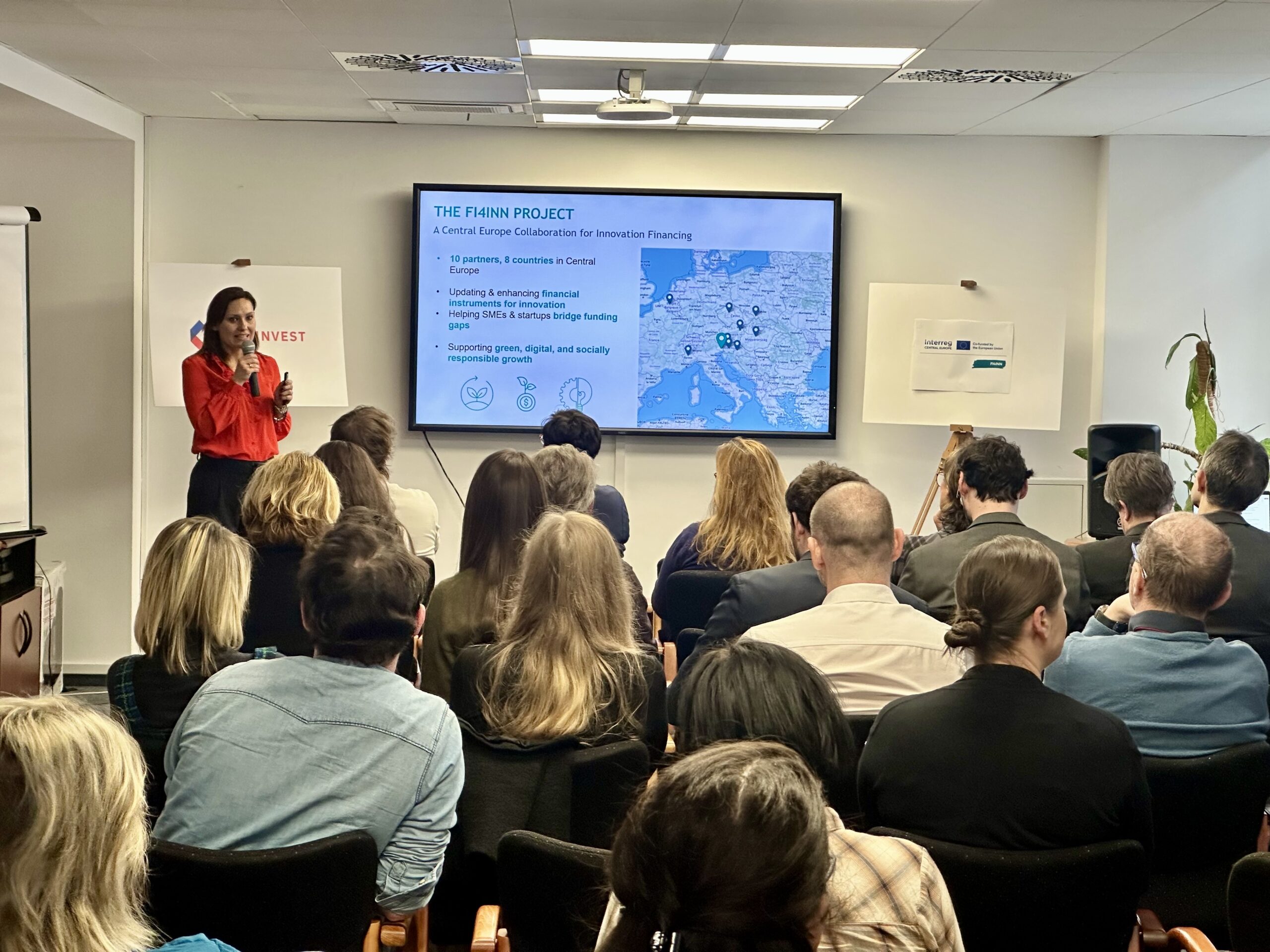
During 2025, the FI4INN project organised and participated in four regional events across Central Europe, creating opportunities to share project results with regional innovation ecosystems and encourage the adoption of innovative financial instruments in diverse territorial contexts.
The events took place in Budapest (Hungary), Innsbruck (Austria), Opatija (Croatia) and Ostrava (Czechia), bringing together policymakers, innovation agencies, investors, incubators, universities, startups, SMEs and business support organisations.
The journey began in Budapest with the Startup Factory Info Day, where discussions focused on strengthening early-stage financing for innovative startups, particularly in deep-tech sectors. Participants explored Hungary’s Startup Factory model and exchanged experiences on venture capital, incubation and public-private cooperation to improve access to finance.
In Austria, FI4INN joined the CO:ACT Conference in Innsbruck, contributing to the “Finance the Future” track through an interactive co-creation session. Rather than relying on traditional presentations, participants worked together to explore how innovative financial instruments could be adapted to the realities of different regional ecosystems, particularly those facing the challenges of inner peripheries.
The Croatian regional event, organised within the INSPIRA LEADER 3 Conference in Opatija, connected innovation finance with community development and sustainability. Discussions highlighted how financial innovation can support resilient local economies, particularly in rural, coastal and island territories, while encouraging participatory approaches to regional development.
The final regional event took place in Ostrava, Czechia, where stakeholders examined how support instruments for startups and SMEs can become more efficient and responsive. Alongside presentations of FI4INN tools and pilot actions, participants discussed practical barriers such as administrative complexity, limited flexibility and communication gaps between institutions and entrepreneurs.
Although each event reflected the specific needs of its regional ecosystem, common themes consistently emerged. Participants stressed the importance of improving access to finance, simplifying support mechanisms, strengthening cooperation between public and private actors and promoting financial instruments that better match the realities of innovative businesses.
Together, the four regional events demonstrated the value of peer learning and cross-border collaboration. By bringing FI4INN’s methodologies into local discussions, they strengthened stakeholder engagement while supporting the transferability of innovative financing solutions across Central Europe’s diverse innovation ecosystems.