
Over the past three years, the FI4INN project has brought together partners from eight countries, representing ten regions and ten organisations, to address one of the most significant challenges facing innovative SMEs and startups: access to finance.
While many emerging businesses have the talent, creativity and ambition to develop innovative products and services, they often struggle to secure the financial support needed to bring their ideas to market. FI4INN set out to bridge this gap by fostering cooperation between regional authorities, innovation agencies and financial stakeholders across Central Europe.
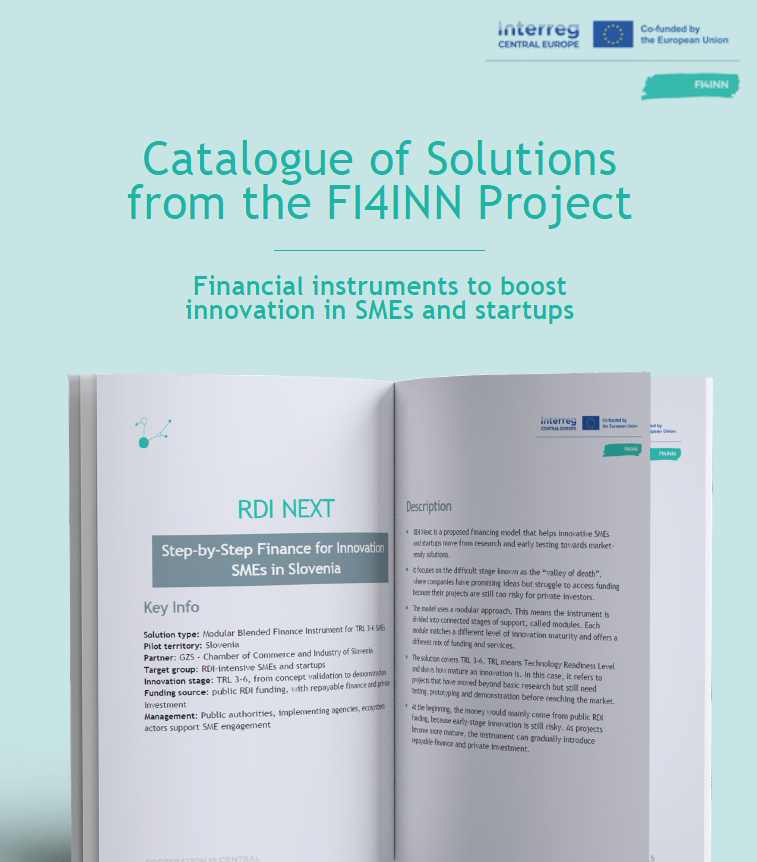
As the project concludes, its most valuable legacy is the FI4INN Catalogue of Solutions—a practical publication showcasing seven financial instruments that have been tested and refined throughout the project. The catalogue is designed as a hands-on resource for policymakers, regional development organisations, financial intermediaries and innovation support agencies looking to strengthen their regional innovation ecosystems.
Each financial instrument is presented in a clear and structured format, allowing readers to understand its objectives, implementation process, key stakeholders, target beneficiaries and potential for replication. By sharing practical experiences and lessons learned, the catalogue supports regions in adapting proven solutions to their own local contexts.
The publication reflects the collaborative work carried out by FI4INN partners and demonstrates how transnational cooperation can generate practical tools with lasting impact beyond the lifetime of a project.
The FI4INN Catalogue of Solutions is now available for download and serves as a valuable reference for anyone working to improve access to finance for innovative businesses and foster regional competitiveness.
Read the FI4INN Catalogue of Solutions
As FI4INN comes to a close, the project leaves behind more than a set of recommendations—it leaves practical, transferable solutions that can continue supporting innovation, entrepreneurship and regional development across Central Europe for years to come.