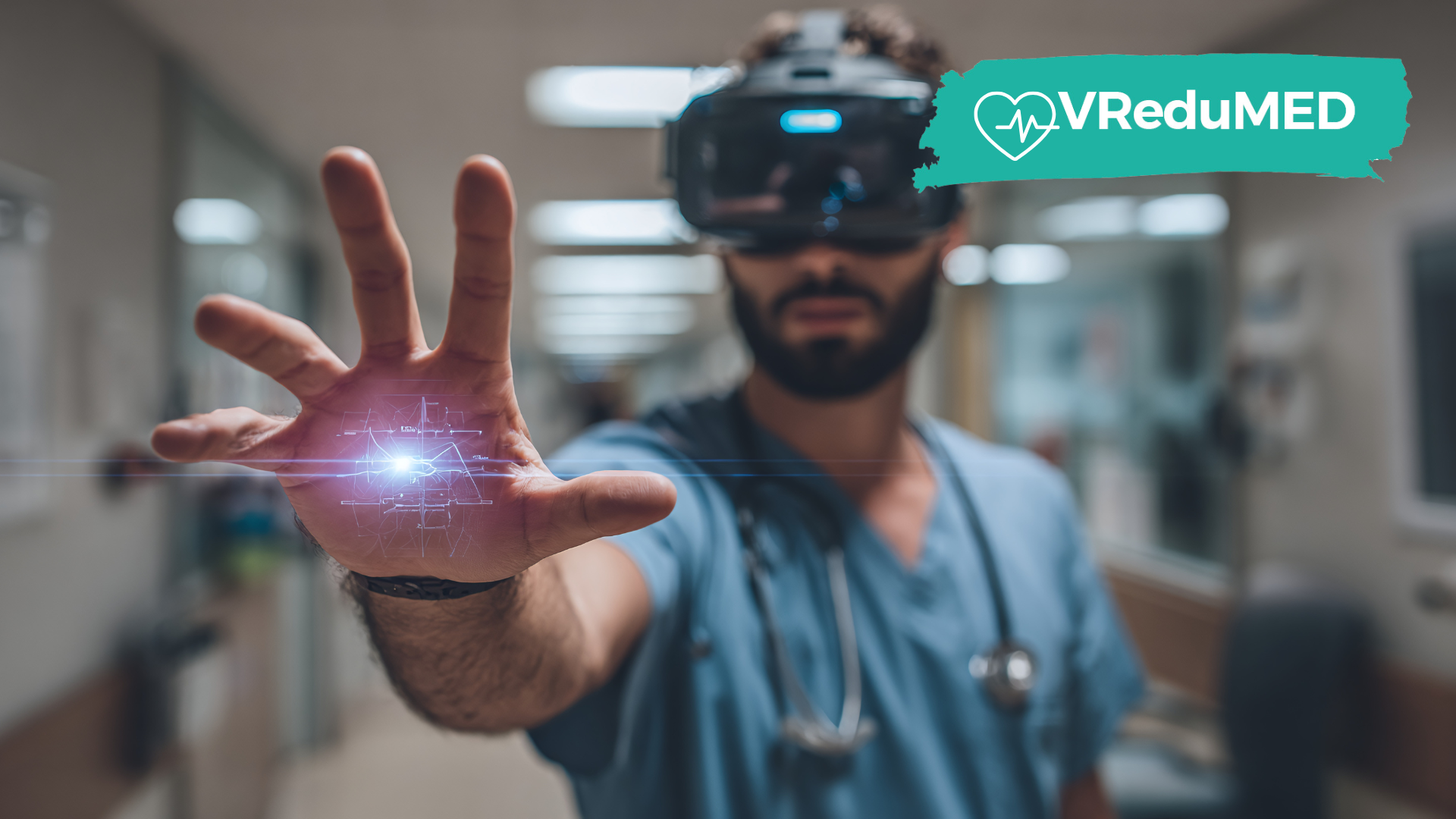
The initiative enables teachers, practice instructors, and healthcare professionals to explore new forms of digital learning in everyday nursing education and clinical practice. The overarching aim is to enrich and modernize teaching by providing vivid, immersive, interactive, and practice-oriented experiences. Virtual learning environments can help learners understand theoretical content, prepare for complex nursing situations, and practise their responses in a safe, controlled, and supportive environment. During the pilot phase, the VReduMED team from OTH Regensburg has introduced the technology at several nursing schools and healthcare institutions. Participants have received technical guidance, tested different applications, and discussed how virtual reality could complement traditional teaching methods and be sustainably integrated into nursing education. Practical VR Experiences at the Vocational School for Nursing at vhs Landshut The VReduMED team from OTH Regensburg visited the vocational school for nursing at vhs Landshut to present the project to a dedicated team of teachers. The teachers were given an introduction to the project, learned about the structure and functionality of the VR systems, and were able to try out the virtual learning environments for themselves. The focus was on practical testing: the participants put on VR glasses, tested various scenarios, and discussed didactic possibilities for their use in nursing education with the project team. This highlighted the versatility of VR—for example, in preparing for complex nursing situations or deepening theoretical learning content through realistic simulations. Prof. Dr. Christa Mohr emphasized: “The cooperation with educational institutions such as vhs Landshut shows that digital learning technologies in nursing education are no longer a topic for the future, but part of a modern, practice-oriented understanding of teaching. Projects such as VReduMED build a bridge between research, teaching, and nursing education practice.” Michael Pöschl, deputy headmaster of the vocational school for nursing at vhs Landshut, commented: “The introduction of virtual reality into our teaching opens up completely new perspectives for our teachers and trainees. The realistic scenarios allow learning content to be not only understood, but also truly experienced. It is particularly impressive how quickly the teaching staff has embraced the technology—with great interest and many ideas for practical application. Projects such as VReduMED show how digital innovation and nursing education can go hand in hand.” Representatives from the vocational school for nursing and geriatric care attended the event, including Michael Pöschl, deputy headmaster; Annette Beisert, nursing teacher; Lilly Hertle, vocational education student; and Nicole Seibold, physician assistant and specialist wound therapist. Anselm Stadler and Cheryl Heinz from the Nursing Research Laboratory at OTH Regensburg were also present. Exploring Digital Learning Spaces at the Heimerer Nursing School in Munich As part of the VReduMED project, the Heimerer Nursing School in Munich was also given the opportunity to borrow virtual reality headsets and accessories for six weeks. The aim of the visit by the OTH Regensburg team was to introduce teachers to VR technology, show them the wide range of practical applications, and gain initial experience in using the devices together. The loan marked another important milestone in the project’s pilot phase, during which nursing educators at various schools are testing the opportunities offered by digital learning spaces in nursing education. After a presentation of the project and a technical introduction, the teachers were able to explore the different virtual learning environments independently. The focus was on practical experimentation—from navigating in virtual space to operating the controllers and functions of the headsets. The OTH Regensburg team accompanied the process, answered technical questions, and provided tips on the safe and efficient use of the devices in everyday school life. The participants showed great interest in the new technology and emphasized the vivid and motivating effect of immersive forms of learning. Anselm Stadler, research assistant at the VR Lab at OTH Regensburg, drew a positive conclusion: “Today’s meeting showed how the didactic experience of teachers ideally combines with the goals of VReduMED. When schools actively contribute their expertise to the further development of digital forms of learning, this creates real added value for nursing education.” Prof. Dr. Christa Mohr, Head of the Laboratory for Nursing Research at OTH Regensburg, added: “Loan programs like this are an important step in introducing teachers to new technologies and preparing for their transfer into nursing education. Only through practical testing can the potential of virtual reality for learning in nursing become apparent.” In the coming weeks, the teachers will use the VR glasses in class to gain experience that will be incorporated into further project work. Two teachers from the Heimerer Nursing School in Munich took part in the introductory session and showed great interest in the virtual learning environments. They exchanged ideas with the OTH team about technical details and possible classroom applications while exploring the VR experiences with visible curiosity. Anselm Stadler, research associate at the VR Lab of OTH Regensburg, presented the VR headsets together with student assistant Cheryl Heinz and supported the introduction on site. Establishing a Dedicated VR Learning Environment at the Neumarkt Academy The Neumarkt Academy for Health and Social Professions was similarly given the opportunity to borrow virtual reality headsets and equipment for six weeks. This loan also marked the start of the pilot phase, during which teachers will prepare and test the VR glasses in class and try out new forms of learning together with their students. The aim is to train teachers to use the VR software and hardware competently and to teach learners in a practical way. The two teachers responsible for the project and interested colleagues took part in the introductory event. Following a presentation of the project and its technical foundations, the participants received a practical introduction to the available applications. These included Human Anatomy VR for Institutions, which provides a realistic experience of anatomical structures, and the communication application from 3spin Learning, which simulates admission interviews and care-related conversation situations. The best-practice applications developed or acquired during the project were also presented. These included the CPR application, which can be used to train and practise resuscitation in a realistic manner. Under the guidance of the VReduMED team, the teachers tested the various applications themselves and discussed questions relating to their didactic implementation. The feedback was consistently positive. In particular, participants highlighted the versatility of the areas of application and their direct practical relevance. Prof. Dr. Christa Mohr, project manager at OTH Regensburg, emphasized: “With virtual reality, we can permanently combine theory and practice in a way that was previously hardly possible in nursing education.” Research assistant Anselm Stadler also drew a positive conclusion: “The combination of specialist knowledge and interactive practice situations in particular gives students the opportunity to combine protected experimentation with real learning success.” In the coming weeks, the two teachers will use the VR glasses in their teaching, gather initial experience, and share it with their colleagues. The aim is to give as many learners as possible access to these innovative approaches and to make sustainable use of the didactic potential of virtual reality in nursing training. The two teachers from the Neumarkt Academy for Health and Social Professions approached the various VR applications with openness and curiosity and explored them in detail. To support implementation at their school, they set up a dedicated VR room where the technology can be used in the future. Other colleagues have already expressed interest in trying out the applications themselves and integrating them into their teaching. Anselm Stadler, research associate at the VR Lab of OTH Regensburg, presented the VR headsets, supported by student assistant Cheryl Heinz. Integrating VR into Clinical Training at the District Hospital Straubing In addition to nursing schools, healthcare institutions have the opportunity to borrow VR headsets for six weeks and explore new approaches to digital learning directly within everyday clinical nursing practice. In this context, representatives of the District Hospital Straubing visited the VR Lab at OTH Regensburg, where the project was presented to key staff members. Among the participants were Franz Braun, Head of Nursing Services, who oversees the hospital’s nursing operations, and Martina Günther, Public Relations Officer and coordinator for the hospital’s trainees. Both play an important role in supporting innovative approaches to nursing education within the institution. After a concise introduction to the aims, structure, and potential of the VReduMED project, the focus quickly shifted to hands-on exploration. The participants were able to personally test the VR applications, gain practical insights into their functions, and receive detailed technical guidance from the project team. This was accompanied by a lively exchange of ideas about how VR technology could be integrated into day-to-day training activities on the wards, particularly in ways that complement and enhance traditional teaching methods. “As part of our pilot phase, we offer educational institutions in the healthcare sector the opportunity to borrow selected scenarios and technology. Above all, we provide them with free consultation and support. This low-threshold offer has been well received,” explained Anselm Stadler, a research associate from the VReduMED team at OTH Regensburg. Prof. Dr. Christa Mohr, Head of the Nursing Research Laboratory, added: “By providing guidance during the trial phase, we hope to gain targeted insights into the concrete processes of integrating VR into educational institutions.” In the weeks ahead, the VR headsets will be actively incorporated into various teaching and training formats at the hospital. This includes, for example, one-on-one learning sessions with trainees directly on the ward. The main objective is to build a stronger bridge between theoretical knowledge and practical application, enabling learners to experience and respond to complex nursing situations in a safe, controlled, and supportive learning environment. Franz Braun, Nursing Manager, and Martina Günther, IBF, Public Relations Officer and trainee coordinator, both work at the District Hospital in Straubing. Anselm Stadler, research associate at the VR Lab of OTH Regensburg, attended the meeting to present the VR headsets, supported by student assistant Cheryl Heinz. Supporting Ward-Based Instruction at Caritas St. Josef Hospital Regensburg The VReduMED team from OTH Regensburg also visited Caritas St. Josef Hospital in Regensburg to introduce the project to three experienced central practice instructors at the hospital. Sophia Lanzl, Gran Alexander, and Maria Anna Cramer-Knaub are all certified nurses with additional qualifications in practice instruction and are actively involved in the clinical training of nursing students at Caritas St. Josef Hospital Regensburg. After a brief introduction to the VReduMED project, the focus shifted to hands-on experience. The practice instructors had the opportunity to try out the VR applications themselves, received technical guidance, and exchanged ideas with the project team about possible didactic uses of VR in daily ward-based instruction. “It is important that we support practice instructors in trying out VR independently in their institutions. We accompany the facilities over several weeks and conduct an expert interview with them afterwards,” emphasized Anselm Stadler from the VReduMED team. In the coming weeks, the VR headsets will be specifically integrated into clinical teaching, for example in one-on-one sessions with trainees directly on the ward. The focus lies particularly on bridging theory and practice and enabling learners to experience complex nursing situations in a safe and controlled environment. Anselm Stadler, a research associate at the VR Lab of OTH Regensburg, headed by Prof. Dr. Christa Mohr, visited the hospital to present the VR headsets on site. Connecting Research, Education, and Everyday Nursing Practice The six-week loan programme provides participating nursing schools and healthcare facilities with an opportunity to explore virtual reality independently and test its use under real educational and clinical conditions. At the same time, the VReduMED team provides consultation, technical guidance, and ongoing support. The experience gathered by teachers, practice instructors, and healthcare professionals during the pilot phase will be incorporated into the project’s further work. Through cooperation between research institutions, nursing schools, hospitals, and educators, VReduMED demonstrates how digital innovation can be translated into practical, motivating, and sustainable learning experiences in nursing education.