
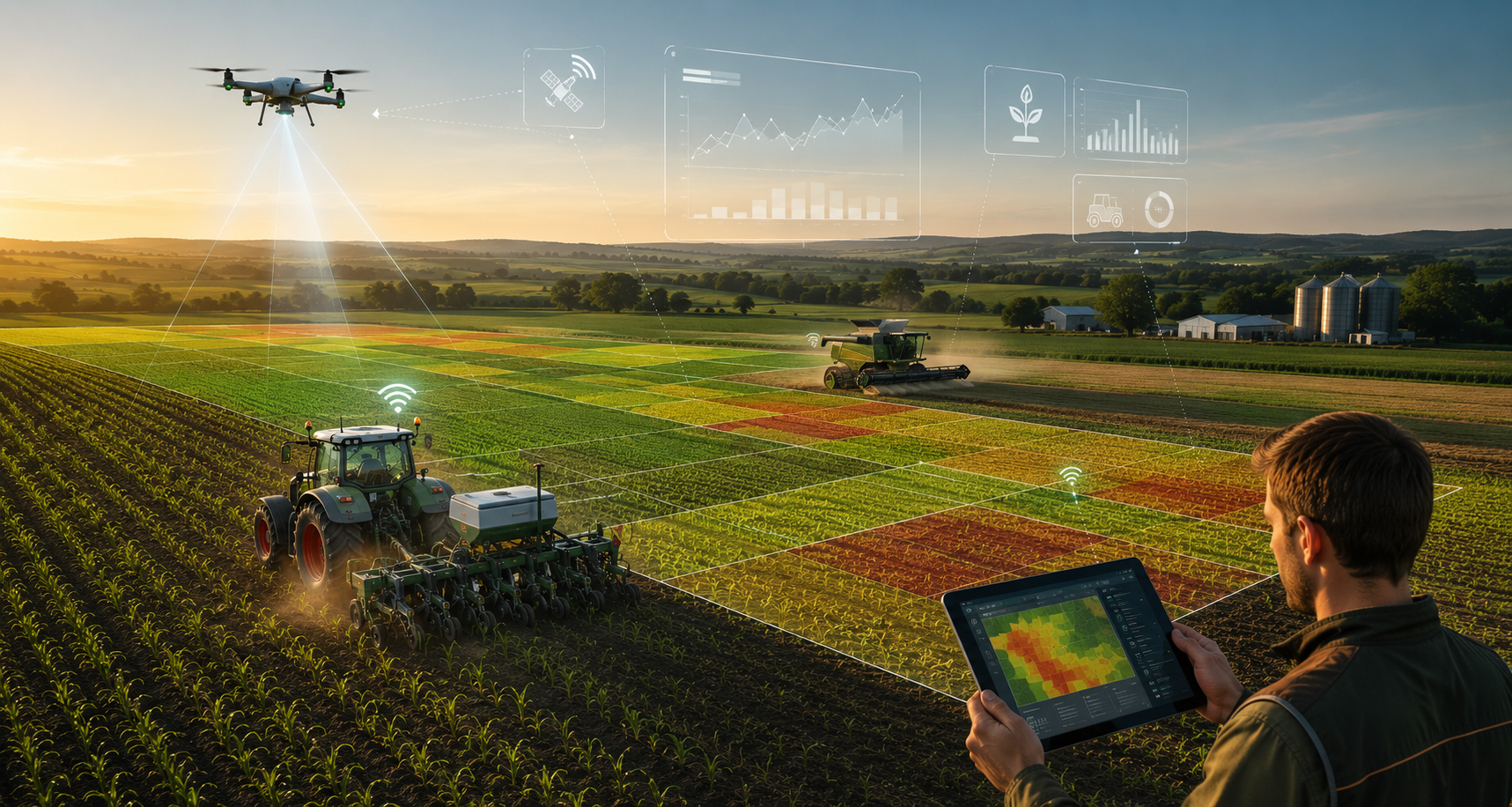
Arable farming faces growing pressure to raise productivity while reducing environmental impact, containing costs and adapting to increasingly erratic weather. Site-specific practices, addressing each part of the field according to its actual needs, have become one of the main levers to reconcile these demands, moving crop management from broad averages to data-driven decisions.
The Agri-Digital Growth course on Precision Arable Agriculture responds to this shift. Produced by Josephinum Research (JR) with the contribution of FederUnacoma, the course is now available on 28Digital, the e-learning platform developed by project partner 28DGTL. It forms part of the five pilot courses that the partnership has designed to close the digital skills gap in the agri-food sector.
The course is organised into ten modules that follow arable crop production from its digital foundations to its most advanced field applications. It starts from the definition and history of precision farming in arable agriculture, then introduces site-specific management, precision seeding and fertilisation, plant monitoring, farm terminals and tractor systems, Farm Management Information Systems, automatic steering, manure application, robotics and plant protection. The ten modules are:
Definition and History
Intro Site-Specific Management in Arable Agriculture
Precision Seeding and Fertilization
Plant Monitoring, Sensor Use and Index Calculations
Application PF Terminal and Tractor
FMIS in Precision Farming
Automatic Steering
Precision Manure Application
Robotics in Arable Agriculture
Precision Plant Protection in Arable Farming
Across the modules, learners work on concrete tools and methods: site-specific nitrogen application and variable corn sowing through satellite-based apps, satellite and drone data for arable farming, the determination of soil and crop state from heterogeneous data, ISOBUS communication between tractors and implements together with its physical elements, functionalities and field applications, topography-aware track planning to mitigate soil erosion, automatic steering, precision manure application, autonomous tractors and field robots in soil tillage and sowing, and precision plant protection.
Like the other ADG pilot courses, Precision Arable Agriculture follows a micro-credential structure of around 25 hours, combining video lessons, quizzes and self-study resources. Learners who complete the course and pass the final test receive a certificate of completion. Those who follow Precision Farming Basics together with one specialised course of their choice obtain the Precision Farming Specialist certification. Learners who do not need a certificate can also select single modules according to their interests.
The course addresses junior profiles in traditional SMEs as well as graduates and professionals who want to align their competences to the requirements of modern arable farming. Access is open and free of charge.
The courses are available on the 28Digital platform: https://28digital.ea.education/adg/
They are also available on the Agri-Digital Growth website: https://www.agridigitalgrowth.eu/pilot-courses-and-how-to-apply/