
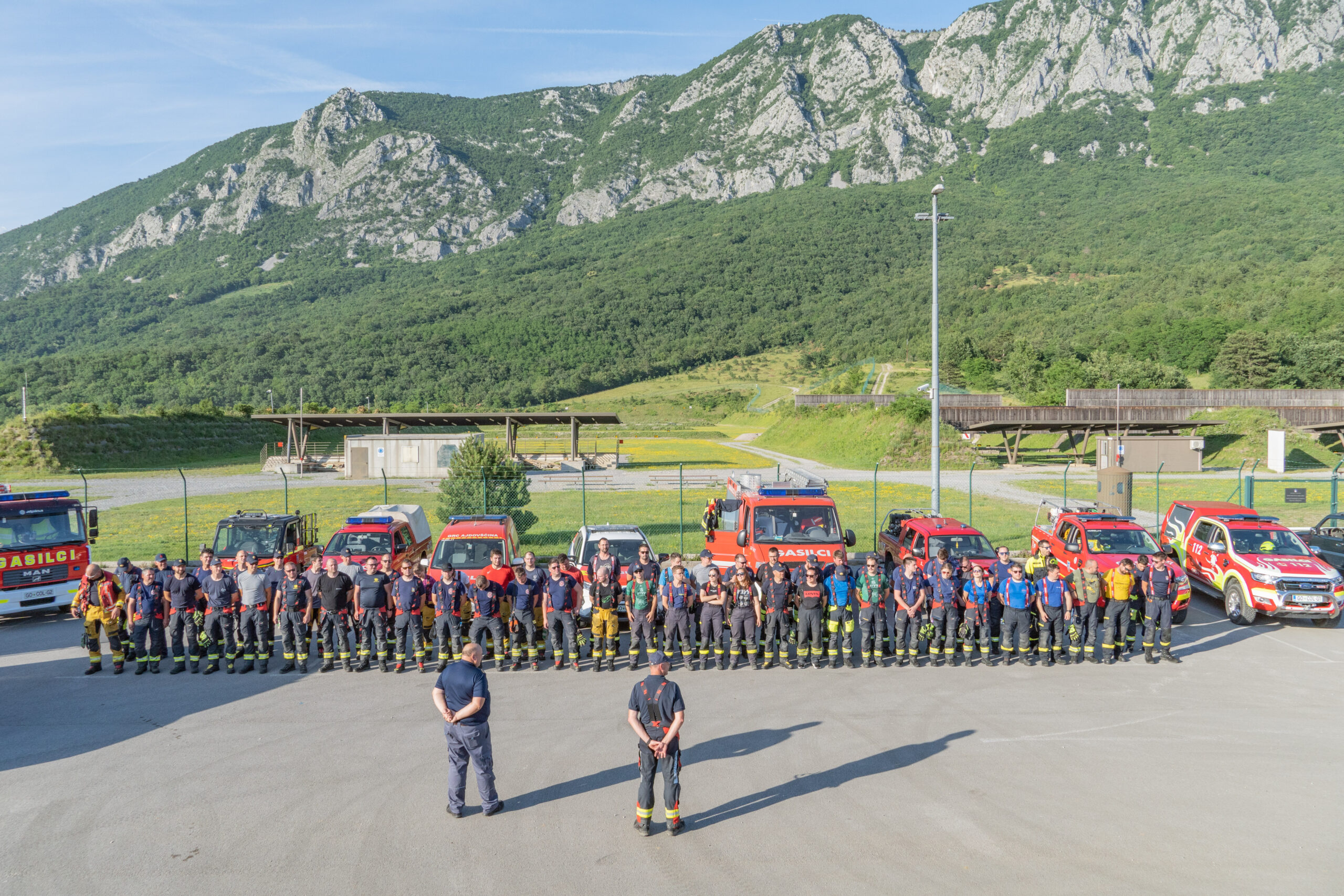
On Monday, June 8, 2026, a large-scale firefighting exercise took place in the Mlake Shooting Range area “Wildfire – Mlake Shooting Range 2026,” in which around 60 firefighters from the Ajdovščina Fire and Rescue Center, as well as volunteer fire departments from the Ajdovščina Firefighters’ Association and the Vipava Firefighters’ Association, participated. In addition to testing the operational readiness of the units ahead of the upcoming wildfire season, the drill was also designed to test advanced technological solutions being developed as part of the European projects WILDFIRE CE and BEALERT.
The exercise served as a continuation of the professional training conducted in late May at the headquarters of the Ajdovščina Fire and Rescue Center, where participants learned how to use the WILDFIRE CE online platform, analyze fire risk in a given area, and utilize advanced digital tools for managing interventions.
As part of the exercise, participants tested the WILDFIRE CE platform, which is designed to monitor field data and support operational decision-making. Particular emphasis was placed on testing the functionality of sensor equipment and displaying data in a digital environment, which provides users with a better overview of conditions on the ground and enables more efficient information sharing.
During the exercise, equipment acquired as part of the BEALERT project was also used, complementing the solutions developed by the WILDFIRE CE project. Together, these two project initiatives contribute to the development of modern systems for monitoring environmental conditions, early risk detection, and decision support during challenging events in the natural environment.
The operational part of the exercise included setting up a reception point, organizing a command post, and preparing a water reservoir for potential water collection by helicopter during firefighting operations. Special attention was also paid to public communication, as participants concluded the exercise with a simulation of providing information to the media, as would occur during an actual large-scale intervention.
Following the conclusion of the operational phase, an analysis of the exercise was conducted, during which participants assessed the course of activities, the coordination of unit operations, and the effectiveness of the tested technological solutions. The experience gained and the feedback received will make a significant contribution to the further development of both projects and to strengthening the preparedness of fire departments and other services to respond effectively to wildfires.