
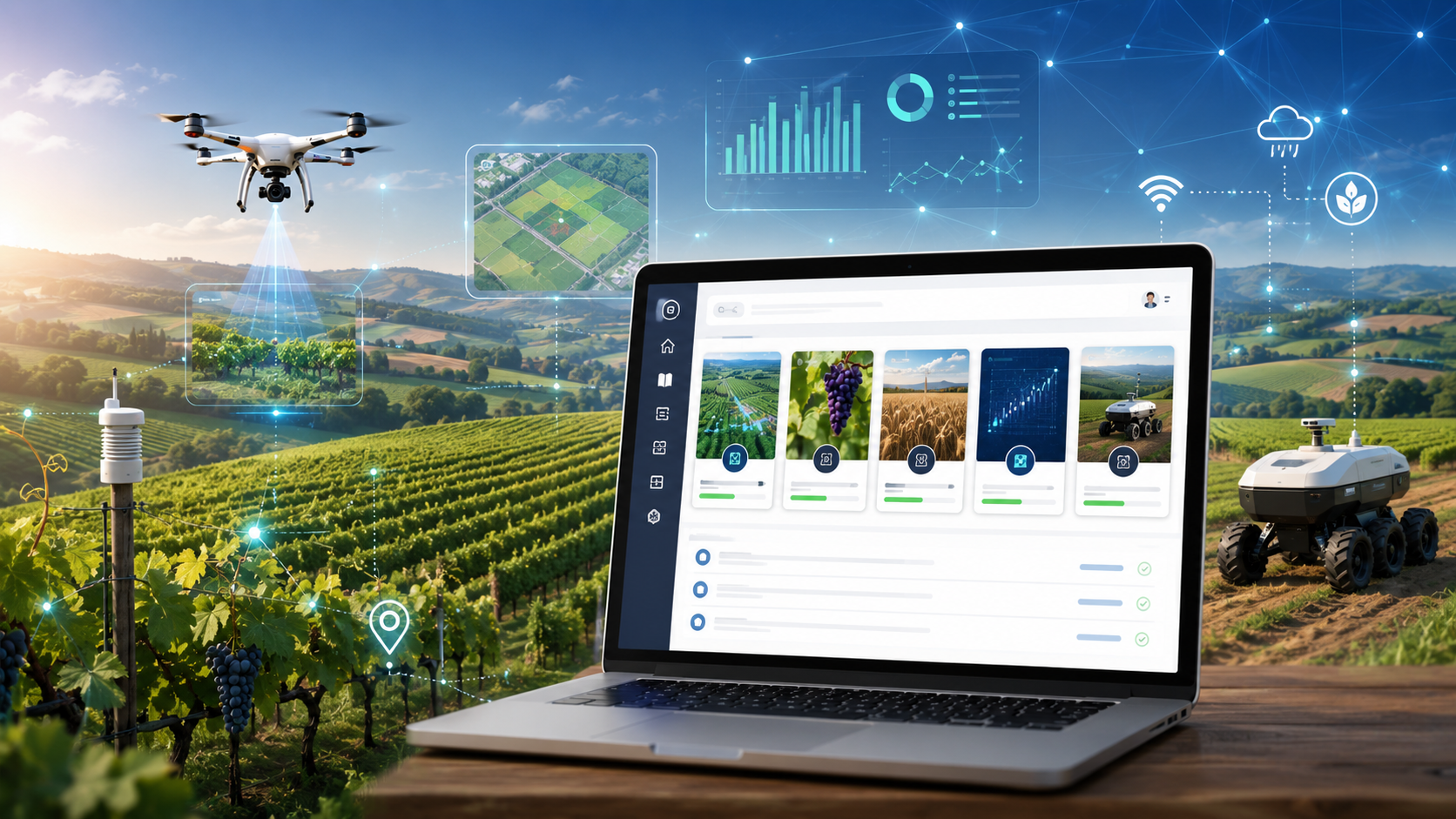
The agri-food and agricultural machinery sectors are undergoing a significant digital transformation. Precision farming increasingly integrates technologies such as IoT, AI, robotics, blockchain and advanced sensing systems into production and management processes, reshaping how knowledge, skills and competitiveness are distributed across the sector. According to Eurostat data, digital skills remain a critical weak point for SMEs across Central Europe: only 21% of small and medium enterprises employ ICT specialists and fewer than one in five small enterprises provided ICT training to their staff.
It is against this backdrop that Agri-Digital Growth has developed five transnational pilot courses, now available on 28Digital, the e-learning platform developed by project partner 28DGTL. The courses cover topics that reflect the key areas of the digital transition in agriculture: Precision Farming Basics, Precision Viticulture, Precision Arable Agriculture, Data Processing and AI, and Robotics Applied to Agriculture.
Each course follows a micro-credential structure of approximately 25 hours, organised into modules and lessons combining video content from project partners’ experts, quizzes and self-study resources. Learners who complete a course and pass the final test receive a certificate of completion, while those who complete Precision Farming Basics together with one specialised course of their choice earn the Precision Farming Specialist certification. Individual modules can also be followed independently, without pursuing a full qualification.
Precision Farming Basics is the first of the five courses to be released. It serves as the entry point of the training offer, conceived for learners who are new to the sector and looking to build a foundation before moving to a specialised course. The course is organised into seven modules that move from the origins of precision farming to its most advanced enabling technologies. It opens with the definition and history of precision agriculture and its differences from conventional practice, then introduces mechatronics, sensors, electrification, robotics, data storage and security, and artificial intelligence. The seven modules are:
Precision Farming History
Mechatronics
Sensors
Electrification
Robotics
Blockchain, Data Storage and Security
Artificial Intelligence
Across the modules, learners work through concrete topics: general mechatronic definitions, drives and multi-physics simulation, an introduction to farm sensors, energy planning and basic energy needs on farm, renewable energy sources and systems, energy storage, the transition from diesel to electric farm machinery, robotic platforms and their applications in agriculture, data security and cloud computing, blockchain, and the history, methods and agricultural applications of artificial intelligence.
The courses are designed for graduates, young professionals and SME workers seeking to develop practical competences in precision farming and are freely accessible on the platform.
The courses are available on the 28Digital platform: https://28digital.ea.education/adg/
They are also available on the Agri-Digital Growth website: https://www.agridigitalgrowth.eu/pilot-courses-and-how-to-apply/