
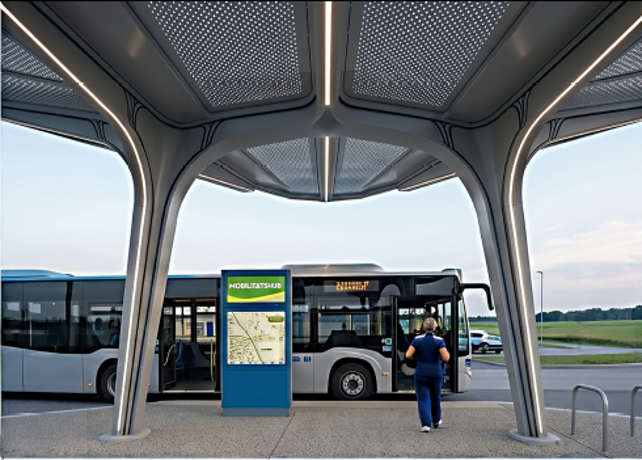
A major achievement is the development of the GO!ByBus service between Gorizia and Nova Gorica. The cross-border bus connection was enhanced as a pilot initiative in 2025 in the context of the European Capital of Culture. The service used electric buses, operated with higher frequency and improved the public transport link between the Italian and Slovenian twin cities.
During the pilot phase, the service carried around 83,000 passengers. Following this successful experience, the responsible authorities decided to continue the enhanced cross-border connection. Since 1 April 2026, the line has been operating in a new post-pilot configuration, financed by the Friuli Venezia Giulia Region and the Republic of Slovenia and jointly operated by TPL FVG and NOMAGO. This shows how a pilot activity can support the transition from temporary testing to a more stable cross-border public transport offer.
Further progress has also been achieved in the Koroška–Carinthia cross-border area. The upgraded Štrekna Bus was selected as the most suitable pilot action after applying a structured decision-making tool. The service connects Velenje, Slovenj Gradec, Dravograd and Lavamünd and combines passenger transport with bicycle transport, tourism and daily mobility.
In the 2025 pilot season, the Štrekna Bus operated on 70 days, including daily service in July and August and weekend operation in September. The upgraded service transported 2,286 passengers and 1,478 bicycles. Compared with 2024, this represents an increase of around 101% in passengers and 254% in transported bicycles. The results confirm the strong demand for combined cycling and public transport services and provide a basis for a second upgraded season in 2026 and for longer-term service planning.
In parallel, TRANS-BORDERS+ partners are applying the project’s mobility point toolbox to selected public transport stops and transport nodes in the project regions. The toolbox supports the stepwise development of conventional bus stops and existing transport nodes into more attractive, accessible and multimodal mobility points.
The selected locations cover different regional contexts and planning situations, ranging from smaller rural stops to existing bus-rail nodes and station-based mobility hubs. Sittersdorf in Carinthia is one example: here, the toolbox supports the preparation of a new local transport hub that can improve passenger information, accessibility, Bike & Ride and Park & Ride functions, and links to future cross-border mobility services.
Across the project regions, the work on mobility points addresses practical planning questions such as accessibility, passenger information, digital equipment, ownership, funding, permitting and long-term maintenance. By applying the toolbox to concrete locations, the project creates transferable experience for other rural and peripheral border regions.
Together, these WP3 activities show how TRANS-BORDERS+ contributes to more user-friendly and better coordinated cross-border mobility. The pilots provide practical evidence on how public transport services can be improved, how existing services can be upgraded, and how stops can become more attractive access points to sustainable mobility.
The results will feed into the project’s transferable solutions and support future cooperation between public authorities, transport providers, municipalities and regional stakeholders in Central European border regions.