
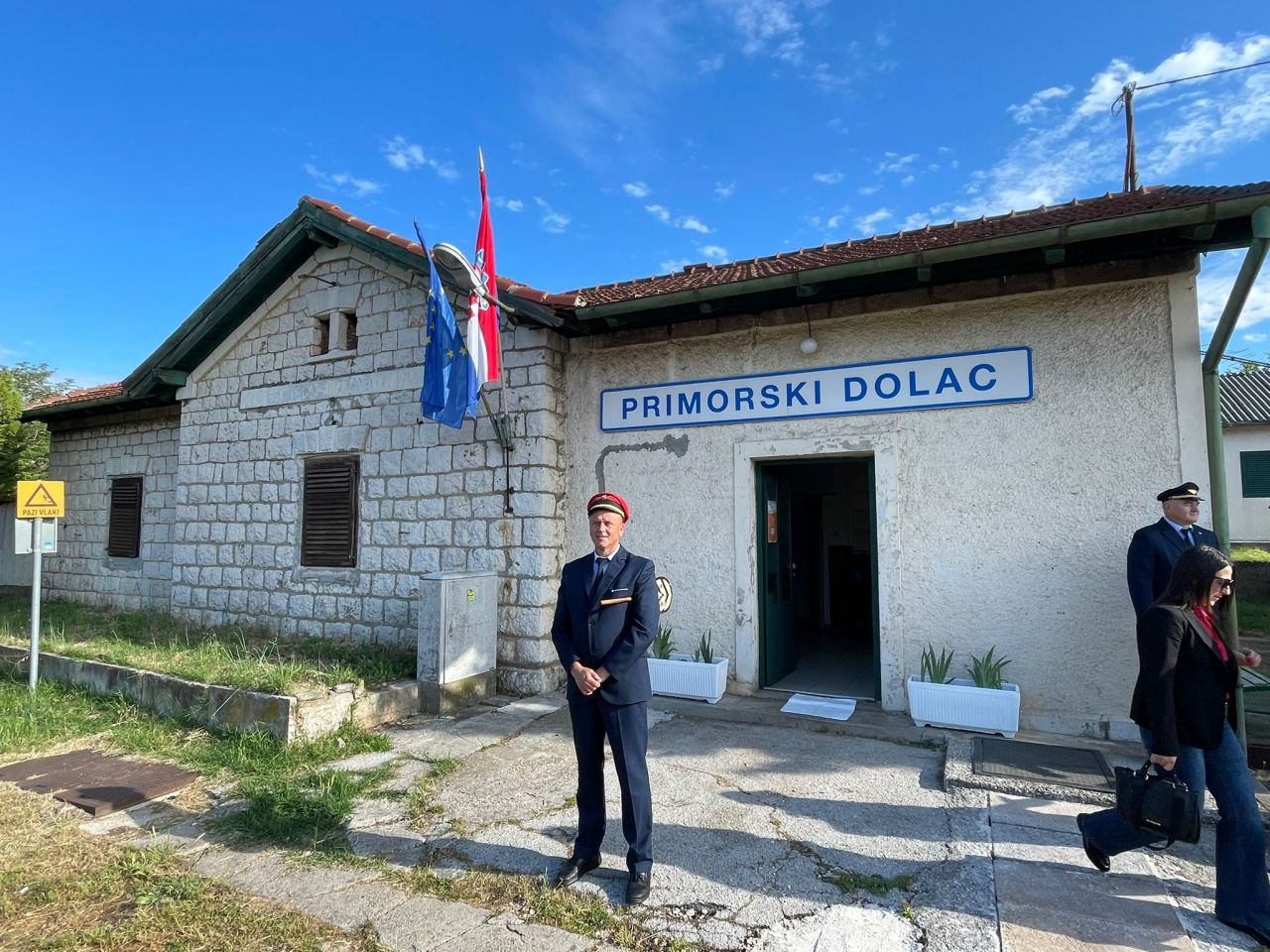
How can a small rural railway station become a place that truly serves its community? This question was at the heart of the second RAISE-CE partner meeting in Croatia, where project partners gathered to transform traditional transport infrastructure into vibrant spaces for everyday life. Hosted by RERA S.D. Public Institution for Coordination and Development of the Split-Dalmatia County, the meeting moved away from standard conference rooms; instead, participants boarded a train from Split to Primorski Dolac, one of the project’s pilot areas, to experience first hand the real opportunities and challenges of rural rail connections. On-site, local representatives and railway experts shared how vital these stations are for the development, connectivity, and overall quality of life in rural, often smaller communities.
Throughout the interactive workshops, partners from across Central Europe exchanged regional experiences to co-design practical solutions aimed at making stations more accessible, linking them seamlessly with other transport modes, and reimagining them as hubs for local services and community life. A major highlight of the event was the presentation of an innovative milestone for European mobility: the First European Battery Train. Unlike existing hybrid models, this 42-meter-long train operates exclusively on battery power across completely non-electrified lines, reaching speeds of 120 km/h and accommodating over 220 passengers. Partners experienced this new era of Croatian and European rail transport first-hand during a test ride, which was followed by a strategic meeting with Croatian Railways representatives to discuss the battery technology and upcoming modernization plans for the Split railway infrastructure.
The RAISE-CE journey now continues on the ground. Over the coming months, partners will actively engage local communities and stakeholders to test and refine these ideas in real-world scenarios. The ultimate goal remains clear: to ensure railway stations are no longer just places people pass through, but welcoming, accessible, and energetic hubs that reconnect rural areas and improve daily life across Central Europe.
Disclaimer
This publication has been developed within the RAISE-CE project, supported by the Interreg CENTRAL EUROPE Programme with co-financing from the European Union. Its content is the sole responsibility of the authors and the project partnership and does not necessarily reflect the views or positions of the Interreg CENTRAL EUROPE Programme, its programme bodies or the European Union. Neither the programme authorities nor the European Union can be held responsible for any use that may be made of the information contained herein.