
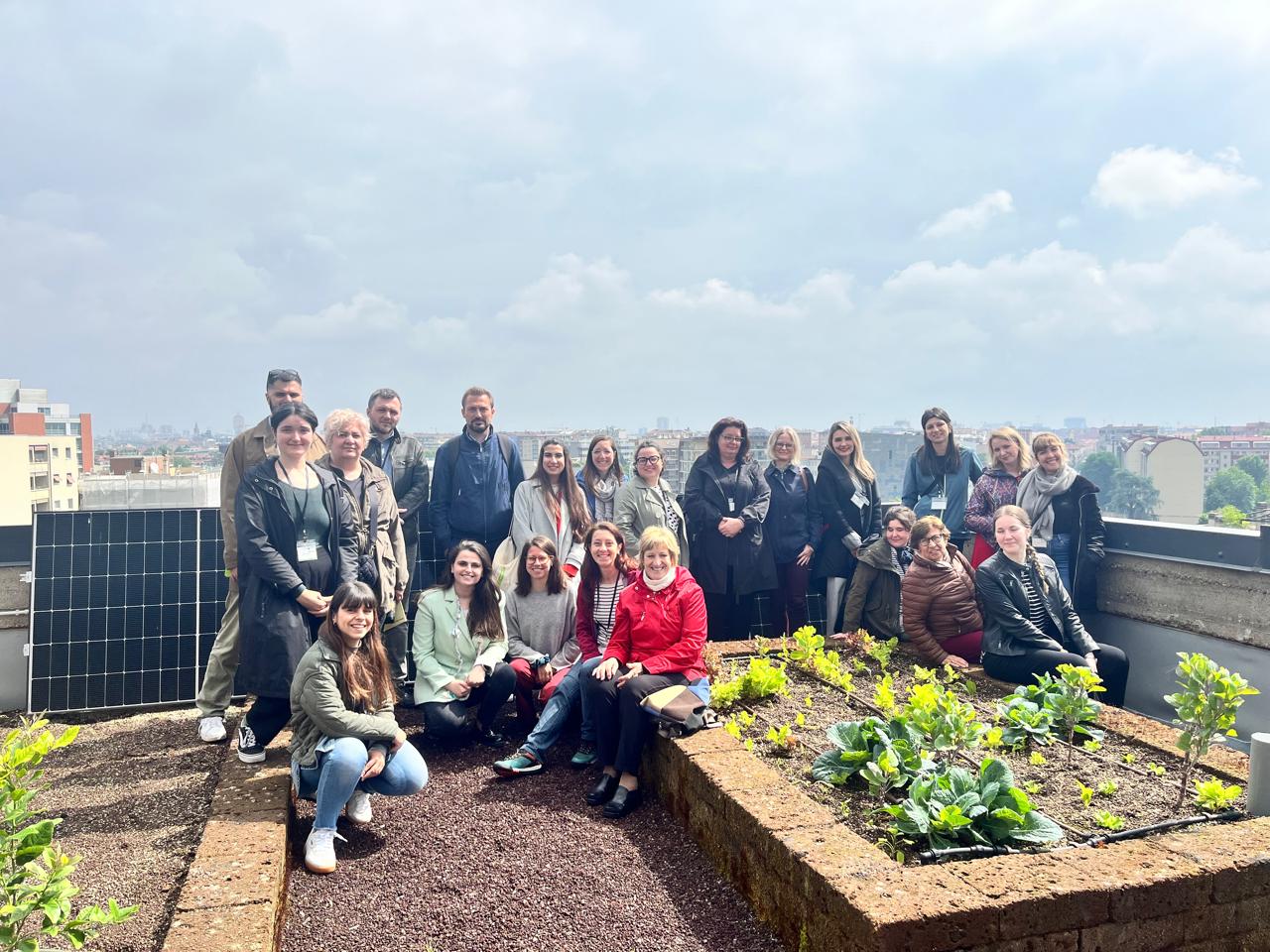
The GreenScape CE project has officially reached its conclusion, marking the end of an intensive period of collaboration, innovation, and knowledge exchange across Central Europe.
Project’s results are now publicly available, offering practical guidance and transferable tools for cities across Europe and beyond.
1. Visual Mapping Platform: A Digital Tool for Understanding Urban Green Systems
What is it? One of the project’s most innovative outputs is the GreenScape CE Visual Mapping Platform (GVMP), an interactive, map-based tool designed to support urban planning and decision-making processes. GVMP provides a comprehensive visual overview of existing green and blue infrastructure, enabling users to identify opportunities for expanding and connecting NbS interventions. It includes three integrated tools: an Accessibility Tool, an NbS Tool, and a Connectivity Tool. Together, these features allow users to assess access to green spaces, explore potential interventions, and strengthen ecological networks.
Who benefits? The GVMP is designed for urban planners, policymakers, researchers, and local authorities, as well as citizens and community groups. It enhances transparency and awareness by making complex spatial data accessible and understandable. Moreover, its transferable design ensures that other cities can reuse and adapt the platform in their own planning processes.
Here you can check the GVMP: https://greenscapece.visualmapping.eu/about/index.html
2. Local Action Plans: Co-Designed Strategies for Urban Transformation
What is it? Another key output is the development of five Local Action Plans focused on NbS and GI implementation in the pilot cities. These action plans are the result of a transnational co-design process involving local governments, experts, and citizens. They define priority areas and concrete measures for the development of green infrastructure, serving as strategic roadmaps for future urban interventions. The plans were shaped through capacity-building workshops and participatory processes, ensuring that they reflect both technical expertise and local needs.
Who benefits? Local authorities and urban planners are the primary users of these action plans, as they provide actionable guidance for implementing NbS. At the same time, citizens benefit through improved urban environments that respond to their needs and preferences. The participatory approach also empowers communities by involving them in shaping their cities.
Here you can check the LAPs final output:
https://www.interreg-central.eu/wp-content/uploads/2024/11/LAPs_FINAL.zip
3. Pilot Action Jointly Developed and Implemented
What is it? Pilot actions carried out in five Central European urban areas, where partners jointly developed, tested, and implemented key aspects of urban nature-based solutions (NbS) and green infrastructure (GI). These actions focused on three main areas: citizen engagement and co-creation, technical and tendering solutions, and financing models (including public, private, and citizen-led approaches). The process combined stakeholder collaboration, practical testing, and shared learning to ensure that solutions were feasible, inclusive, and adaptable to real urban contexts. The results were presented through clear infographics, making the outcomes more accessible and easier to understand for the general public.
Who benefits? The benefits reach a wide range of people and institutions. Residents and public space users gain greener, more livable neighborhoods and greater opportunities to shape their surroundings. Also the broader public gains clearer, more accessible information about urban greening initiatives through infographics and public events. Local communities and NGOs benefit from stronger relationships with local authorities and a lasting culture of collaboration. City administrations gain practical, replicable models for financing, governance, and citizen engagement.
Here, you can visit the infographics for each city:
● Warsaw
● Ptuj
● Szeged
● Zagreb
4. Practical Handbooks: Tools for Implementation
What is it? A comprehensive set of practical guides has been developed. This output consists of three complementary handbooks: a financing handbook for NbS/GI projects, a technical handbook, including guidelines for tendering processes, a guide on citizen engagement and co-creation. Together, these documents provide step-by-step support for integrating NbS into public infrastructure projects.
Beyond their practical application, these handbooks reflect the broader impacts observed during the project. Environmentally, NbS interventions contribute to improved stormwater management, reduced heat stress, and increased biodiversity. Socially, they enhance the quality and usability of public spaces, fostering healthier and more cohesive communities. Economically, they offer long-term savings and increase urban attractiveness.
Who benefits? Different levels of governance can find this useful, including community organizations and stakeholders involved in participatory processes can benefit from the co-creation guide.
- GreenScape Handbook on Citizen Engagement
- GreenScape Handbook onTechnical Handbook
- GreenScape Handbook on Financing
5. Joint Transnational Strategy: A Framework for the Future
What is it? The final key output is a Joint Transnational Strategy for implementing, integrating, and funding NbS in urban areas. This strategy synthesizes the knowledge and experiences gained throughout the project into a comprehensive framework. It addresses critical aspects such as identifying gaps in green infrastructure, ensuring network coherence, and developing effective funding mechanisms.
A central pillar of the strategy is community engagement. It emphasizes the importance of involving citizens, businesses, and local groups from the earliest stages of project development through to long-term maintenance. Methods such as workshops, hackathons, and participatory platforms are highlighted as essential tools. Another key component is capacity building and knowledge exchange. The strategy promotes the creation of transnational networks, training programs, and knowledge hubs to support cities in adopting and scaling NbS.
Who benefits? This strategy is intended for a wide range of stakeholders, including policymakers at all levels, urban planners, technical experts, and civic organizations. It also benefits citizens by fostering more inclusive, resilient, and sustainable urban environments.
A Lasting Legacy
Although the GreenScape CE project has formally ended, its results remain open, visible, and ready to be used. By making its outputs publicly accessible, the project ensures that its impact will continue to grow, supporting cities in their transition toward greener, healthier, and more resilient futures. Project’s outputs together form a comprehensive toolkit; bridging knowledge, practice, and community engagement and stand as a valuable resource for anyone committed to sustainable urban development. In addition, the transnational NbS network of cities and followers established within the project, is foreseen as a permanent and evolving group of institutions and cities that will continuously exchange experiences, share knowledge, and collaborate on Nature-based Solutions, and will be actively promoted by all project partners even after the project ends, with the aim of further expanding and strengthening the network over time.