
Why Rural Railway Stations Matter for Sustainable Regional Mobility
Rural areas encompass more than 80% of the European Union’s territory and are home to 30% of its population. Despite their importance as suppliers of food, raw materials, and energy, these regions often grapple with low population density, depopulation, and a scarcity of services. In this context, rural railway stations are not just transport stops; they are essential lifelines that can bridge the urban-rural divide and foster sustainable development.
The Role of Stations in Regional Connectivity
For many rural inhabitants, the private car is the only practical means of transport, leading to high car dependency and social exclusion for those unable to drive. Rural railway stations have the potential to reverse this trend by acting as “functional keystones” of the territorial system. When well-integrated, they provide access to Services of General Interest (SGI), such as healthcare, education, and employment opportunities in larger urban centers.
Furthermore, revitalizing these stations can generate a significant “value uplift” for the surrounding areas, making them more attractive for residents and tourism. By treating stations as strategic assets rather than simple transit points, regions can improve the quality of life and encourage a modal shift from private cars to greener, rail-based public transport.
Introducing RAISE-CE: Revitalizing Rural Areas
To address these challenges, the project RAISE-CE (Revitalizing rural Areas through Integrated Station Enhancements) was launched under the Interreg Central Europe program. Lead by the Lombardy Region (Italy), the project brings together six partners from Croatia, Slovenia, Hungary, Poland, and Germany to transform underutilized stations into vibrant, functional mobility hubs.
The project focuses on two main clusters of innovation:
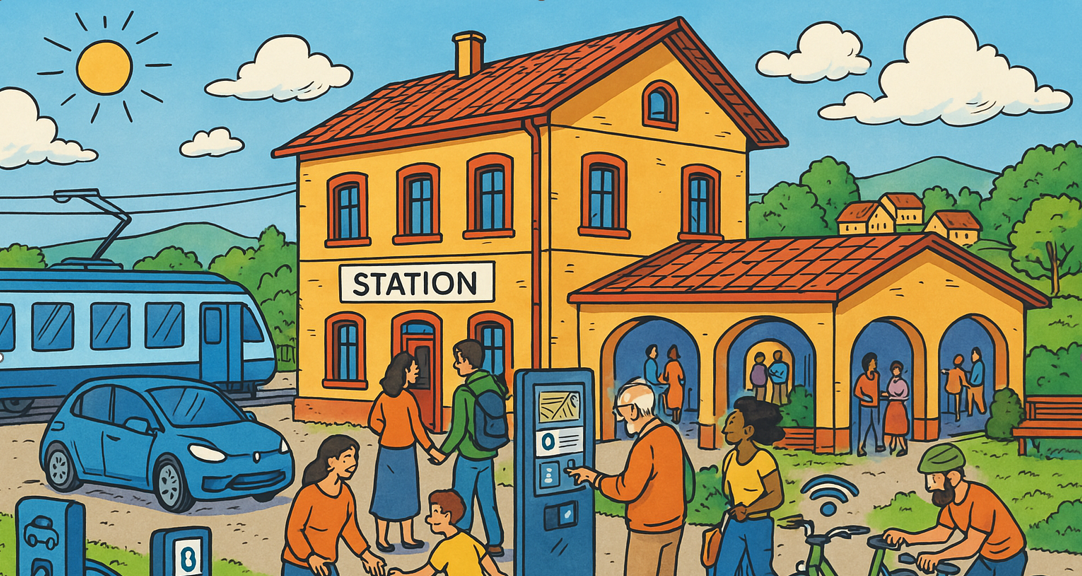
- Innovative Mobility Services: Tailored solutions to solve “first and last-mile” connectivity. This includes e-bike and e-scooter sharing in Primorski Dolac (Croatia) and Demand-Responsive Transport (DRT)—flexible, van-based shuttle services—in Pivka (Slovenia).
- Community-Centered Enhancements: Transforming station spaces into usable community assets. Pilots include interactive digital kiosks with real-time travel information in Edolo (Italy) and Ajka (Hungary), Wi-Fi-enabled workstations, and inclusive waiting areas designed to support the elderly and persons with physical impairments.
Scaling Success for a Greener Europe
RAISE-CE is built on the principle of leaving no one behind. By co-designing services with local stakeholders, the project ensures that solutions are adapted to the unique demographic and geographic needs of each region.
The lessons learned from these pilots will be consolidated into scalable operational models that can be replicated across Central Europe. This transnational cooperation is essential for creating a unified approach to rural mobility, ensuring that even the most peripheral areas remain connected to the European transport corridors.
By revitalizing infrastructure and embracing digital innovation, RAISE-CE directly contributes to the European Green Deal and the Territorial Agenda 2030, fostering a more resilient, connected, and sustainable future for our rural communities.
Disclaimer
This publication has been developed within the RAISE-CE project, supported by the Interreg CENTRAL EUROPE Programme with co-financing from the European Union. Its content is the sole responsibility of the authors and the project partnership and does not necessarily reflect the views or positions of the Interreg CENTRAL EUROPE Programme, its programme bodies or the European Union. Neither the programme authorities nor the European Union can be held responsible for any use that may be made of the information contained herein.