
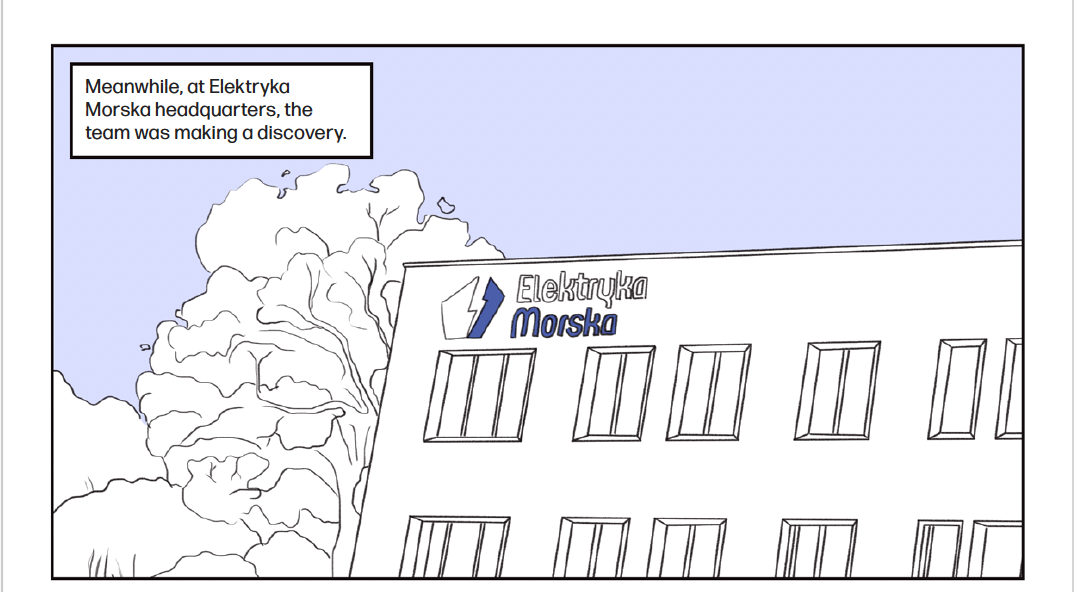
Connected Cells is a comic inspired by real research and development activities carried out within the international Circotronic project. Through a narrative format, it presents the process through which innovation emerges—beginning with a simple question, developing through collaboration and experimentation, and eventually leading to the formulation of a new research agenda. The story takes place in the environment of Elektryka Morska, a Szczecin-based company specializing in electrical, power, and automation systems for marine vessels.
The comic begins with a Future Scenarios Workshop, which becomes an important trigger for new ways of thinking within the company. Such workshops encourage participants to move beyond everyday operational thinking and explore broader technological, environmental, and regulatory perspectives. Rather than focusing only on immediate challenges, the participants are invited to imagine possible futures and consider how their organizations might respond to them. For the team at Elektryka Morska, this moment becomes an opportunity to reflect on emerging possibilities in energy technologies and on the increasing importance of sustainability in the maritime sector.
During discussions within the company, a key question begins to emerge: could batteries be diagnosed before they fail? Instead of replacing battery systems according to routine schedules, the team wonders whether it might be possible to detect early signs of degradation and react accordingly. This leads to a speculative but intriguing idea—what if batteries emit acoustic signals that reveal their internal condition?
The concept of diagnosing batteries through acoustic emission analysis becomes a starting point for further exploration. If such signals could be detected and interpreted, they might allow engineers to assess battery health more precisely, extend their operational lifetime, and avoid unnecessary replacement of components that are still functioning. This approach could significantly improve maintenance strategies for energy storage systems used in marine environments.
At this stage, international collaboration becomes essential. Within the Circotronic project, Elektryka Morska works alongside researchers, engineers, and innovation specialists from various institutions. Through discussions with project partners and scientists, the team gains access to new perspectives and tools that help structure the innovation process. One of these tools is the Circularity Assessment Tool, which supports the design of solutions aligned with circular economy principles.
Using such frameworks allows the team to look beyond the purely technical dimension of the problem. Instead, they begin to consider how new diagnostic methods could influence broader business strategies. If battery conditions could be monitored accurately, maintenance could be based on actual performance rather than standard replacement intervals. This shift could open the door to new service models focused on maintenance, repair, and lifetime extension.
Such strategies reflect the principles of short-loop circular approaches, where the priority is to keep products and components in use for as long as possible. Rather than discarding entire systems, companies can repair, upgrade, or selectively replace parts that are truly worn out. In this context, the idea of battery diagnostics becomes not only a technological innovation but also a potential foundation for a new business model.
The comic highlights that innovation rarely follows a linear path. Instead, it develops through a series of conversations, experiments, and encounters between people with different expertise. Engineers, sustainability specialists, scientists, and managers gradually combine their knowledge to explore a shared idea. Step by step, the initial question evolves into a proposal for a new research and development project that could test the concept of acoustic emission–based diagnostics for energy storage systems.
Ultimately, Connected Cells is not only a story about technology. It is also a story about relationships, curiosity, and trust. The narrative demonstrates how collaboration between industry and science can create fertile ground for new ideas and inspire companies to rethink their future development paths.
By using the visual language of comics, the project makes complex processes of innovation and circular design accessible to a broader audience. Through dialogues, scenes from everyday work, and moments of discovery, readers can follow how a simple question gradually transforms into a vision for more sustainable technological solutions. In this way, Connected Cells illustrates that the transition toward a circular economy depends not only on new technologies but also on open collaboration, imagination, and systemic thinking.
Concept&Story: Magdalena Małachowska Illustration&Design: Ludwika Hawryszuk