
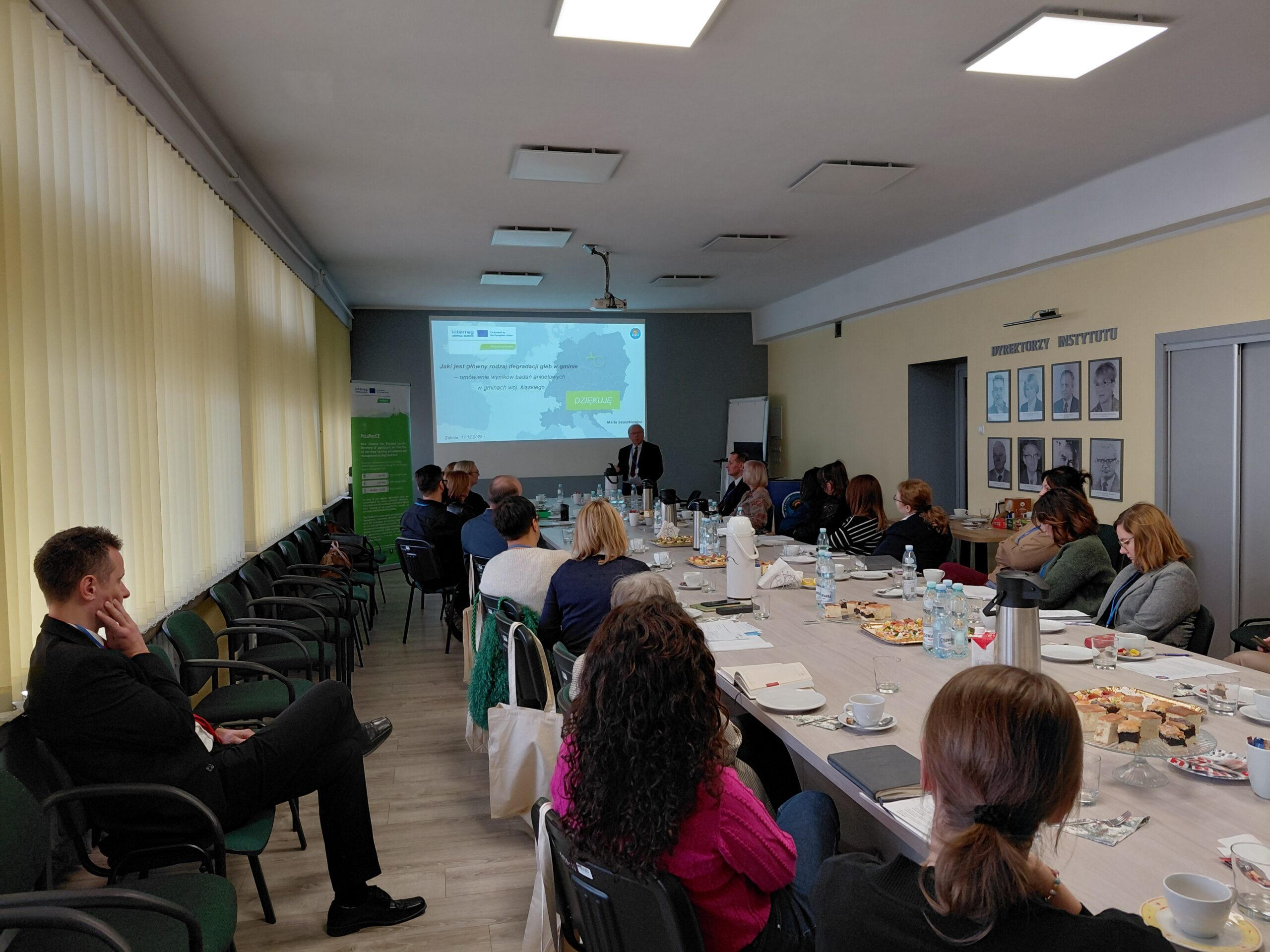
On 17 December 2025, the Institute of Environmental Engineering of the Polish Academy of Sciences in Zabrze organized a seminar introducing the main concept of the PoLaRecCE project, “A New Opportunity for Contaminated Areas: Restoring the Functions of Agricultural Soils through Non-Food Agriculture and Appropriate Soil Management in Degraded Areas,” carried out under the Interreg Central Europe programme.
Invited guests representing local and regional administrations—including municipal officers from the Silesian Region and the Marshal’s Office of the Opole Voivodeship—had the opportunity to attend presentations addressing issues of soil degradation and the potential for restoring the productive function of degraded areas.
During the seminar, the assumptions and main objectives of the PoLaRecCE project were presented, and various forms of soil and land surface degradation present in the Silesian Voivodeship were discussed. Another part of the agenda focused on the results of surveys conducted in the municipalities of the Silesian Voivodeship as well as in partner countries (Italy, Slovenia, Hungary, Croatia, and Austria). The surveys provided data concerning the main types of soil degradation occurring in the selected municipalities. Participants also received detailed information on possible sources of financial support to address the issue of degraded areas.
Since the new EU Directive on Soil Monitoring and Resilience (Soil Monitoring Law) came into force, it was crucial to discuss its main assumptions and priorities, taking into account the potential for joint cooperation between local administrations and scientific institutions. Representatives of local government units were also informed about the potential application of soil magnetometry (ISO 21226:2019) as a preliminary tool for detecting soil contamination.
The seminar provided an excellent opportunity to establish dialogue and cooperation between local government units and scientists regarding the implementation of the new EU Directive, as well as to exchange knowledge on the topic of degraded areas.