
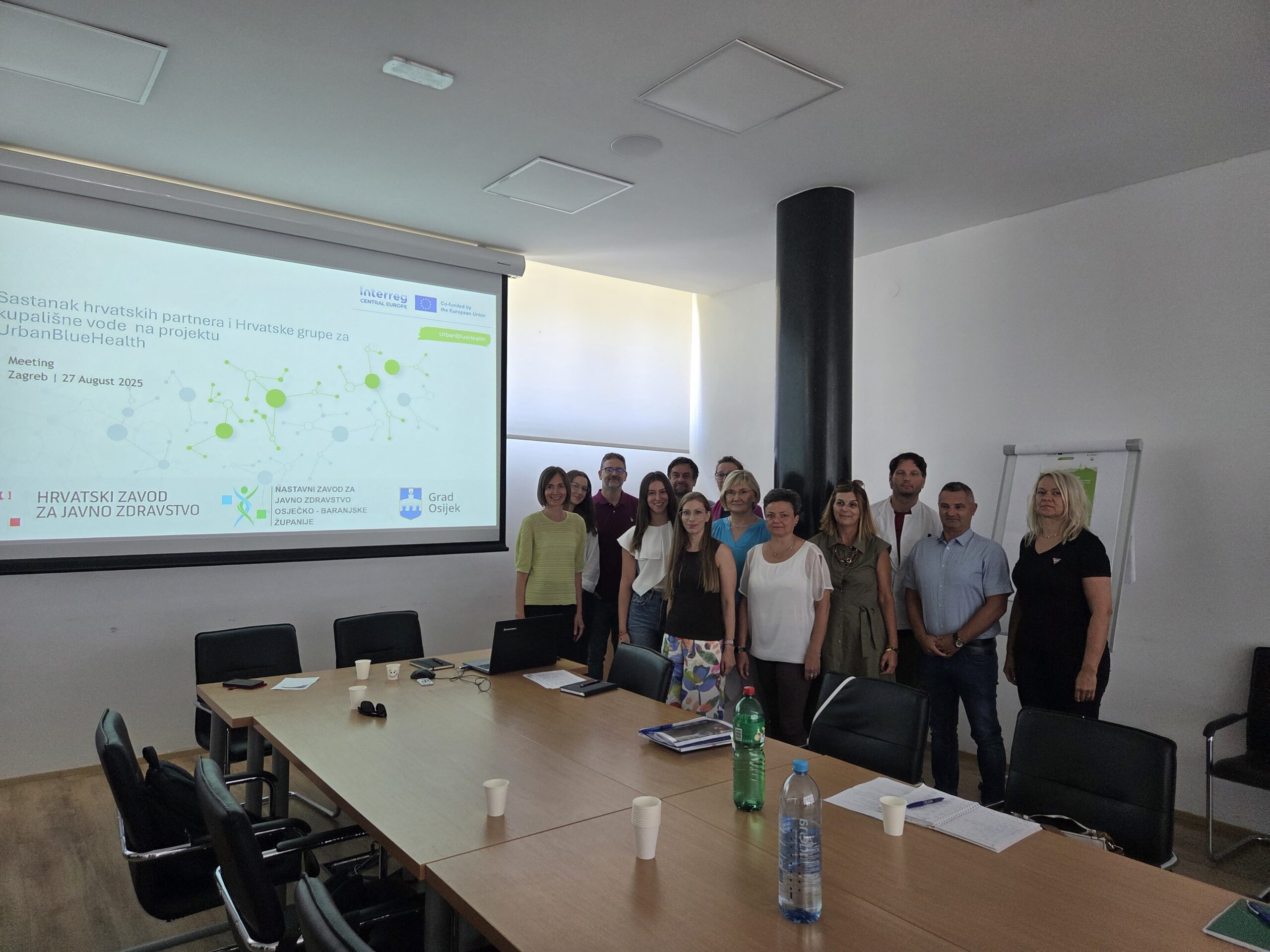
Second Meeting of Croatian Partners of UrbanBlueHealth and the Croatian Bathing Water Group (CrBWG)
The second meeting of Croatian partners in the UrbanBlueHealth project, together with members of the Croatian Bathing Water Group (CrBWG), was held at the Croatian Institute of Public Health, Rockefellerova Street 7, Zagreb. The meeting gathered representatives from public health institutions, local authorities, and CrBWG members to review project progress, present water quality monitoring results, and discuss future activities.
Attendees
Teaching Institute of Public Health of Osijek-Baranja County (NZJZ OBŽ):
- Snježana Benkotić, BSc in Food Technology
- Uranela Horvat, MSc in Food Technology
City of Osijek:
- Romano Kristić, MSc in Economics
- Hrvoje Kučan
Croatian Institute of Public Health (CIPH):
- Magdalena Ujević Bošnjak, PhD, MEn
- Jurica Štiglić, BSc Eng.
- Ana Jakopić, MSc in Biotechnology
- Marija Gregov, PhD, MSc in Food Technology
Croatian Bathing Water Group (CrBWG) members:
- Valentina Zoretić Rubes, BSc Eng., Ministry of Health
- Anica Brlek Juren, MSc, BSc Biol., Ministry of Environment and Energy Transition
- Đorđa Medić, BSc Chem. Eng., Hrvatske vode
- Bojan Lazar, BSc Elec. Eng., Vodovod-Osijek
- Antonija Kezerle, PhD, BSc Food Eng., Vodovod-Osijek
Members absent with justification:
- Tatjana Burić, BSc Eng., State Inspectorate of the Republic of Croatia
- Slaven Jozić, PhD, Institute of Oceanography and Fisheries
- Jasmina Antolić, BSc Chem. Eng., Hrvatske vode
Meeting Highlights
Magdalena Ujević Bošnjak, PhD opened the meeting with an introductory speech presenting the project, partners, activities, and results achieved. Attendees were asked to suggest local NGOs from Osijek-Baranja County for potential involvement.
Water Quality Monitoring
- Pre-pilot sampling (2024) and 2025 bathing season results for Drava Pampas, Drava Copacabana, and Drava Railway Bridge beaches were presented.
- NZJZOBŽ conducted water testing including Salmonella spp. detection.
- CIPH analyzed 16 pharmaceuticals in 2025 and somatic coliphages.
- Sampling frequency increased, including post-rainfall samples, and daily sampling continued from August 1, 2025, to the end of the season.
- New probes and a meteorological station enable online automatic monitoring.
Key Findings
- Earlier appearance of Salmonella spp. in 2025 (June 16 at Pampas vs. August 7 in 2024).
- On July 15, 2025, Salmonella spp. detected at all beaches; somatic coliphage concentrations 20–38 PFU/100 ml.
- Post-rainfall samples (July 10–11) showed elevated E. coli and intestinal enterococci.
- All samples contained at least one pharmaceutical, with the highest total concentration at Railway Bridge Beach (0.3970 μg/L). Most frequently detected: sulfadiazine and sulfamethoxazole. Ibuprofen, carbamazepine, crotamiton, and oxytetracycline HCl were below detection limits.
SWOT Analysis and Discussion
- Draft national SWOT analysis presented.
- Local risks: upstream bridges with road traffic, potential for accidents/spills (Kezerle, Lazar).
- Legal and monitoring insights provided by Brlek Juren, Zoretić Rubes, and Medić.
Next Steps
- Develop a predictive model for water quality using historical and current data.
- Sampling will continue until May 2026, covering all seasons.
- Next transnational partner meeting in Łódź, Poland, September 2025, discussing the transnational SWOT analysis and strategy as well as development of training materials and organization of final project conference.