
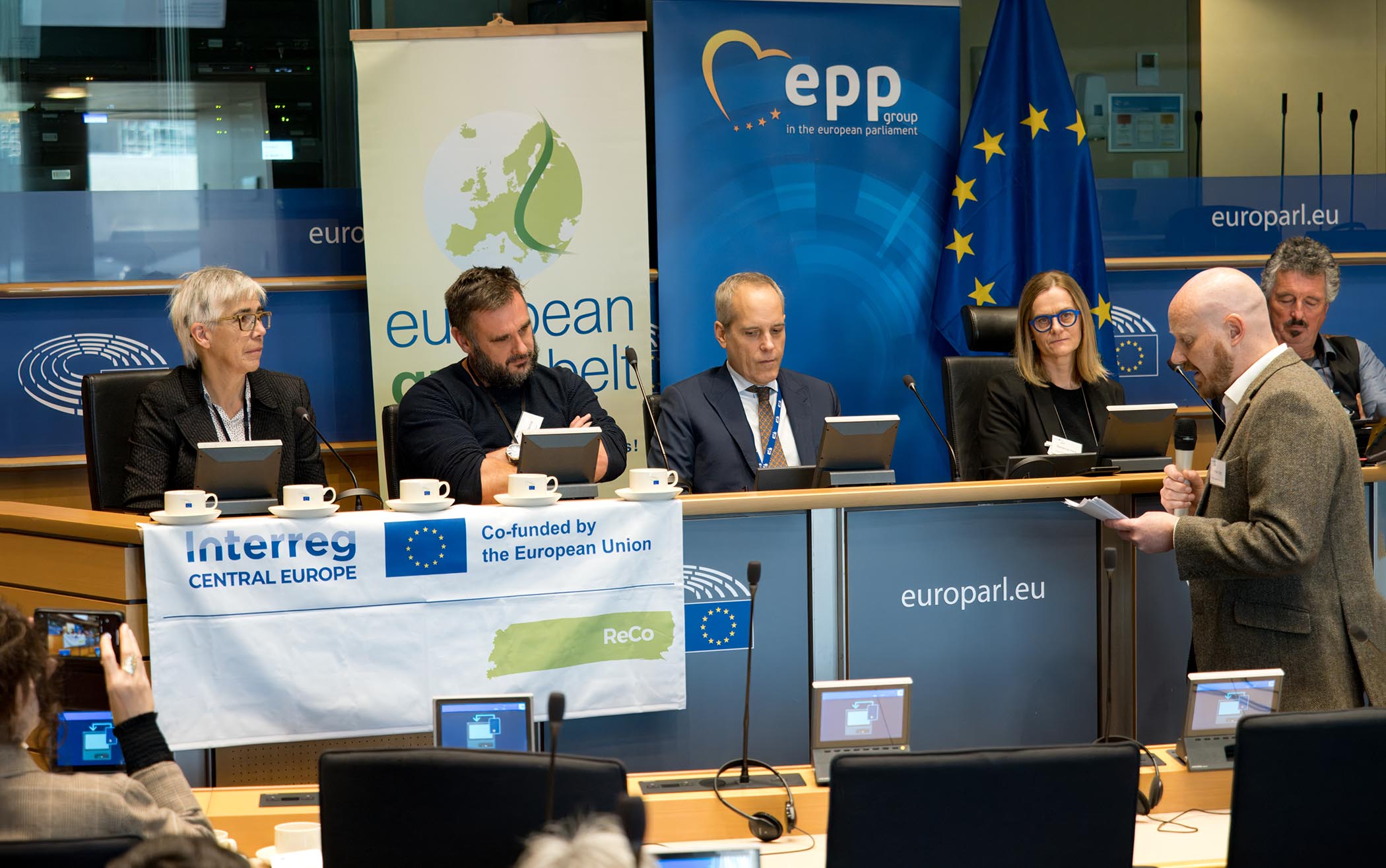
Opening the conference, MEP Danuše Nerudová underlined that the European Green Belt embodies the goals of the EU Nature Restoration Law and the Biodiversity Strategy 2030.
“Where Europe was once divided, we now build connections — ecological and human,” she said. “But turning vision into action requires policy coherence and stable financing. Restoration is not a cost; it is an investment in Europe’s resilience and future prosperity.” Michal Servus, Deputy Minister of the Environment of Czechia, presented the country’s work on the National Nature Restoration Plan, a participatory process translating EU objectives into concrete national actions. “The lessons from ReCo are directly shaping how we plan restoration at home — combining science, community engagement, and long-term cooperation,” he noted. Members of the European Parliament Dr. Jutta Paulus (Greens/EFA, Germany) and Dr. Michal Wiezik (Renew Europe, Slovakia) emphasised that the Nature Restoration Law is a cornerstone for Europe’s ecological and climate policies. They called for stable, long-term funding through programmes such as Interreg and LIFE, and for continued scientific monitoring to measure real biodiversity gains.
ReCo’s success, supported by the Interreg Central Europe Programme, demonstrates how EU cooperation can rebuild ecological connectivity and trust among neighbouring communities. Panelists agreed that future restoration must focus on climate-resilient landscapes, adaptive management, and integration of local knowledge.
“Restoration happens in the field but starts with shared values,” said Melanie Kreutz of the BUND Green Belt Competence Center. “The Green Belt proves that when Europe invests in nature, it also invests in peace, identity, and solidarity.”
Today, the European Green Belt includes more than 3.200 protected areas, among them over 40 national parks, stretching across 24 countries. It is both an ecological backbone and a symbol of reconciliation between nature and history.
As Europe faces renewed geopolitical and environmental challenges, participants agreed that protecting and restoring the Green Belt is more vital than ever. “In a time when peace and stability in Europe are again being tested,” said Nerudová, “the Green Belt reminds us what we can achieve together — across borders, across differences, and in harmony with nature.”