
Project overview
CO-MOVE – COnnecting coMmunities through cO-design of innoVativE mobility solutions
Scattered settlements and low population density make classic public transport unviable in many rural areas, deepening transport poverty and depopulation. CO-MOVE seeks to bring people closer to their jobs and public services through community-based mobility. Partners co-design social carpooling, demand-responsive and peer-to-peer schemes with citizens and stakeholders, integrate them into existing networks and prepare action plans. Shared lessons also lay foundations for future data-driven and autonomous mobility solutions.
-
0,74m €
-
Project Budget
-
80%
-
of the Budget is funded by ERDF
-
3
-
Countries
-
5
-
Regions
-
5
-
Partners
-
2
-
Pilots
Duration
Start date
End date
Project progress
Project partnership
Project partners

Lead partner
DOLOMITI BUS S.P.A.
Project partner
Tenders and Project management Department
Roadmap
Pilot Area 1 - Alpago-Zoldo (Belluno, Italy)
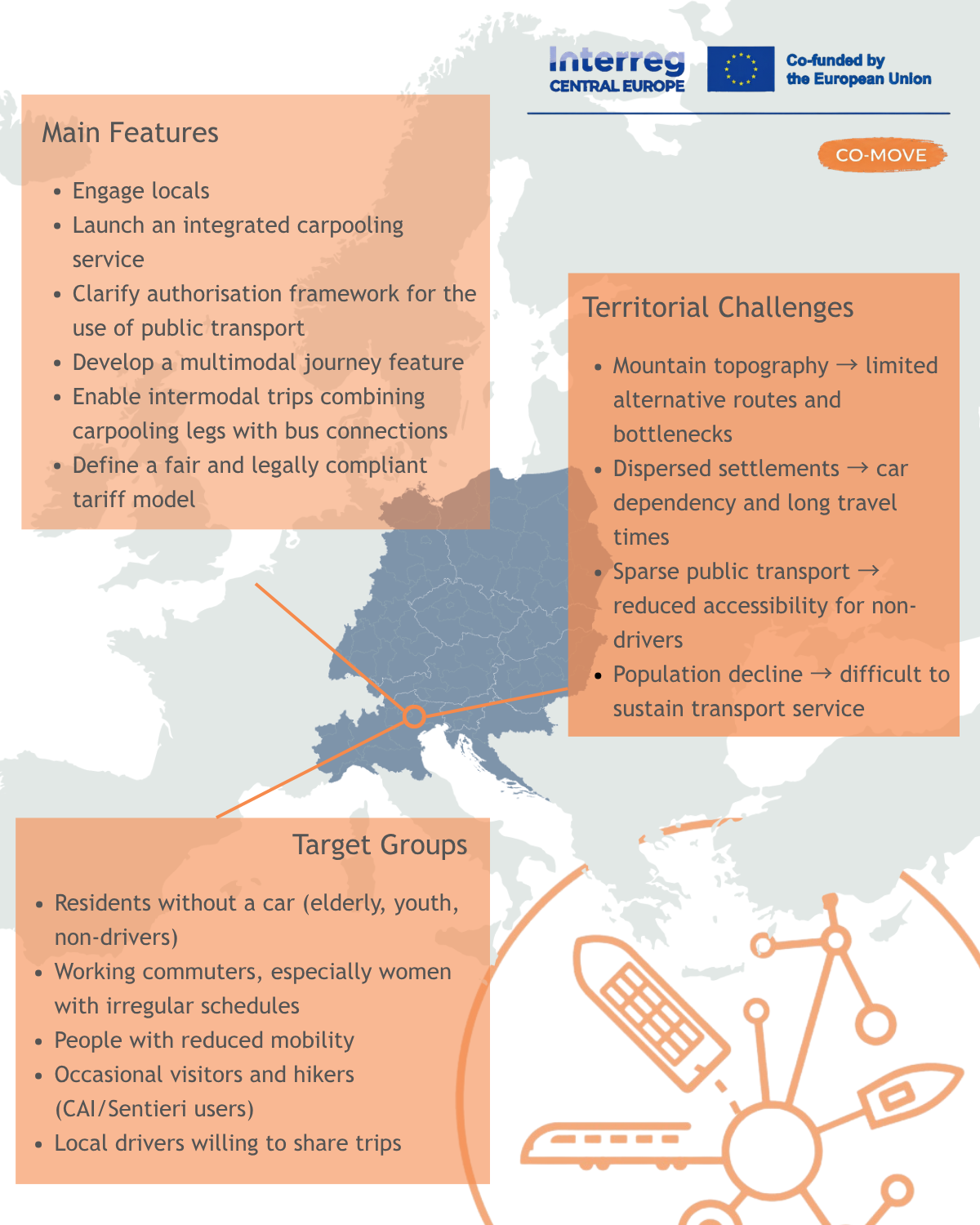
The Alpago–Zoldo pilot area is located in a mountain context in the Italian Alps, where mobility is strongly influenced by the territory’s topography, settlement patterns and demographic trends. Complex mountain terrain creates bottlenecks and limits the availability of alternative routes, while dispersed settlements contribute to high car dependency and longer travel times. Public transport services are often sparse, making accessibility more difficult for people who do not drive or do not have access to a private car. At the same time, population decline adds further pressure on the long-term sustainability of regular transport services in the area. Within this context, CO-MOVE will work to improve local accessibility by developing a carpooling service integrated into the existing DBus app. The service is intended to complement public transport, supporting more flexible and inclusive mobility options rather than competing with existing services. The pilot will focus on several target groups, including residents without access to a car, older people, young people, non-drivers, commuters — particularly women with irregular schedules — people with reduced mobility, occasional visitors, hikers and local drivers willing to share trips. Key activities will include the involvement of local municipalities, LAGs and community groups as promoters of the service; the clarification of the authorisation framework for using public transport stops as carpooling pick-up and drop-off points; the development of multimodal journey planning features; the integration of carpooling and bus connections to enable intermodal trips; and the definition of a fair and legally compliant tariff model for both drivers and passengers. Through this pilot area, CO-MOVE aims to test mobility solutions that can strengthen connections between people, places and services in mountain areas, contributing to more accessible, sustainable and community-based mobility.
Pilot Area 2 - Heart of Slovenia (Slovenia)
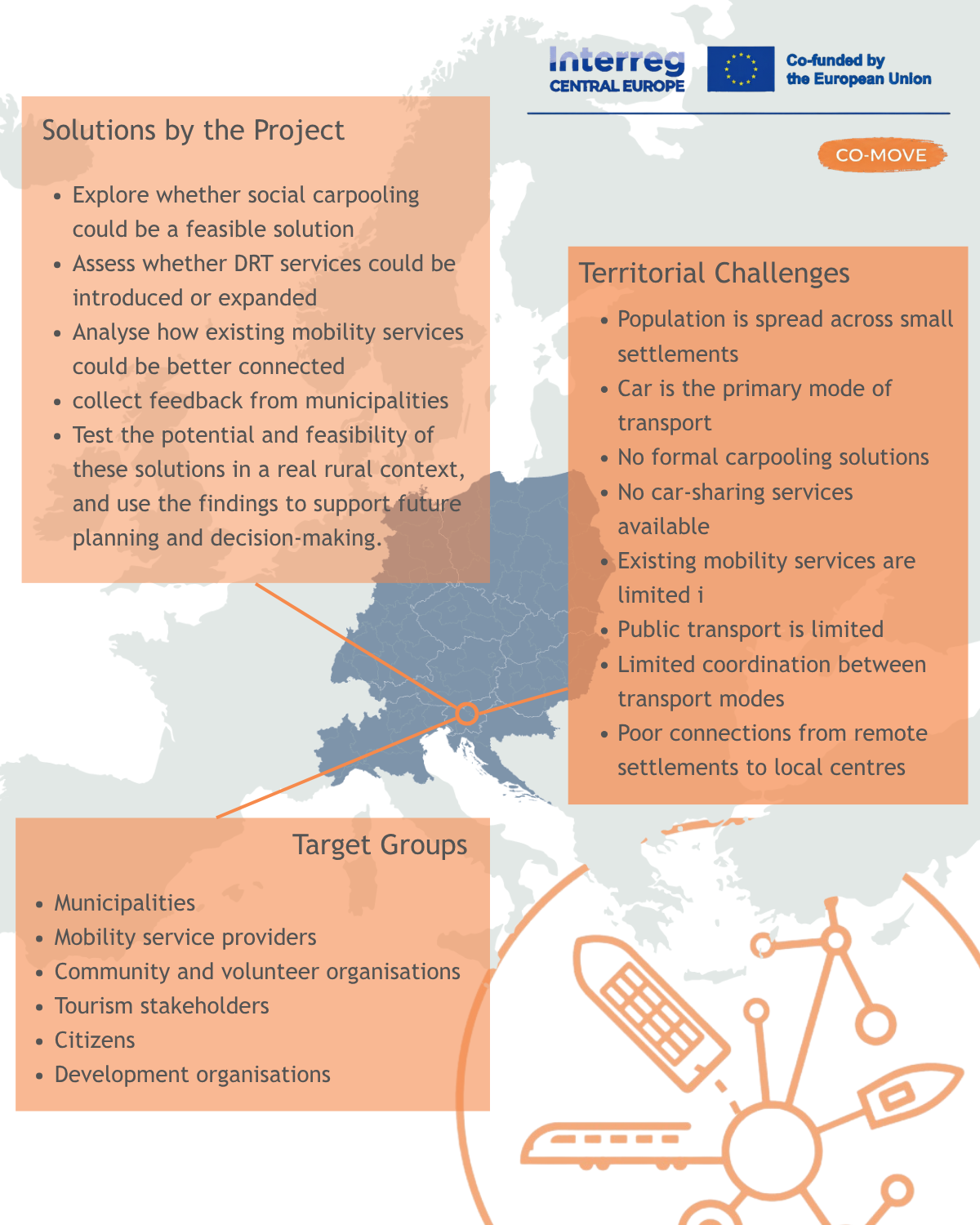
The Heart of Slovenia is a rural area where mobility is strongly influenced by the distribution of the population across small settlements and by the limited availability of public transport services. In this context, the private car remains the primary mode of transport. At the same time, there are currently no formal carpooling or car-sharing services available, while existing mobility options are limited and not always well coordinated. This creates challenges in connecting remote settlements with local centres, especially for people who do not have regular access to a car. CO-MOVE will explore whether social carpooling could represent a feasible mobility solution for the area. The project will also assess whether Demand Responsive Transport services could be introduced or expanded, and how existing mobility services could be better connected to respond more effectively to local needs. A key part of the pilot will be the involvement of local stakeholders, including municipalities, mobility service providers, community and volunteer organisations, tourism stakeholders, citizens and development organisations. Their feedback will help assess the potential and feasibility of these solutions in a real rural context. By testing flexible, community-based and better connected mobility options, the Heart of Slovenia pilot will provide useful findings to support future planning and decision-making, contributing to more inclusive and sustainable mobility in rural areas.
Pilot area 3 - Nyìregyhàza
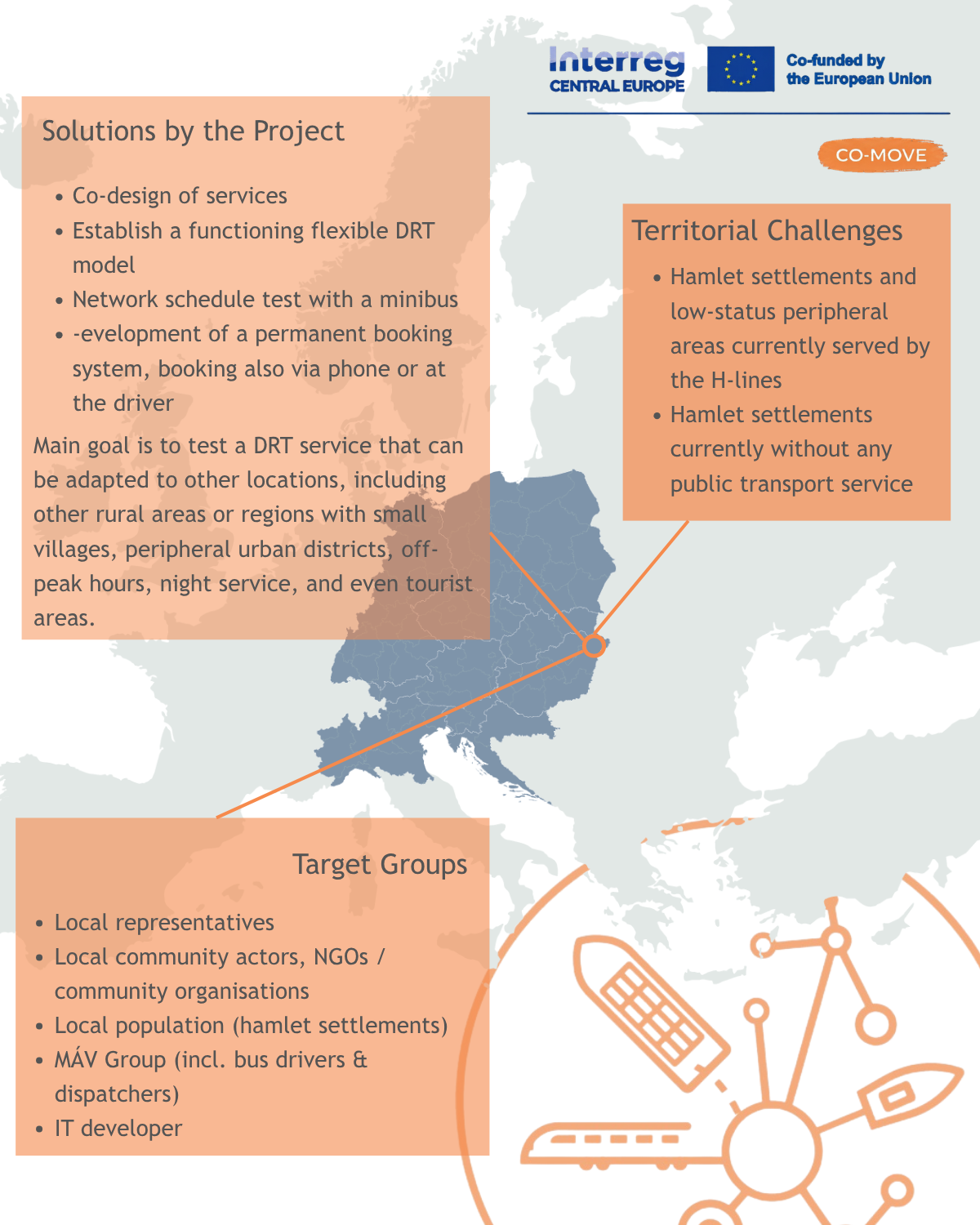
The Nyíregyháza pilot focuses on improving accessibility for residents living in hamlet settlements and peripheral urban areas, where public transport is currently limited or, in some cases, completely unavailable. These mobility gaps restrict access to essential services, employment opportunities, and social activities, particularly for people living in remote communities. Within this context, CO-MOVE will develop and test a Demand Responsive Transport (DRT) service designed to provide flexible, user-oriented mobility that complements the existing public transport network. The pilot will engage local representatives, community organisations, residents, the MÁV Group (including bus drivers and dispatchers), and IT developers in a co-design process to ensure that the service responds to local needs and can be effectively integrated into the existing transport system. Key activities include: - Co-designing the DRT service together with local stakeholders and citizens; - Testing a flexible transport model through a dedicated minibus service; - Developing a permanent booking system, allowing users to reserve trips via app, phone, or directly through the driver. Beyond the local pilot, the main objective is to validate a flexible DRT model that can be replicated in other rural and peripheral areas, small villages, urban outskirts, during off-peak and night-time hours, and even in tourist destinations, contributing to more inclusive and accessible mobility across Europe.
News
No news found
Events
CO-MOVE
The project lead partner is responsible for the content of this project website.