
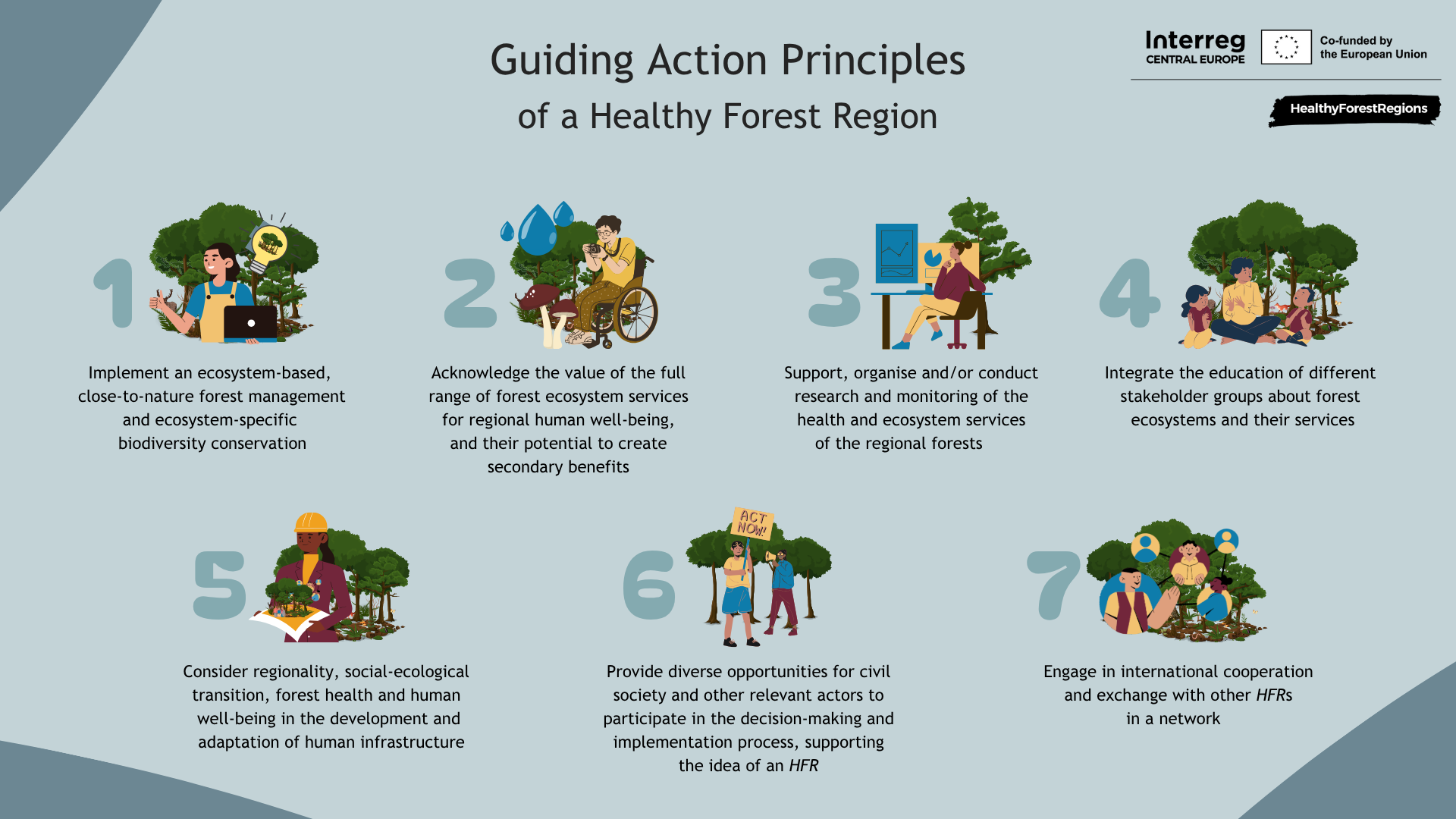
In a series of four workshops — the so-called “cupcake workshops” — we worked to define what makes a region a Healthy Forest Region. Subject to further refinement, we reached the following conclusions. Following the HFR Guiding Action Principles, a Healthy Forest Region should:
Normal 0 21 false false false DE X-NONE X-NONE
/* Style Definitions */ table.MsoNormalTable {mso-style-name:”Normale Tabelle”; mso-tstyle-rowband-size:0; mso-tstyle-colband-size:0; mso-style-noshow:yes; mso-style-priority:99; mso-style-parent:””; mso-padding-alt:0cm 5.4pt 0cm 5.4pt; mso-para-margin-top:0cm; mso-para-margin-right:0cm; mso-para-margin-bottom:8.0pt; mso-para-margin-left:0cm; line-height:107%; mso-pagination:widow-orphan; font-size:11.0pt; font-family:”Calibri”,sans-serif; mso-ascii-font-family:Calibri; mso-ascii-theme-font:minor-latin; mso-hansi-font-family:Calibri; mso-hansi-theme-font:minor-latin; mso-bidi-font-family:”Times New Roman”; mso-bidi-theme-font:minor-bidi; mso-fareast-language:EN-US;}
- Implement an ecosystem-based, close-to-nature forest management and ecosystem-specific biodiversity conservation.
- Acknowledge the value of the full range of forest ecosystem services for regional human well-being, and their potential to create secondary benefits.
- Support, organise and/or conduct research and monitoring of the health and ecosystem services of the regional forests
- Integrate the education of different stakeholder groups about forest ecosystems and their services.
- Consider regionality, social-ecological transition, forest health and human well-being in the development and adaptation of human infrastructure.
- Provide diverse opportunities for civil society and other relevant actors to participate in the decision-making and implementation process, supporting the idea of an HFR.
- Engage in international cooperation and exchange with other HFRs in a network.