
The programme began at the District Office of Lörrach, where participants were welcomed by Ulrich Hoehler with an introduction to the wider territorial context. From the outset, one message was clear: in the Basel area, cross-border cooperation is not an optional extra, but a practical necessity. Mobility, labour markets, public services and spatial planning are all shaped by the fact that the region functions across three countries.
A central part of the first morning focused on the institutional architecture behind this cooperation. Dr Frédéric Duvinage presented the work of the Trinational Eurodistrict of Basel, which plays a key role in connecting municipalities and helping partners coordinate projects across borders. His presentation demonstrated that the Eurodistrict is much more than a symbolic platform: it helps bring together planning, political dialogue and project development. The examples ranged from cross-border mobility initiatives to public-space and landscape projects, showing how cooperation can gradually move from a shared vision to visible results.
This was complemented by Dr Manuel Friesecke’s presentation on Regio Basiliensis, which offered an important Swiss perspective. His contribution highlighted that cooperation in the Basel area depends not only on relations between countries, but also on coordination within them. In the Swiss case, canton-level structures, sectoral competences and funding logics all shape how cross-border action can be organised. The presentation made clear that durable cooperation requires institutions that can translate between different administrative cultures while also demonstrating concrete benefits for the participating territories.
The French perspective was presented by Elise Lachat through the example of the Collectivité européenne d’Alsace and its Alsatian cross-border cooperation strategy. This session showed how a mainstream territorial authority can give cross-border cooperation a stable political and administrative home. Rather than treating it as a series of isolated projects, the French approach combines strategy, funding, thematic partnerships and digital tools. This helps turn cooperation into a more continuous and structured process, while also opening it up to topics such as bilingualism, culture, tourism and heritage.
In the afternoon, the group moved to Saint-Louis, where the focus shifted from institutions to services and projects on the ground. Marc Borer introduced the work of INFOBEST PALMRAIN, a one-stop advisory service that supports citizens and commuters navigating the legal and administrative differences between neighbouring countries. This session was especially revealing because it translated cross-border integration into everyday reality. For many people living in the region, cross-border life means practical questions: taxation, health insurance, social security, pensions, family benefits or employment rights. INFOBEST’s value lies in helping people find their way through this complexity and in reducing the friction caused by borders that remain legally significant even where functional integration is strong.
The visit then turned to Parc des Carrières, a major landscape project in the Saint-Louis area. Presented by Marion Préfol and followed by a site visit, this part of the programme showed how a former extraction landscape is transferred into a large public park and ecological corridor serving a densely populated border area. It was a strong example of how landscape, access, recreation and ecological restoration can be linked through long-term planning and broad partnership.
The second day, held in Basel, focused more strongly on spatial planning. Dr Sebastian Wilske presented different planning scales and tools used in the wider Upper Rhine and Basel metropolitan area. His presentation showed that cross-border cooperation cannot rely on a single method: different challenges require different instruments. Citizen-oriented services, mobility corridors, large-scale urban development and wider regional planning all call for distinct governance approaches. At the same time, they need to be connected by a shared territorial understanding.
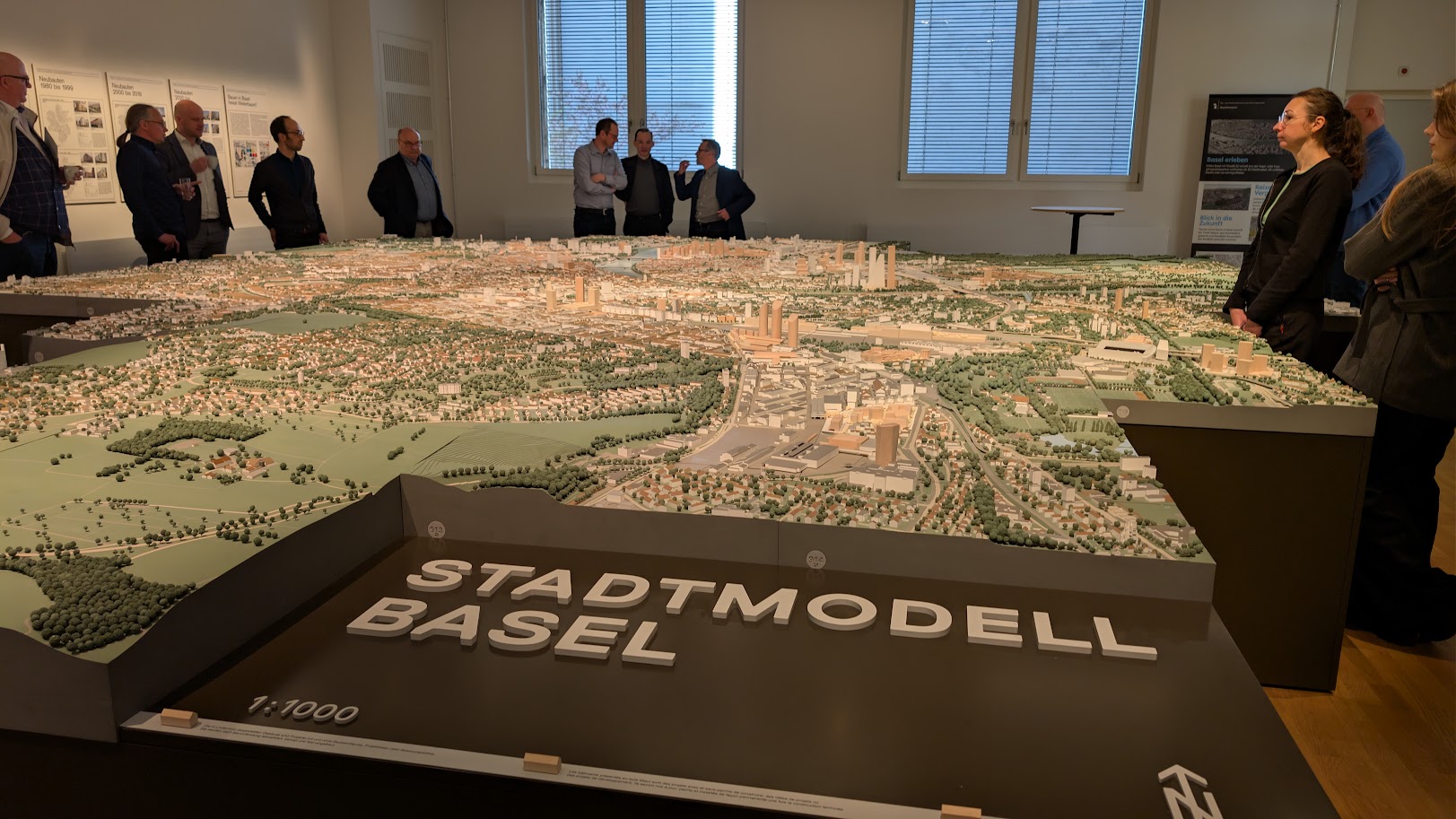
The final major thematic block of the study tour was dedicated to the 3Land project, one of the region’s most ambitious long-term cross-border development initiatives. Covering an area where Basel, Weil am Rhein, Huningue and Saint-Louis meet, 3Land aims to transform former industrial and port zones into a lively urban district. The discussions highlighted both the promise and the difficulty of such a project. Landscape, mobility and settlement development have to be planned together, while partners also need to work across different legal systems, funding frameworks and institutional traditions. After studying the huge model of the borderland, the participants visited the tri-border area, where the rehabilitation has already started.
Taken together, the study tour offered several important lessons for BorderLabs CE. First, successful cross-border cooperation depends on a layered institutional ecosystem rather than on one single actor. Second, different issues require different instruments: what works for citizen support is not the same as what works for spatial planning or metropolitan transport. Third, long-term continuity matters. Many of the most impressive initiatives in the Basel area are the result of years, and sometimes decades, of sustained collaboration. Finally, the visit showed that cross-border governance is not only about formal agreements or legal solutions. It is equally about translation: between languages, planning cultures, administrative systems and public expectations.