
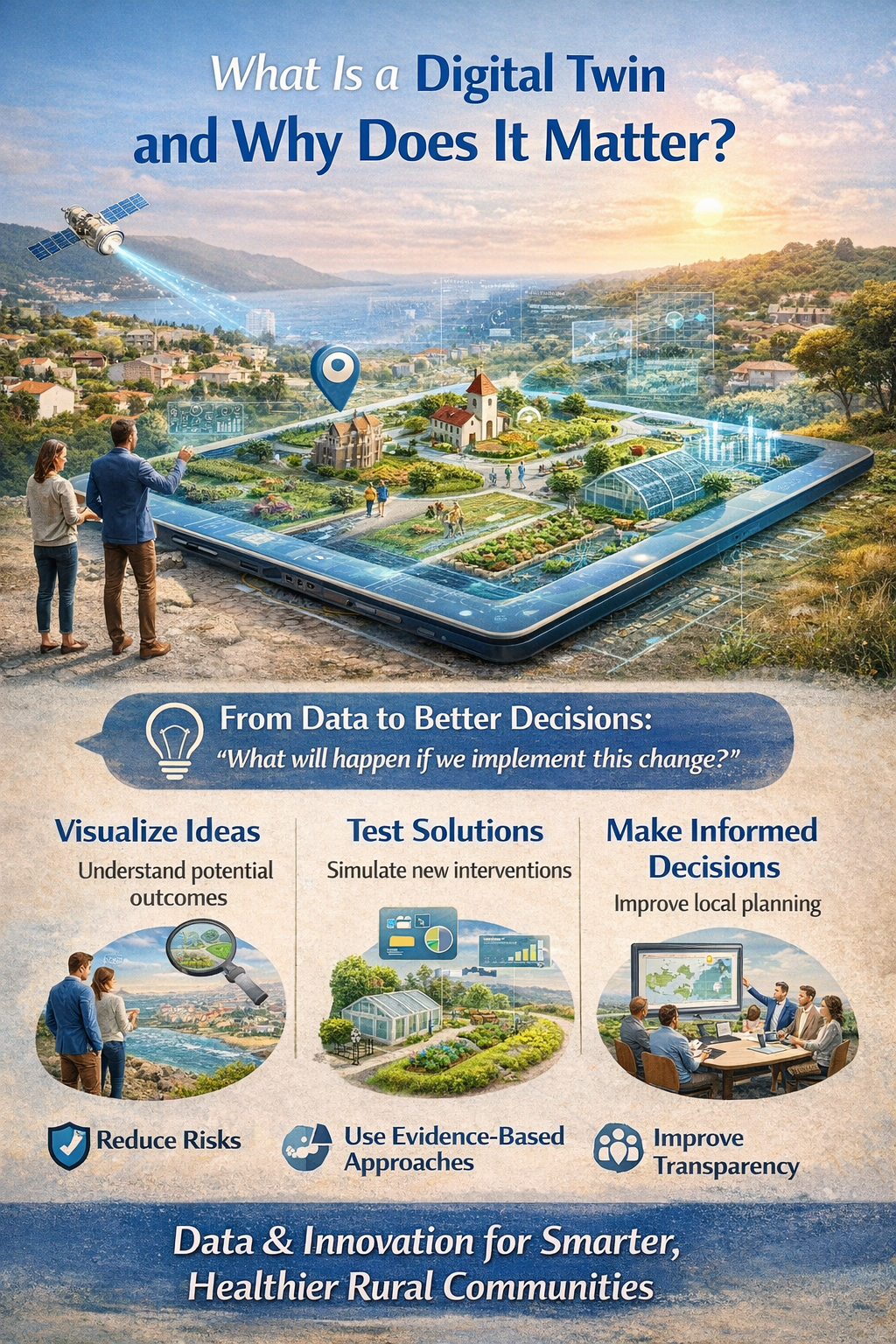
Alongside the Blue Zone approach, the BlueTwin-CE project is built on a second key pillar: Digital Twin technology.
But what exactly is a Digital Twin — and why is it so important for rural communities?
Understanding the Digital Twin
A Digital Twin is a virtual representation of a real-world environment, such as a town, neighbourhood, or infrastructure system. It is built using real data and allows users to simulate and analyse different scenarios before making decisions in the real world.
In simple terms, it helps answer the question:
👉 “What will happen if we implement this change?”
From Data to Better Decisions
By using Digital Twin technology, municipalities can test ideas in a safe, data-driven environment. For example:
- What happens if new walking routes are introduced?
- How would a community garden influence local lifestyle habits?
- Can changes in public space design improve social interaction?
Instead of relying only on assumptions, decision-makers can use simulations to better understand potential impacts.
Why Is This Important for Rural Areas?
Rural communities often face limited resources and capacity for experimentation. This makes it especially important to make the right decisions from the start.
Digital Twin technology supports this by:
- reducing risks in planning and implementation
- enabling evidence-based decision-making
- helping local authorities prioritize effective interventions
- improving transparency and stakeholder involvement
Supporting the Blue Zone Approach
In the BlueTwin-CE project, the Digital Twin is not used in isolation. It is closely connected to the Blue Zone principles.
While the Blue Zone approach defines what kind of changes are needed to improve health and well-being, the Digital Twin helps answer how and where these changes should be implemented for maximum impact.
From Innovation to Practice
In the pilot areas, Digital Twin technology will be used to support local decision-making processes and to visualize the expected outcomes of different interventions. This makes complex planning processes more understandable and accessible — not only for experts, but also for citizens and stakeholders.
By combining human-centered principles with data-driven tools, the BlueTwin-CE project aims to create smarter, healthier, and more resilient rural communities.