
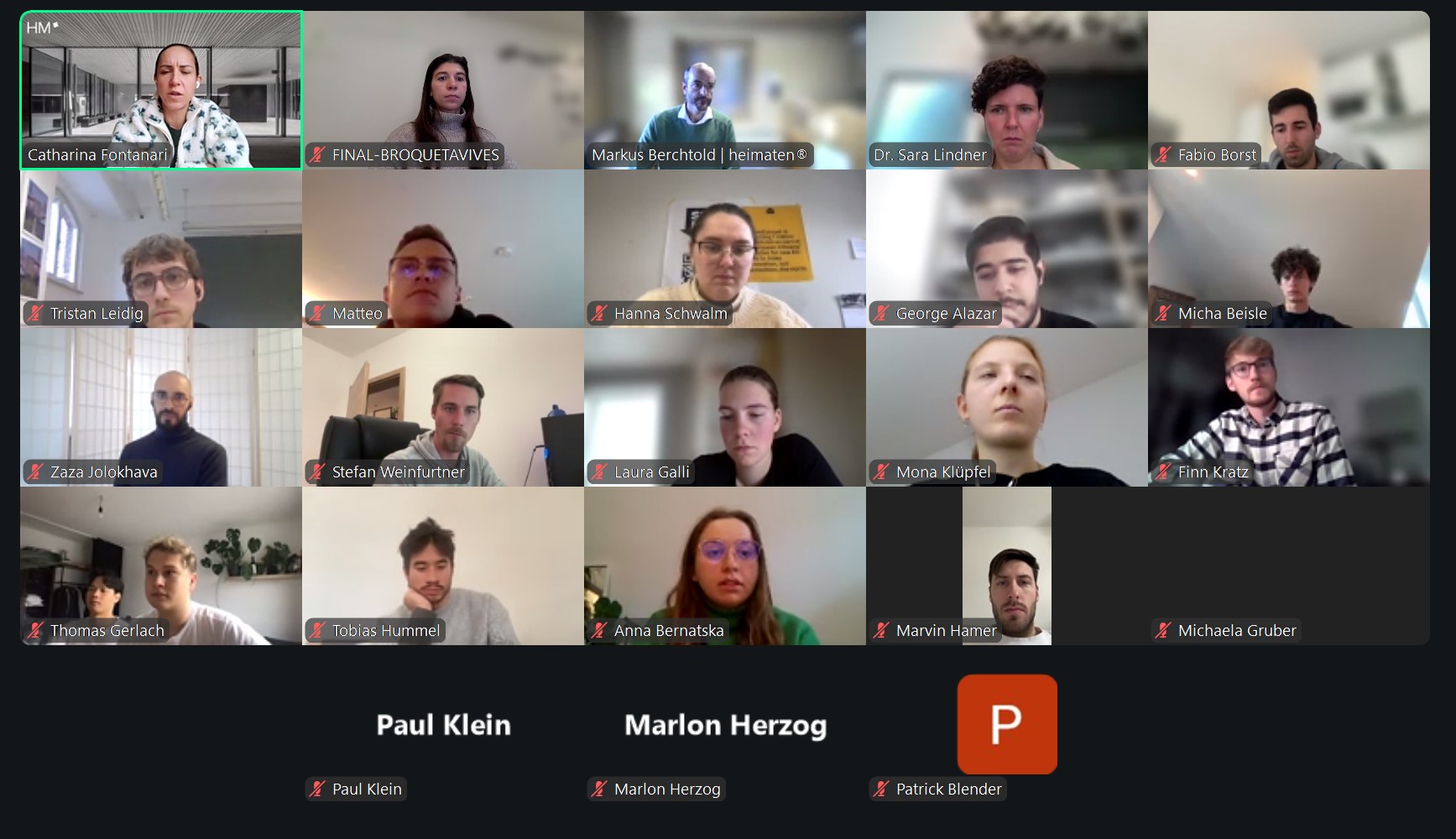
A Focus on Practical Climate Adaptation
The online workshop guided participants through the SuPeRBE Decision Making Model and several key risk assessment modules, including:
• Extreme heat impacts on buildings and population health
• Heavy precipitation risks for individual buildings
• Flood-related transport network vulnerabilities
• Drought impacts on biodiversity and the environment
Through these modules, attendees learned how to gather relevant data, analyze hazards, and apply risk categories in real-world scenarios. The training strengthened their ability to plan, supervise, and evaluate effective climate adaptation measures.
Most participants were German residents, with additional attendees from Austria. The group consisted of students, professionals from external organizations, and public authorities. This diverse group ensured a productive learning environment enriched by both academic and professional perspectives.
Hands-On Application in Schnifis
In addition to the online content, MUAS students conducted an on-site Risk-Based Evaluation (RBE) exercise in Schnifis. Using the SuPeRBE RB and RN tools, they assessed two selected buildings and the surrounding neighbourhood to test the practical application of the methodology. This field activity provided valuable insight into how digital risk assessment tools translate into concrete local analysis.
Interactive Learning
The workshop format offered opportunities for active engagement, with participants discussing data needs, hazard assessment techniques, and multi-scalar decision-making. No specific improvements were suggested, indicating a smooth and well-structured training experience.