
The Mission CE climate project, co-financed by the EU INTERREG Central Europe programme (Standard type projects), under priority axis 2.2. – ‘Increasing resilience to climate change risks in Central Europe’, addresses climate change challenges such as heat waves, floods, urban heat islands and water scarcity.
The Brač pilot project – Managing water scarcity in the Island of Brač aims to support communities to respond to these processes in a coordinated manner and build lasting systems and capacities for climate change resilience. Within the pilot project, the local public company (Vodovod Brač) received equipment, technical assistance and support in introducing better monitoring pracrices for detection and prevention of loses in the network.
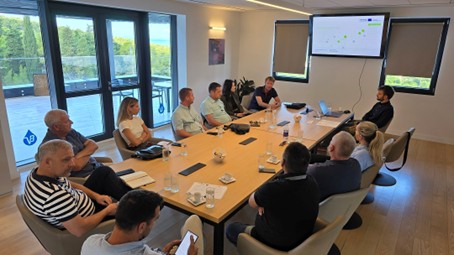
In September, Brač hosted its local Sustainability festival. The event was also an opportunity to present the results of the pilot activities, the local community climate missions and the innovative solutions developed through the project. Special attention was paid to the involvement of citizens, whose active participation contributes to the long-term resilience of local communities.
‘The main goal is to support Central European communities to become resilient to climate change and enable them to respond in a coordinated manner to processes caused by climate change. Namely, the island of Brač recorded significant water losses in the water supply system, which was recognized as one of the main challenges. This project shows how energy efficiency and responsible water supply management can go hand in hand. This pilot activity and the results obtained are a good example of practice that we want to show and make applicable to other water service providers in the county and beyond.’ said Martin Bućan from Split-Dalmatia County.
The project also includes the Municipality of Sutivan as a partner, where reviews of existing measures from the SECAP (Climate Change Adaptation Plan) are being carried out and new activities that contribute to the climate resilience of the local community are being identified. This creates concrete examples of good practice that can be used by other local government units.
‘In addition to local authorities, the project is also aimed at citizens. A special Guide for Households has been created, which provides residents of the island and the county with practical advice on reducing energy and water consumption.
The Director of Vodovod Brač, Petar Anibalović, pointed out that in the last few years the company has invested significantly in the modernization and development of the water supply network with the aim of reducing losses and ensuring safe drinking water for citizens.
‘Since my arrival, we have formed the water loss detection department, managed by Mr. Petar Matulić, and today we can proudly say that losses have been reduced to 20 percent, while previously they were 26 percent. This is a great progress because reducing losses also means lower electricity consumption, which was one of our main goals,’ said Anibalović.
Ilja Drmač from the Hrvoje Požar Energy Institute presented concrete measures how local communities can increase resilience to climate risks and raise citizens awareness of the need for adaptation. The focus is on reducing losses in the water supply system, which is especially important in conditions of drought risk, which pose a threat to both the population and tourism.
After just four months of using the new equipment, losses have been reduced by 10 to 12 percent. ‘The greatest value of the project is that Vodovod Brač established a special team for water loss detection, which is rare in Croatia. This shows that the company has recognized the importance of a systematic approach and now has people who deal with the problem of losses on a daily basis,’ Drmač emphasized.
Petar Matulić, B.Sc. in Civil Engineering and Head of the Losses Department at Vodovod Brač, pointed out that company received equipment worth 70 thousand euros to reduce losses in the water supply system. ‘We received 15 flow meters, 10 forest loggers and one portable ultrasonic flow meter. The equipment allows us to precisely monitor night-time consumption and quickly detect breaks in pipelines, said Matulić. Thanks to the new devices, Vodovod Brač managed to reduce losses to 20 percent during the verification period, which ranks it among the best in Croatia. ‘Our goal is to further reduce losses to 15 percent, which could rank us among the best in the country. This also means lower energy consumption and lower costs for users,’ concluded Matulić.