
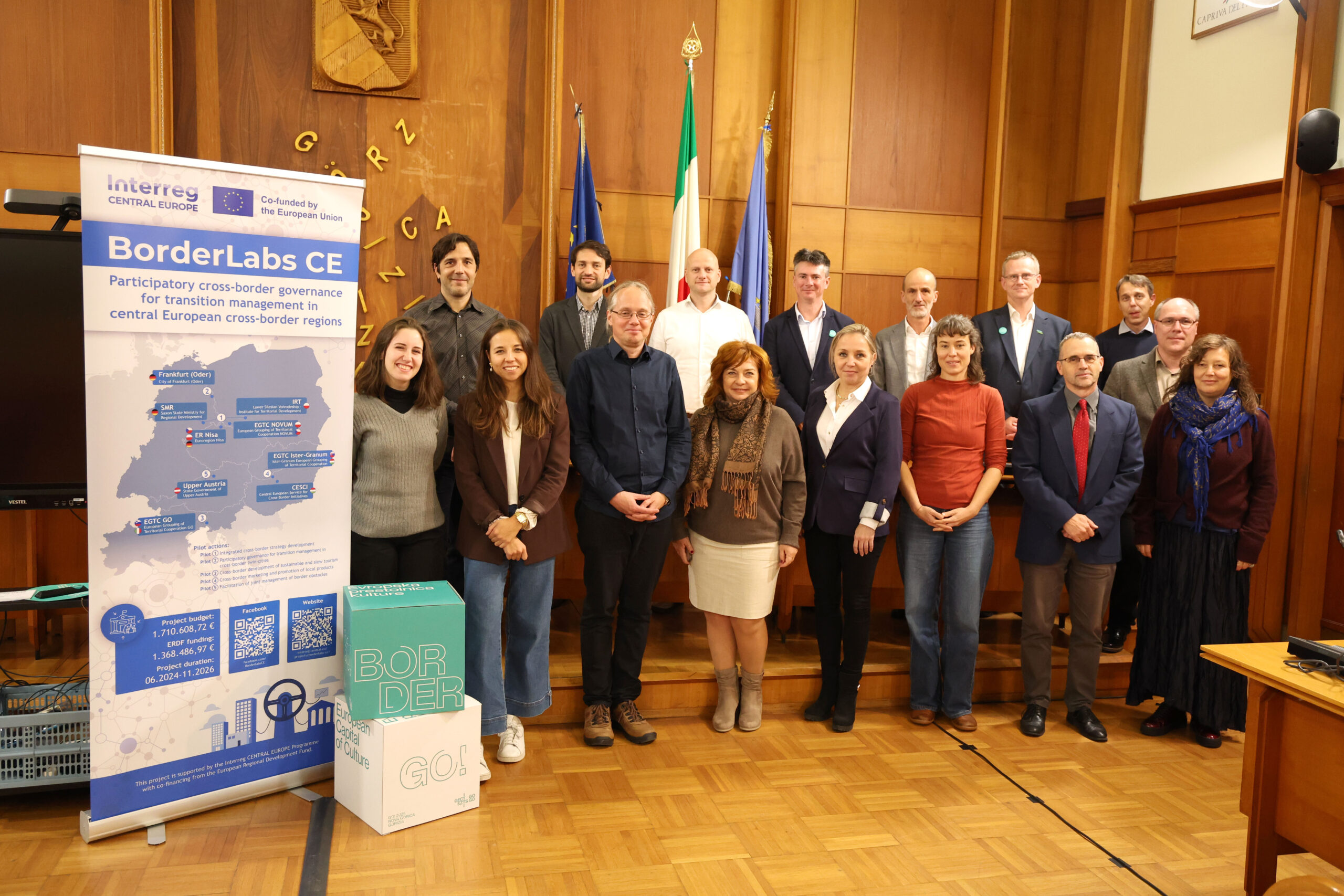
The BorderLabs CE project partners convened in Gorizia on 21–22 October, alongside its Slovenian twin town, Nova Gorica. As the European Capital of Culture in 2025, the twin towns hosted numerous cultural events, providing a unique backdrop for discussions on cross-border participatory governance.
The workshop on 22 October, held in the former Provincial Palace, focused on participatory governance. Daniele del Bianco, director of the Institute of International Sociology of Gorizia (ISIG), outlined participatory and deliberative democracy, emphasizing participation as an engine of legitimacy while highlighting challenges in engaging citizens. Krisztina Keresztély (Comparative Research Network, Berlin) summarized methods facilitating participatory governance from preparation to action research. Peter Ulrich (University of Potsdam) addressed cross-border governance challenges, particularly the visibility of cross-border structures, proposing pragmatic methods for citizen engagement.
In the second panel, best practices were showcased. Irene Covi (Interreg Italy-Austria) presented the cross-border CLLD tool applied in four regions. Friedrich Veider detailed the HEurOpen Cross-Border CLLD initiative, integrating three LEADER LAGs and involving local actors via thematic focus groups. Nicole Zambanini (Tyrol South-Tyrol Trentino EGTC) introduced the first European cross-border Citizens’ Council, which engaged citizens in design workshops and led to practical outcomes, such as the Euroregion ticket for unrestricted public transport within the EGTC.
The third panel highlighted BorderLabs CE pilot activities.
· EGTC GO experts (Giulio Selvazzo and Mojca Stubelj) presented participatory aspects of the European Capital of Culture project, including a web application, cross-border youth group, and joint events of Italian and Slovenian artists. The small project fund supported 56 ECoC projects targeting diverse societal groups in the border area.
· Frankfurt/Oder and Słubice shared their long-standing experience in citizen participation. Since 2009, the cities have organized the Future Conference, citizens’ picnics, political education months, and dialogue forums, with the BorderLabs CE project extending these practices.
· The Neisse-Nysa-Nisa Euroregion effectively engaged citizens through three cross-border small project funds, involving over 160,000 people in more than 1,000 small-scale projects.
· Ister-Granum EGTC focused on cross-border retail of local products, engaging citizens in an online survey to gather needs and expectations. Local producers, market operators, shopping communities, and municipalities participated in a regional stakeholder group to guide the pilot.
· Katja Rosner representing Pilot 5 and Upper Austria, presented methods to engage citizens in addressing cross-border legal obstacles, using Padlet for stakeholder input. The pilot activity narrowed its focus to cross-border labor mobility (Austrian-Bavarian) and forestry (Austrian-Czech). The first information forum for cross-border commuters is scheduled for November.
On 21 October partner meeting, the project partners reviewed pilot achievements and next steps, including upcoming study tours to Basel, Maastricht, and Copenhagen. Participants also visited key local sites, including the new cycle bridge over the Isonzo/Soča River, the renovated EPIC centre, and the European square revitalized by EGTC GO under a cross-border integrated territorial investment.
Further information and photodocumentation: https://budapest.cesci-net.eu/en/borderlabs-ce-partner-meeting-gorizia/