
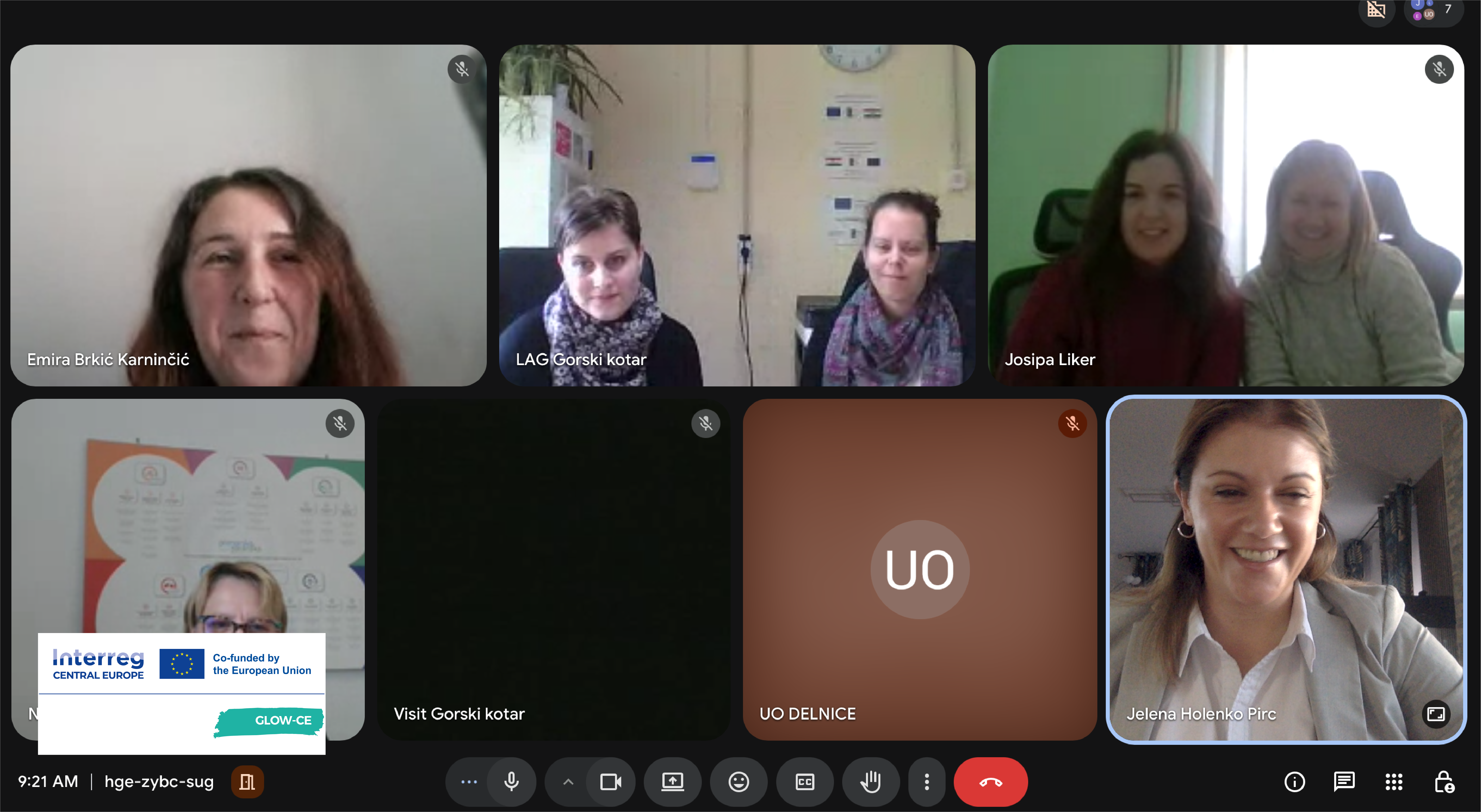
The focus group gathered seven organisations whose work places them at the heart of the local support system – the institutions entrepreneurs typically turn to when starting or growing a business. Participants included LAG Gorski Kotar, the Skrad Business Incubator (PINS), the regional development agency PRIGODA, the Rijeka Development Agency (PORIN), the Tourist Board of Gorski Kotar and the Association of Craftsmen Delnice, Čabar and Vrbovsko. The discussion was complemented by an additional individual meeting with STEP RI, the Science and Technology Park of the University of Rijeka, to deepen insights into innovative approaches in education and entrepreneurial support. The event was also closely linked to the WP1 survey, serving as a further channel to engage organisations in the data collection process.
Through a moderated and participatory discussion, participants exchanged practical experiences and reflected on the current state of the entrepreneurial ecosystem, the accessibility and quality of support services, and the specific challenges facing women in business. A consistent message emerged: while Gorski Kotar has a diverse range of institutions and support programmes, the system remains fragmented and insufficiently coordinated, which limits its visibility and its actual reach among end users in rural areas. These challenges are further shaped by the specific realities of entrepreneurship in a rural and mountainous region such as Gorski Kotar, where geographical dispersion and distance from services can place additional demands on entrepreneurs and make access to support more difficult.
Participants also highlighted that lower engagement among potential entrepreneurs should not be read simply as a lack of interest. Feelings of uncertainty, fear of entrepreneurial risk and a tendency to stay within familiar environments all play a role – pointing to the need to strengthen trust, motivation and a sense of security alongside the services themselves. Many users, they noted, struggle to find a clear entry point to support and often receive incomplete information. A central recommendation was therefore the creation of a centralised information point or advisory centre, potentially supported by a modern, AI-based digital tool that could offer reliable, up-to-date guidance in a more accessible and less intimidating way.
On the specific situation of women, participants did not identify significant formal barriers specifically targeting women, but highlighted several structural and cultural challenges: balancing professional and private life, lower confidence in starting a business, under-representation in sectors such as technology and innovation, and continued concentration in more traditional fields. They also underlined a wider lack of strategic direction in the region, including limited market-needs analysis and weak coordination between institutions, and called for more flexible, practical and demand-driven training formats, better use of digital communication channels, and stronger networking and collaboration across the support system.
The insights gathered during the focus group will feed directly into the next steps of GLOW-CE, informing the design of pilot actions and the preparation of the regional action plan. The aim is clear: to move beyond fragmented provision towards a more effective, accessible and inclusive support system for women’s entrepreneurship in rural areas – built, in line with the project’s co-creation approach, together with the people it is meant to serve.