
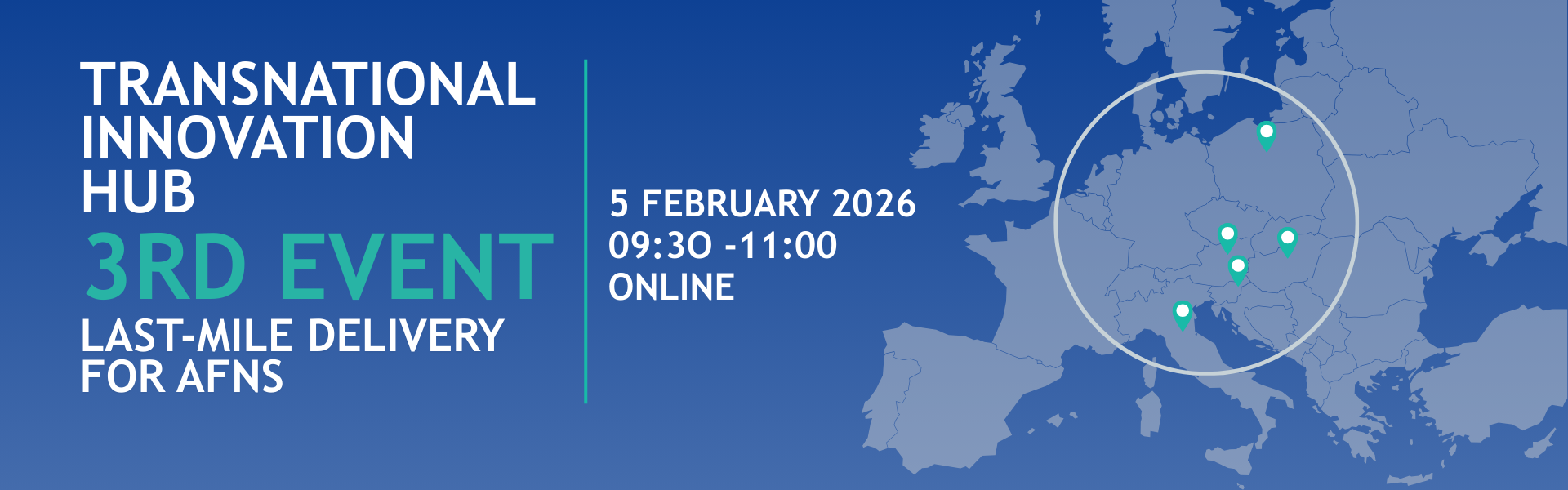
On 5 February 2026, the third meeting of the Food4CE Transnational Innovation Hub took place online, bringing together the five Food4CE Regional Innovation Hubs across Central Europe – Slovenia (ORbITaLA), Austria (Austrian Food Connective), Italy (Localog), Poland (PULS) and Hungary (Food4Health Budapest) – to explore role last-mile delivery as a key enabler for Alternative Food Networks (AFNs).
Building on the kick-off meeting and the second meeting focused on digitalisation of AFNs, this third and last event before the end of the project provided a valuable opportunity to share knowledge, reflect on lessons learned and exchange experiences from the different FOOD4CE Innovation Hubs related to last-mile delivery practices supporting Alternative Food Systems.
The meeting was opened by Riccardo Maratini (OpenENLoCC), who highlighted the role of the Transnational Innovation Hub as a collaborative space for cross-border knowledge exchange and innovation within Alternative Food Networks in Central Europe. He also emphasised the relevance of last‑mile delivery for AFNs due to its multifaceted nature, comprising different aspects for its implementation (logistics, coordination, perishability, regulations, cold chain, small batches, trust, cost‑sharing).
Session focus: Last-mile delivery best practices
The session introduced the topic of last-mile delivery, a key yet still evolving dimension for the development of AFNs, which work on different levels depending on their regions. Three best practices were presented from Hungarian, Austrian and Slovenian Innovation Hubs respectively.
Dr. Géza Hitka from MATE – Hungarian University of Agriculture and Life Sciences presented an innovative solution to implement effective last-mile delivery through the mobile-app service SET – Shop Every Time, developed with Cibus Hingaricus, that developed a fully automated shop container operating 24/7 by using a robot order picker to prepare orders to customers. The container, with a storing capacity of up to 7,000 items, is equipped with a solar‑powered with grid backup, cooled chambers for dairy products. The first demo model of the container has been deployed in the university parking zone in Budapest, while a second updated version is going to be inaugurated in another campus of MATE University in Hungary.
David Strauß (University of Applied Sciences of BFI Vienna) focused on the relevance of parcel lockers as an innovative tool to optimise last-mile delivery food supply chain, particularly presenting Next Box and Rosy’s use of parcel lockers as best practices in Vienna and other Austrian regions.
Maršenka Marksel (University of Maribor) presented Rifuzl Autonomous Shop, a self-service micro-shop solution for neighbourhood in Ljubljana with around 250 products from local producers. Some of the features of this shop are bulk deliveries, customer‑driven last‑mile and a scalable low‑tech model replicable in different contexts.
Afterwards, the focus of the discussion moved on the identification of criticalities in each AFN on five main macro-topics in last-mile delivery: coordination of multi-actor logistics, infrastructure & equipment; digitalisation and IT gaps, flexibility and adaptability of delivery; cost sharing and economic feasibility.
In the Slovenian AFNs, lack of trust and coordination through a neutral platform, absence of cooled lockers and share logistics infrastructure and high unit costs were among the main issues local food operators have to face.
In Austria, AFNs are grouped into advanced, single‑provider, and self‑service users, lacking a collaborative logistics approach.
In the case of the Italian AFNs, both physical (lack of proper infrastructure and expensive electric vehicles) and non-physical (limited digital presence and regulatory barriers for shared transports) are present.
In Hungary there are legal and tax constraints for automated systems, but also a cultural hesitation towards cooperation with other operators.
While there’s a growing trend towards AFNs and collaboration, Polish local food operators still lack of proper cooled infrastructure and digital tools that could be improved through public subsidies.
After gathering all the inputs from the AFNs representatives, Riccardo Maratini highlighted the achievements made by the project consortium and emphasized the important work carried out by partners, outlining how the FOOD4CE platforms – the Knowledge Transfer Platform and Matchmaking Platform – will still operate after the upcoming end of the project.
FOOD4CE partners are signing a Memorandum of Understanding to continue their efforts to keep contributing to keep active the Regional Innovation Hubs and the Transnational Innovation Hub beyond the project lifetime, while external stakeholders such as local, national and transnational associations and networks, are invited sign a Letter of Intent to contribute to promote the two platforms in the next years.
Save the date: FOOD4CE Consortium will hold a hybrid-mode Final Conference at the University of Maribor in Slovenia on 26 February 2026 together with relevant best practices from local AFNs. Check out the agenda and register to join us!