
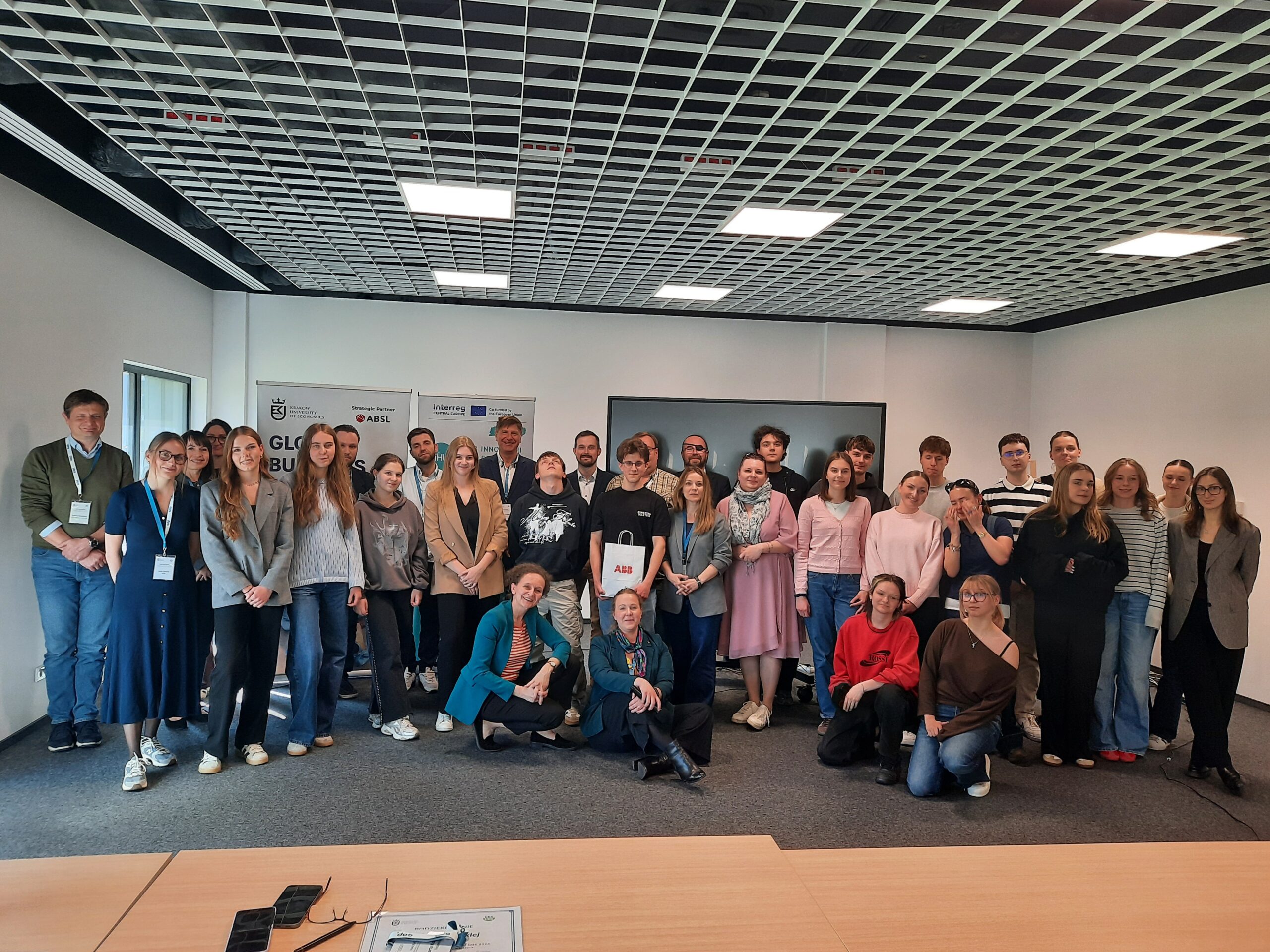
Hackathon GBS 2026 has successfully come to a close, leaving behind a strong impression of creativity, entrepreneurial energy and collaboration. Over the course of the event, students of the Krakow University of Economics worked intensively on developing their own business ideas, supported by mentors from the Municipality of Krakow and major international companies operating in Krakow, including Heineken, ABB, Zurich Insurance, Genpact, Cisco and TE Connectivity.
The final day of the hackathon brought together 16 teams, each of which presented and refined its business concept under the guidance of experienced mentors. The ideas developed during the event were remarkably diverse, innovative and ambitious. Participants showed not only creativity and fresh thinking, but also a strong ability to identify real challenges and respond to them with practical, future-oriented solutions.
What made Hackathon GBS 2026 particularly valuable was its collaborative format. Students had the opportunity to work directly with professionals from business and public administration, receiving practical feedback, inspiration and support at every stage of the process. This created an environment in which ideas could be tested, improved and challenged in a constructive way. It also allowed participants to experience entrepreneurship not as an abstract concept, but as a dynamic process of problem-solving, teamwork and value creation.
The event proved to be a great success thanks to the dedication and excellent work of its organisers, Dr Agnieszka Pacut and Anna Mirzyńska from the Department of Public Management. Their commitment was essential in creating a well-structured and engaging event that combined academic knowledge, practical mentoring and entrepreneurial experimentation. The support of mentors from the corporate sector also played a crucial role, providing both organisational and substantive input that significantly enriched the participants’ experience.
An important contribution also came from the Municipality of Krakow, whose involvement added strong institutional support to the event. The presence of city representatives during the final part of the hackathon highlighted the value of connecting academia, local government and business in order to support young talent and entrepreneurial development.
Hackathon GBS 2026 also fits closely with the broader goals of the TASK4ISI project and its focus on inclusive entrepreneurship. One of the key aims of TASK4ISI is to encourage and support young people in entering the world of entrepreneurship by strengthening their skills, building confidence and creating spaces where ideas can grow into real initiatives. In this sense, the hackathon was much more than a student competition or workshop. It was a practical example of how young people can be actively included in entrepreneurial ecosystems and supported in turning their creativity into action.
Inclusive entrepreneurship is about opening access, creating opportunities and ensuring that talent and motivation can be transformed into meaningful ventures. Events such as Hackathon GBS 2026 show how important it is to invest in young people, give them room to experiment and connect them with experienced stakeholders who can guide and encourage them. The innovative potential of younger generations does not only lie in their ability to generate new products or services, but also in their openness, adaptability and readiness to approach social and economic challenges from new perspectives.
The success of Hackathon GBS 2026 clearly demonstrated that when universities, public institutions and business actors work together, they can create a powerful environment for learning, innovation and entrepreneurship. It also confirmed that young people have both the imagination and the determination to shape solutions that are relevant, responsible and promising.
This publication has been developed within the CE0200771 TASK4ISI project, supported by the Interreg CENTRAL EUROPE Programme with co-financing from the European Union. Its content is the sole responsibility of the authors and the project partnership and does not necessarily reflect the views or positions of the Interreg CENTRAL EUROPE Programme, its programme bodies or the European Union. Neither the programme authorities nor the European Union can be held responsible for any use that may be made of the information contained herein.