
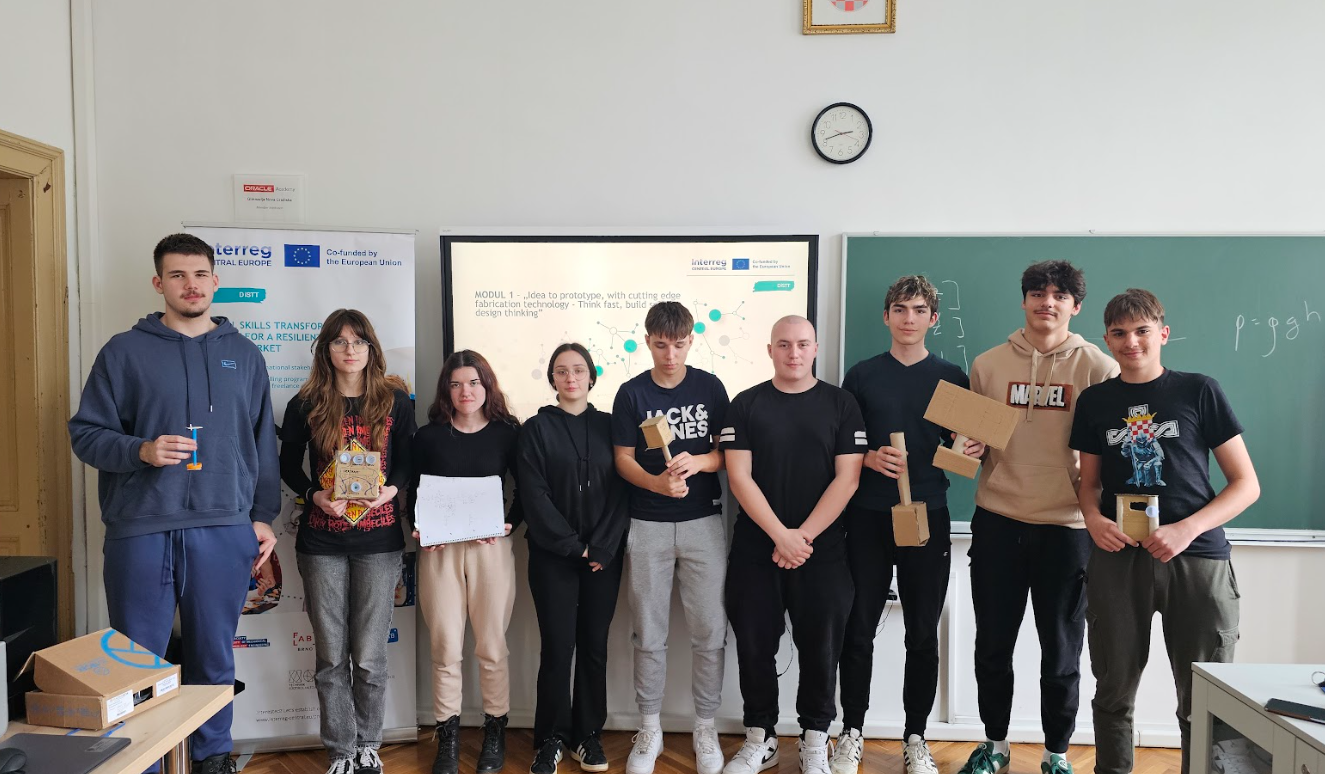
FabLab Zagreb delivered these activities to introduce students to digital fabrication tools, familiarise them with the goals of the DiSTT project, and demonstrate how such approaches can support inclusion and engagement, particularly in schools located in remote areas and among less privileged groups. A strong emphasis was placed on building creative confidence, enabling students to trust their ideas, actively participate in the learning process, and approach problem-solving with greater independence and initiative.
The programme began with Module 1: Idea to Prototype with Cutting-Edge Fabrication Technology: Think Fast, Build Smart – Design Thinking, implemented in Matija Mesić High School and Nova Gradiška High School.
During the workshops, students were introduced to the fundamentals of design thinking as a structured approach to identifying problems and developing solutions. Through guided discussions and real-life examples, they explored how ideas emerge and how they can be shaped into meaningful concepts. Working in pairs or small groups, participants defined their own problems, identified target users, and developed initial solution ideas using tools such as morphological matrices, requirement lists, and functional decomposition.
In the final phase, the focus shifted to rapid prototyping. Students were challenged to transform their ideas into physical models within a limited timeframe, using waste and secondary materials. This hands-on task encouraged quick thinking, collaboration, and practical application of previously developed concepts. Each group then presented their solution, clearly explaining the problem, their approach, and the outcome.
Through these activities, students successfully completed the first step from idea to prototype. They gained new experience, developed practical and communication skills, and built confidence in presenting and shaping their own ideas. In the upcoming modules, they will continue to develop their skills and expand their knowledge through the DiSTT project.