
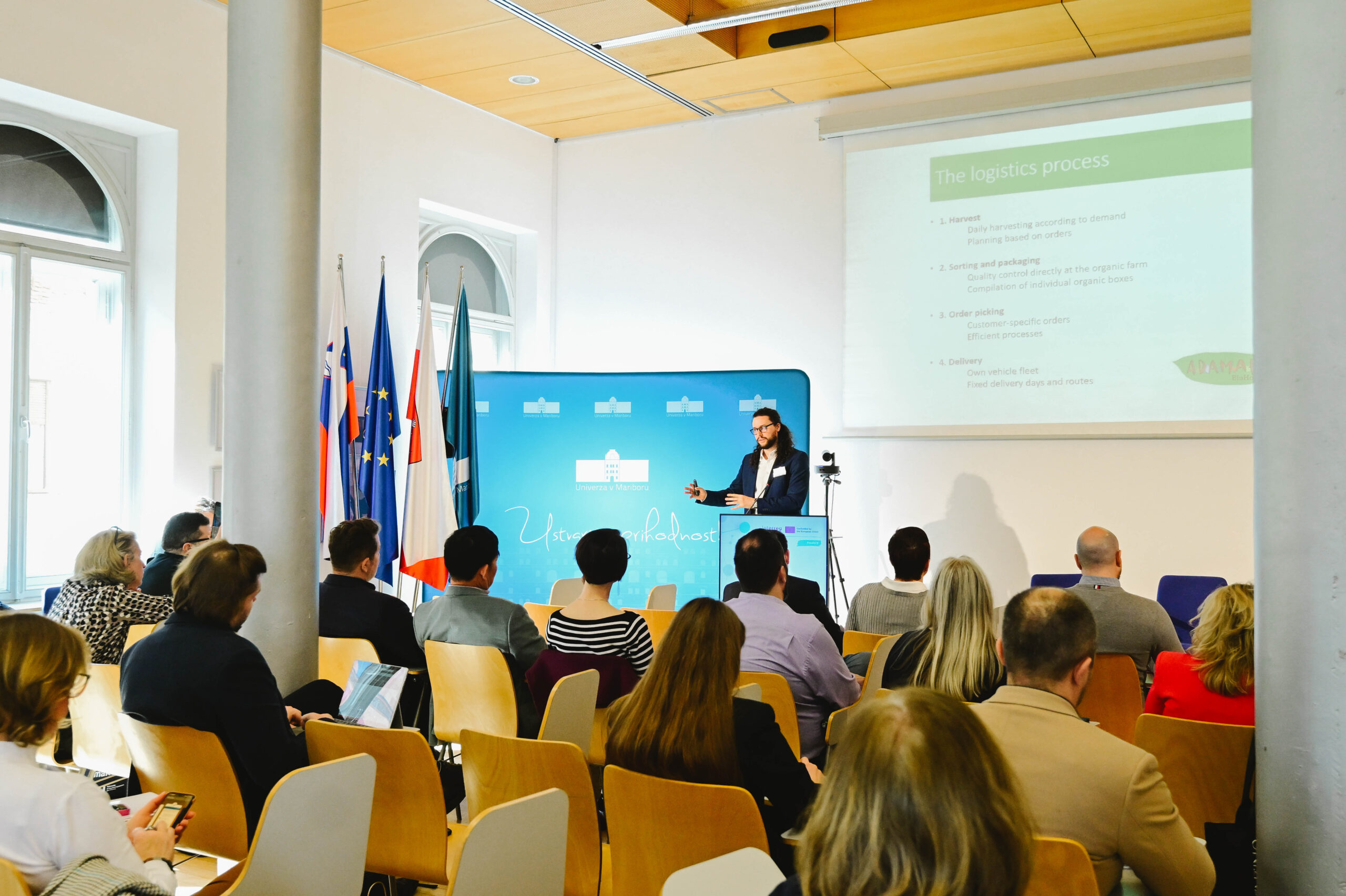
Maribor (Slovenia), 26 February 2026 – On 26 February 2026, the Food4CE Final Conference, titled “From Best Practices to Policy – Advancing Logistics and Collaboration in Alternative Food Networks”, brought together producers, logistics operators, policymakers, researchers and innovation stakeholders in Maribor, Slovenia, for a high-level exchange on the future of Alternative Food Networks (AFNs) across Central Europe.
Hosted as the Food4CE project’s closing event, the conference marked the culmination of three years of transnational cooperation under the Interreg Central Europe programme. It showcased the project’s main achievements, highlighted concrete solutions developed across partner regions and outlined the next steps for sustaining their impact.
From project results to policy uptake
The conference programme highlighted Food4CE’s main achievements and their relevance for policy development and regional innovation. Sessions featured presentations of the project’s digital tools — including the Knowledge Transfer Platform (KTP) and the Matchmaking Platform (MP) — demonstrating how they support AFNs in improving logistics, strengthening cooperation and expanding market access.
Policy discussions gathered regional, national and EU representatives to explore how Food4CE findings can inform Smart Specialisation Strategies, macro-regional initiatives and future funding instruments. Speakers emphasised the importance of integrating AFNs into broader policy frameworks to reinforce resilient, sustainable and locally embedded food systems.
Real-world solutions from across Europe
A dedicated segment showcased inspiring best practices from AFNs across partner regions, presenting concrete examples of innovative logistics models, collaborative approaches and community-based food initiatives. These experiences illustrated how practical solutions developed at local level can address shared challenges and generate replicable impact across territories.
The conference also featured a forward-looking panel discussion on sustaining Innovation Hubs and scaling project results. Policymakers, practitioners and researchers discussed how to maintain the collaborative ecosystems established through Food4CE, ensuring continued exchange between producers, logistics actors, digital innovators and public authorities.
Certificates of Excellence awarded to outstanding AFNs
One of the highlights of the event was the Certificates of Excellence ceremony, recognising selected Alternative Food Networks for their innovative and impactful practices aligned with the project’s five Best Practice Criteria.
Among the awardees, Slovenia was represented by Kmetijska zadruga Rače z.o.o., recognised for its strong local focus, and Krapše, d.o.o., honoured for its advanced logistics approach.
From Poland, Frymark received the award for local focus, while Wiejska e-skrzynka was recognised for excellence in digitalization.
Hungary’s selected AFNs included Cibus Hungaricus, awarded for digitalization, and Capriovus Kft., acknowledged for its achievements in sustainability.
Austria was represented by ADAMAH BioHof (Advanced Logistics and Digitalization) and ROSY’S (Advanced Logistics, Digitalization, Local Focus and Sustainability).
Italy’s selected AFNs included Arvaia, awarded for Sustainability, Local Focus and Transparency, and Furgoncino Solidale, acknowledged for its achievements in Advanced Logistics.
The awards highlighted how diverse AFNs are successfully addressing logistical, environmental and market challenges while strengthening regional food ecosystems.
A launchpad for future collaboration
Rather than serving solely as a closing event, the Final Conference was conceived as a launchpad for future action. Participants stressed that Food4CE’s greatest legacy lies not only in its tools, methodologies and policy recommendations, but also in the strong transnational network created among stakeholders.
Speakers highlighted that sustaining this cooperation will be essential to keeping Alternative Food Networks at the centre of regional development strategies and enabling them to adapt to evolving economic and environmental challenges. In this context, the project’s key assets will remain active beyond its duration: the Knowledge Transfer Platform and the Matchmaking Platform will continue supporting AFNs, while the local and Transnational Innovation Hubs will carry forward collaboration, knowledge exchange and innovation across regions.
Partners reaffirmed their commitment to building on these foundations, ensuring that the tools, networks and partnerships developed through Food4CE continue to drive the transition towards more resilient, sustainable and cooperative food systems in Central Europe.