
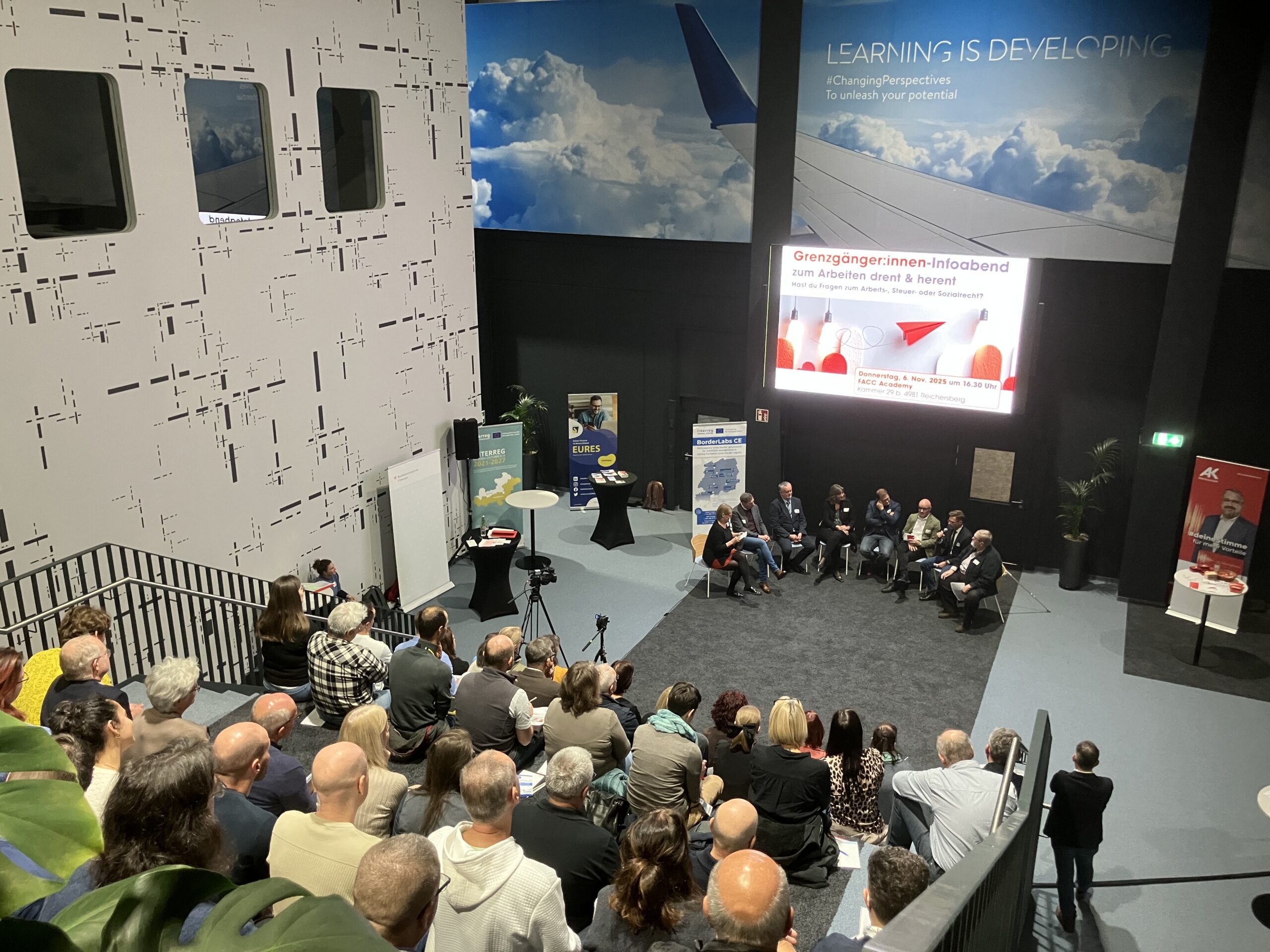
Cross-Border Information Evening in Reichersberg Draws Strong Interest
Upper Austria–Lower Bavaria Border Region in Focus: Working “Drent & Herent”
Reichersberg, 6 November 2025 — More than 140 people joined the information evening “Arbeiten drent & herent” (“Working here and there”), held at the FACC Academy in Reichersberg, to learn about the realities of cross-border employment in the Upper Austria–Lower Bavaria region. With nearly 90 participants attending in person and another 50 following online, the event highlighted the growing importance—and complexity—of cross-border work.
Participants included employees and HR managers from major companies such as FACC, Fill, EV Group, and Wacker Chemie, as well as representatives of small enterprises, healthcare providers, and public institutions. Roughly half of those attending came from Austria and half from Germany—an even balance reflecting the region’s dynamic labour exchange.
While in past decades most commuters travelled north to work in Bavaria, the trend has begun to even out. Thanks to the rapid economic development of major companies in the Innviertel region, and increasingly competitive wages, more and more Bavarian residents now cross southward for work. FACC alone employs around 600 Bavarians among its 3,000 staff—an impressive symbol of cross-border integration.
This exchange of labour is vital for the region’s prosperity. Yet, for many workers, navigating two tax systems, two sets of social security rules, and differing employment laws remains a daily challenge. The strong attendance at the information evening clearly demonstrated that cross-border employment is thriving, but so too are the questions and uncertainties it brings.
Cooperation for a Stronger Border Region
The event was organised by the Government of Upper Austria in cooperation with Regionalmanagement OÖ – Innviertel-Hausruck as part of the INTERREG Central Europe project “BorderLabs CE.” The project helps border regions across Europe overcome administrative barriers and foster better cooperation.
After a welcome by FACC CEO Robert Machtlinger, Katja Rosner from the Government of Upper Austria outlined the province’s ongoing efforts to simplify legal and administrative processes for cross-border workers. Helmut Söllinger from the Cross-Border Workers’ Association followed with an engaging presentation on the practical realities faced by employees who live in one country and work in another.
A lively panel discussion brought together experts from both sides of the border—including the Tax Office, Chamber of Labour, Pension Insurance Institution, Public Employment Service (AMS), German Pension Insurance, and the Federal Employment Agency (Agentur für Arbeit)—to discuss concrete solutions and provide guidance.
Key Takeaways and Ongoing Challenges
During the networking session that followed, participants had the chance to discuss personal issues directly with representatives from the Austrian Health Insurance Fund (ÖGK), EURES, and trade unions from both Austria and Germany (ÖGB and DGB).
Feedback from the evening was overwhelmingly positive. Participants appreciated the clear information provided, but also raised several key issues for future action:
- Advisory services: A need for better coordination and a single contact point for cross-border workers.
- Tax processing delays: Manual submissions slow down procedures—digitalisation is urgently needed.
- Cross-border certificates: Clearer procedures and harmonised requirements between Austria and Germany.
- Insurance and pension rules: Differences in deductions, benefit levels, and record-keeping continue to create confusion.
- Information materials: A strong wish for an updated, multilingual EURES brochure to guide commuters.
Towards Smoother Cross-Border Cooperation
The Government of Upper Austria reaffirmed its commitment to tackling these practical and legal obstacles, working hand in hand with Bavarian and EU partners. The aim is to make life easier for the thousands of people who live and work across the border—ensuring that geography remains a bridge, not a barrier.
Events like “Arbeiten drent & herent” show that open dialogue, expert advice, and strong partnerships are key to building a seamless cross-border labour market in Central Europe.