
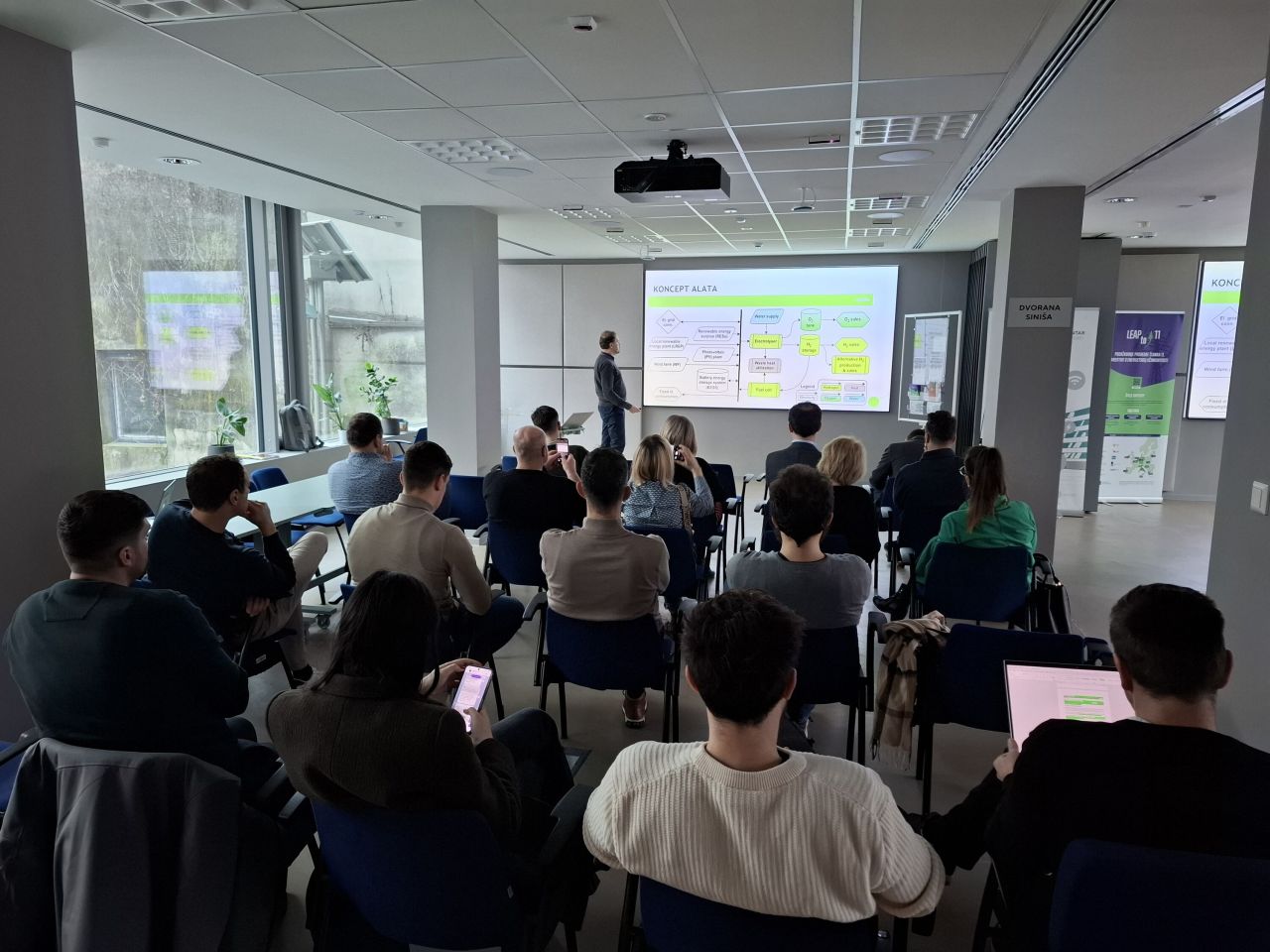
The event brought together energy planners, representatives of local and regional governments, investors, public authorities, development and energy agencies, and other stakeholders. The workshop served as a platform for knowledge exchange and constructive dialogue aimed at strengthening data-driven decision-making in the development of sustainable hydrogen energy systems.
Two innovative and complementary tools developed within the HyEfRe project were introduced to support realistic and informed hydrogen planning at the local and regional levels:
Hydrogenn Potenitial Model (HPM) – This model enables the assessment of local hydrogen production potential based on hourly data on renewable electricity generation and energy demand. By analysing renewable energy surpluses, it calculates the potential for hydrogen production and hydrogen carriers. The model also provides spatial visualisation of areas with the highest potential for renewable energy installations and hydrogen production, including estimated greenhouse gas emission reductions.
Decision Support Tool for Renewable Energy Hubs with Hydrogen (DST) – This user-friendly planning tool provides recommendations on optimal component sizing and operational modes within renewable energy hubs integrating hydrogen technologies (e.g. electrolyzers, photovoltaic systems and batteries). Primarily intended for local governments, cities, energy agencies, investors and energy planners, the tool enables comprehensive techno-economic assessments, including CAPEX and OPEX analyses.
The workshop was organised within the framework of the HyEfRe and GREET CE – Green transition in Central Europe projects, reinforcing regional cooperation and innovation in clean energy transitions.
The event concluded with an open exchange of feedback from participants, which will contribute to the further refinement of the presented tools and associated business model concepts, ensuring their practical relevance and applicability for stakeholders.