
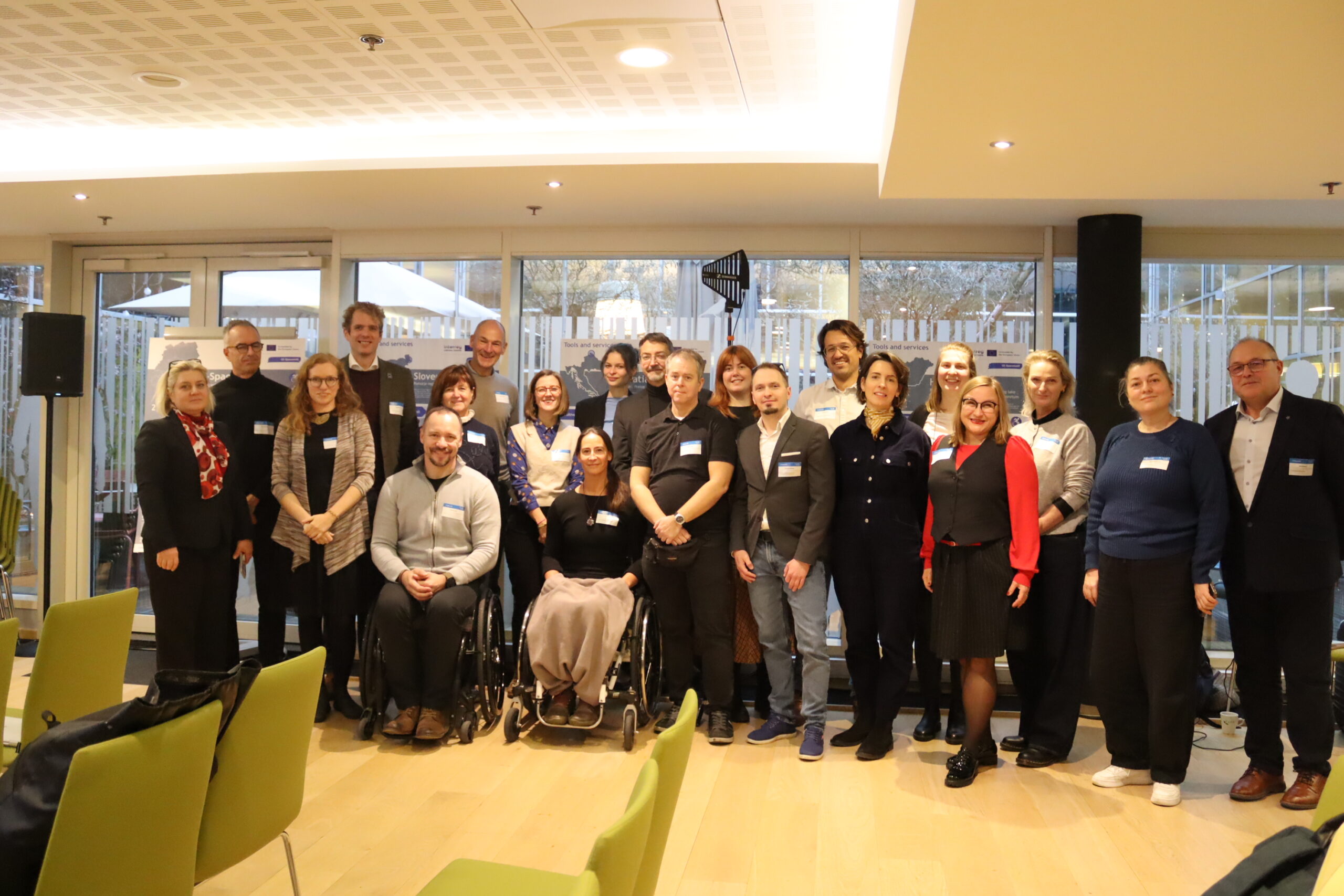
Brussels, 27 November 2025 — As part of the CE-Spaces4All project, the international Accessible Tourism Conference took place in Brussels, presenting the latest trends, practices and research findings in accessible tourism in Central Europe. The main themes included the sharing of good practices, the development of practical tools and the promotion of systemic changes at the European level. The conference highlighted that accessibility is not a marginal issue, but an essential part of tourism planning and public services. The opening session featured representatives of the European Commission, the European Disability Forum and the European Network for Accessible Tourism – Clara Kiess, Alejandro Moledo and Emiliano Deferrari.
The morning programme focused on concrete solutions enabling easier travel for people with disabilities. Speakers presented perspectives ranging from research to practical implementation and community experience. A presentation on the travel needs of blind and visually impaired people, delivered by Clemens Beyer (BOKU Vienna), demonstrated the importance of logical spatial orientation, clear design and the availability of audio and text descriptions. Primož Jeralič (National Council of Disability Organisations of Slovenia) followed with a presentation on the benefits of the EU Disability Card, which supports cross-border mobility and reduces administrative barriers. Practical recommendations for service providers were summarised in the Accessibility Guide, presented by Marie Scott (Czech Paraplegic Association). At the end of the session, Blaž Barborič (Geodetic Institute of Slovenia) introduced the new Five Spaces methodological framework, which offers a structured way of assessing destinations in terms of mobility, services, social environment, information accessibility and territorial characteristics.
The afternoon session was devoted to strategic issues and the roles of institutions, civil society organisations and the private sector. Discussions focused on how to harmonise accessibility standards in Europe, how to effectively involve communities and how to build trust between users and service providers. This block, moderated by Marie Denninghaus (European Disability Forum), brought both European and community perspectives — for example, from the European Commission (Victoria Petrova, DG MOVE), representatives of the EESC (Pietro Vittorio Barbieri), and organisations representing people with disabilities (Daniel Casas from EDF and Alexandre Bloxs from the European Union of the Deaf). The private sector was represented by Suzanne Edwards (Airbnb), who presented possibilities for implementing accessibility standards in commercial accommodation through Airbnb.
A key part of the conference was the poster presentation and interactive workshop, which provided an overview of the results from three pilot regions of the CE-Spaces4All project: Slovenia–Croatia–Hungary, Austria–Czech Republic and Poland. Participants rotated between thematic stations and discussed field experience, persistent barriers and concrete recommendations. In this part of the programme, CENIA played a key role — coordinating the preparation of posters, unifying visual identity, structuring the content and ensuring accessible graphic design, thus providing a clear presentation of results for a wide range of participants
In the closing session, the project leader Blaž Barborič summarised the main findings and future challenges — in particular the need for accurate and shared data, practical tools for service providers, active involvement of persons with disabilities and systematic support for accessibility in European regions. The CE-Spaces4All project thus makes a significant contribution to the development of inclusive tourism in Central Europe, all partners have developed useful tools freely available to everyone – more information can be found on the project website in the Outputs section.