
Between 15 and 16 April 2026, the partners of the BorderLabs CE project took a study trip to “the heart of Europe”, the trinational Meuse-Rhine Euroregion. Hosted by the Institute for Transnational and Euregional cross border cooperation and Mobility (ITEM) at Maastricht University and the Eurode Business Center, the tour provided a comprehensive overview of the complexity of the region, which is a real hub of cross-border cooperation, navigating three nations (the Netherlands, Germany, and Belgium), five regions, and several different governance levels.
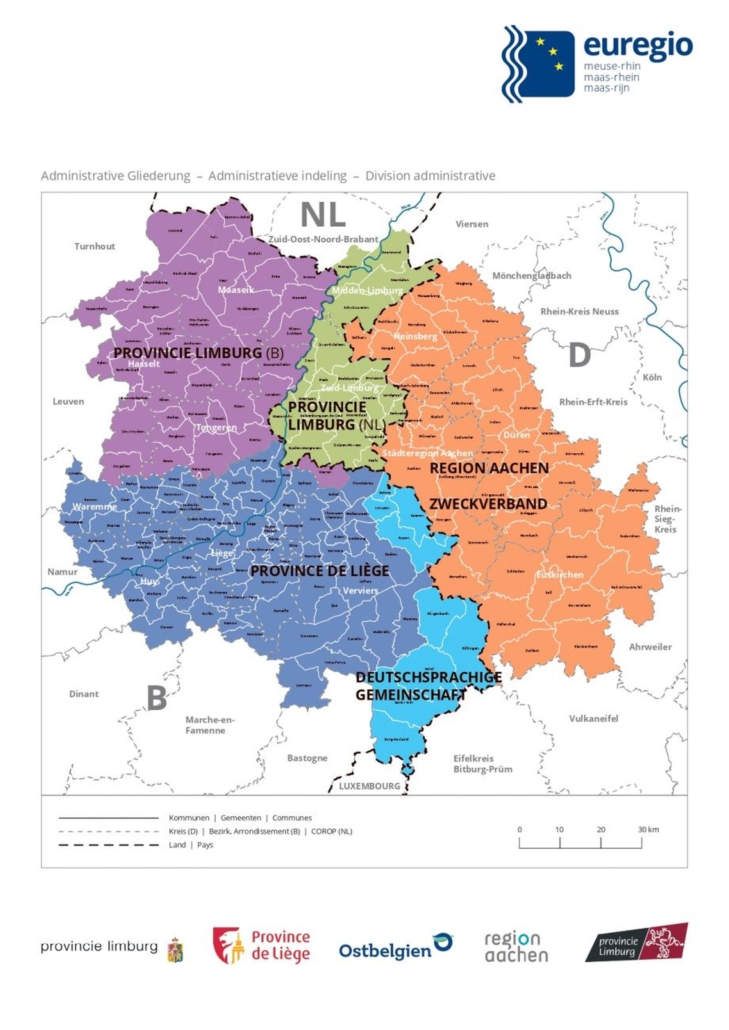
The agenda of the first day of the study visit started with the presentations of the experts and researchers of ITEM together with an expert from the public transport association of the Aachen Region (AVV), featuring topics such as the cross-border labour market, healthcare and public transport on the Dutch-German-Belgian border. In their opening remarks, Martin Unfried (Director of ITEM) and Pim Mertens (Scientific Coordinator and Researcher of ITEM) pointed out that cross-border commuters in the Meuse-Rhine Euroregion account for approximately 8% of the total cross-border workforce within the European Union. This high level of mobility places the burden of resolving mismatched regulations in taxation, health insurance, and social security on the concerned states, as these issues are often too specific for general EU-level intervention. In this region, the core idea behind cross-border cooperation in the field of employment is to create a 360-degree labour market, based on the concept that a worker should be able to look in any direction and find a job, regardless of national borders. Illustrating this idea, the following map demonstrates the ‘360-degree’ reality of the region:
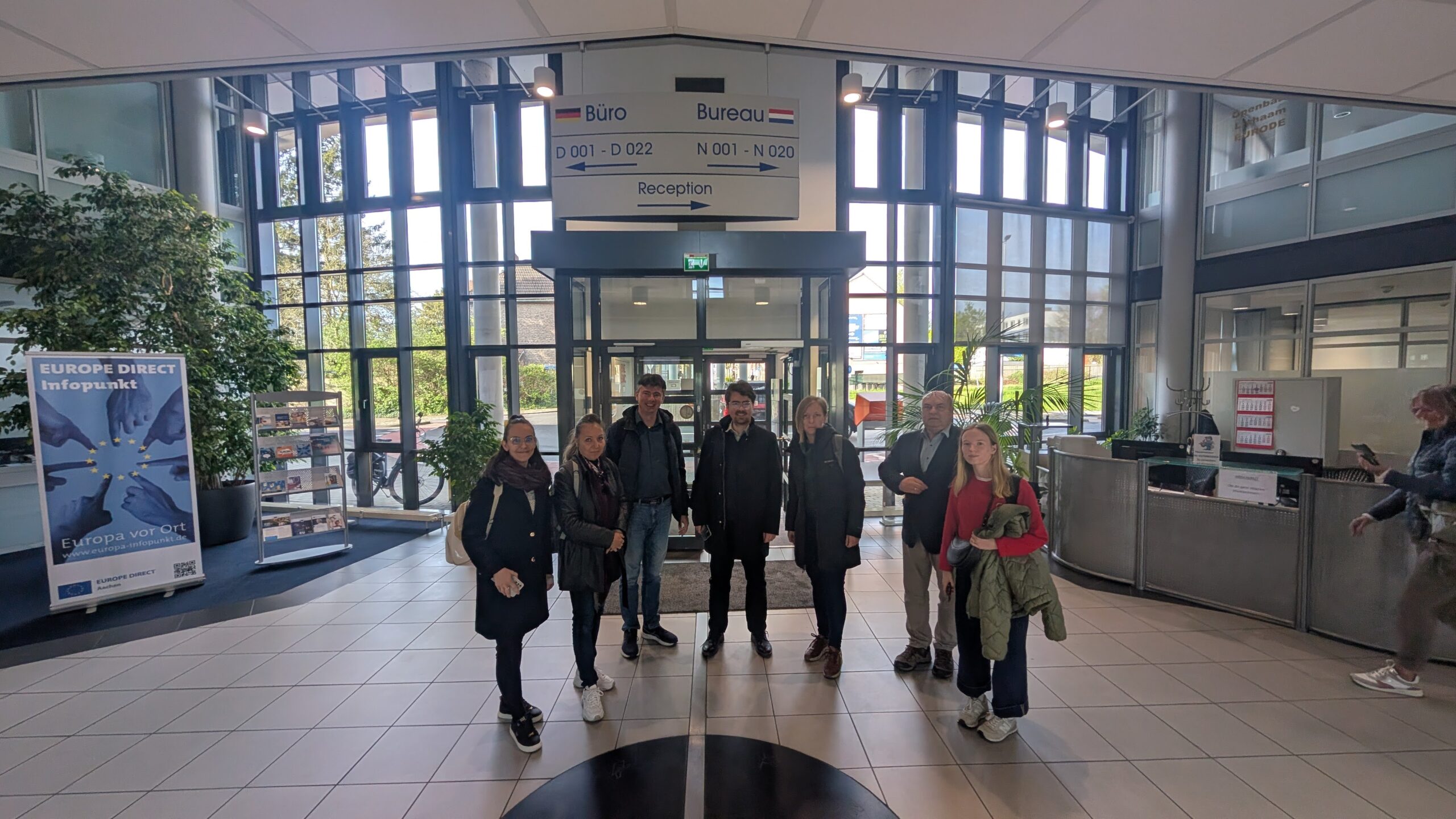
The second day of the study visit started at the Eurode Business Centre, a building situated right at the Dutch-German border between Kerkrade and Herzogenrath facilitating cross-border business relations. Sorush Brandenburg (Cross-border Cooperation Policy Officer of Kerkrade Municipality) Beyond infrastructure like shared bike paths and bilingual daycares, the Eurode cooperation fosters a unified “Knowledge Corridor” connecting the Universities of Aachen, Maastricht, and Cologne, emphasising the importance of academic cooperation in higher education. The cooperation is further amplified via local representative organs like Stadsregio Parkstad (municipality-level cooperation on the Dutch side of the border) and Städteregion Aachen (municipality-level cooperation on the German side of the border). Practical barriers are systematically tackled by the AG Charlemagne working group and specialised services like Grensarbeid, which focuses on cross-border labour market assistance, job mediation being the most relevant, and Grensinfo, a specialised office that provides information on specific border-related life events, including complex tax and social security cases, and helps cross-border commuters to identify the specific legislation applicable to their individual cases. This model of localised support has proved so successful that the initial information point has expanded into a network of 15 Grenzinfopunkt (GIP) locations along the Dutch-German border, facilitating cross-border mobility for citizens in the region.
The study visit concluded with a joint border walk along the Neustraße/Nieuwstraat, a street where the border runs directly down the centre, connecting the Netherlands and Germany.