
Pilot concept
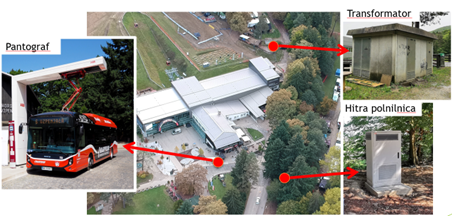
The pilot implemented by the Municipality of Maribor in cooperation with the University of Maribor focused on the deployment of a Battery Energy Storage System (BESS) based on repurposed second-life batteries. The system was installed at the Vzpenjača fast-charging station for electric buses and designed to act as an intermediate energy buffer between renewable energy sources, the electricity grid, and charging demand. Instead of sending batteries directly to recycling after their first use in electric vehicles, the pilot reintroduces them into a second-life application, where their remaining capacity can still be effectively utilised for stationary storage purposes. This enables more efficient energy management and supports the operation of electric bus charging infrastructure under variable demand conditions.
Implementation approach
The pilot followed a structured implementation process:
Design and planning phase
Definition of system requirements, selection of second-life battery modules, and design of the energy storage and integration concept.
Installation phase
Deployment of the BESS at the Vzpenjača fast-charging station and integration with existing charging infrastructure and renewable energy sources.
Operational phase
Operation of the system under real conditions, enabling energy buffering between the grid, renewable generation, and bus charging events.
Evaluation phase
Assessment of system performance in terms of energy efficiency, grid impact reduction, and feasibility of second-life battery integration in public transport systems.
Key results and outcomes
The Maribor pilot demonstrated several key outcomes:
- successful integration of second-life batteries into public transport energy infrastructure
- improved utilisation of renewable energy for electric bus charging
- reduced peak load and dependence on the electricity grid
- enhanced energy flexibility and system stability at charging stations
- demonstration of cascading use of battery assets in a circular economy model
Impact and outlook
The pilot demonstrates how second-life battery applications can contribute to more sustainable and resource-efficient public transport energy systems. By extending the lifecycle of battery assets and enabling their reuse in stationary storage applications, the approach reduces waste generation and supports the transition towards circular energy infrastructure. The Maribor pilot provides a scalable and transferable model for other cities aiming to integrate renewable energy, battery storage, and electric mobility within a circular economy framework. A video summarizing the Maribor pilot and its outcomes is available here: https://youtu.be/5c5CmsQa3lA