
How can circular economy move from policy ambition to practical implementation in Eastern Europe?
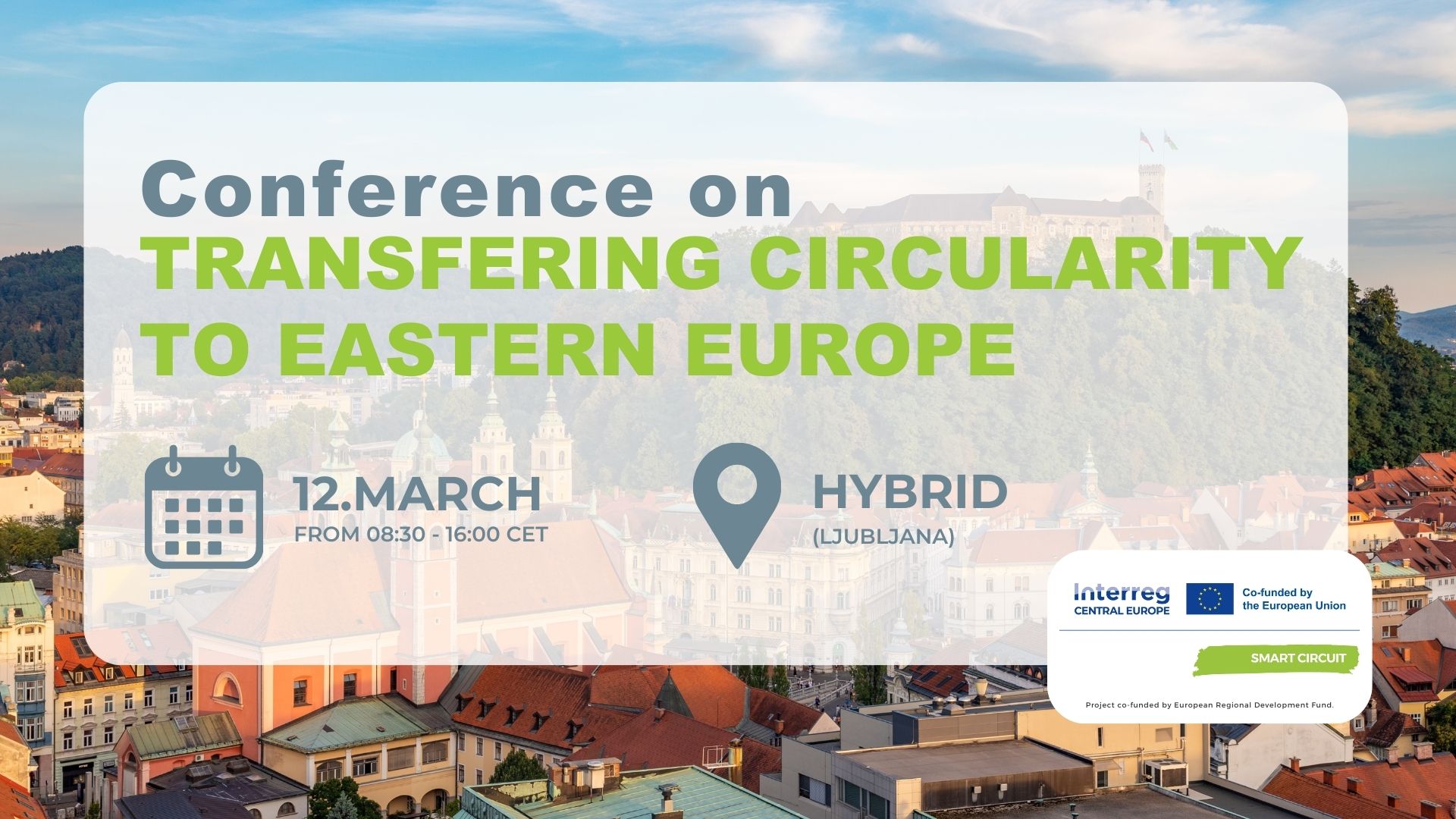
This is the central question of the conference “Transferring Circularity to Eastern Europe”, taking place on 12 March 2026 in Ljubljana (hybrid format).
The event brings together policymakers, innovation actors, industry representatives and project partners to explore how circular economy principles can be effectively transferred into regional and industrial practice—building on European policies, digital tools and concrete project experiences.
Why does circular economy in Eastern Europe need a strategic rethink now?
Eastern Europe faces a specific challenge: while circular economy goals are clearly defined at European level, their implementation often varies significantly across regions. Fragmentation, limited coordination and gaps between policy and practice remain key barriers.
The conference opens with a strategic outlook session, bringing together EU-level, national and innovation perspectives.
- Tomislav Pinter (Policy Analyst, DG REGIO) presents how digital solutions and cohesion policy can support circular transition.
- Marko Hren (Ministry for Cohesion and Regional Development of Slovenia) highlights how smart specialisation strategies can function as real transformation tools, while
- Marco Segovia Bifarini (Climate KIC) shares lessons learned from the Deep Demonstration approach in Slovenia.
Together, these perspectives set the framework for understanding why a strategic rethink is needed—and how it can be achieved.
How can EU policies and support instruments drive circular transition?
Vision alone is not enough. Circular transition requires well-designed policy instruments, funding schemes and innovation support structures that are accessible to regions and companies.
This part of the programme focuses on concrete enablers:
- Walter Schrittwieser (Mindconsult) presents public calls supporting circular transition, explaining how funding mechanisms can be aligned with circular objectives.
- Aneta Rząca-Czampiel (hub4industry – European Digital Innovation Hub, Krakow Technology Park) demonstrates the role of European Digital Innovation Hubs (EDIHs) in supporting companies with digital and circular solutions.
The session highlights how policy frameworks and innovation ecosystems can work together to accelerate implementation on the ground.
What have we learned from the SMART CIRCUIT project?
Projects create real value only if their results are shared, transferred and scaled.
The Strategy Dissemination Lab focuses on key lessons learned from the SMART CIRCUIT project, targeting both businesses and policymakers.
Speakers include:
- Christine Neuy (microTEC Südwest), presenting insights from the Circular Innovation Academy and its role in upskilling for a circular future;
- František Janke (TUKE – Technical University of Košice), addressing the challenge of closing the gap between circular policy goals and industrial practice;
- Alen Draganović (TECOS), showcasing how pilot actions can evolve into flagship circular industry projects.
This session translates project experiences into actionable knowledge that can be applied beyond the project context.
How can circular economy lessons be integrated into real policies?
One of the most critical questions of circular transition is governance: how can lessons learned be embedded into long-term policy frameworks?
A transnational panel discussion, moderated by Agnieszka Włodarczyk-Gębik (Krakow Technology Park), brings together:
- Marko Hren (Ministry for Cohesion and Regional Development of Slovenia)
- Klara Grašič (Chamber of Commerce and Industry of Slovenia),
- Aneta Rząca-Czampiel (hub4industry – EDIH, Krakow Technology Park).
The panel explores how cooperation between public authorities, chambers of commerce and innovation hubs can help turn insights into effective policy measures that support companies in their circular transition.
What does circular economy mean for businesses in practice?
For companies, circular economy only becomes relevant when it delivers practical, applicable solutions.
The afternoon masterclasses focus on technology-driven and business-oriented approaches, addressing real operational challenges.
Topics include:
- Ram Dušić Hren (TECOS) on using data responsibly and avoiding greenwashing,
- Marcello Guaiana and Marinella Favot (Area Science Park) on applying circular economy principles through secondary raw materials and practical cases,
- Vera Amtmann (BeanSaver) on leveraging open innovation to generate sustainable solutions in circular food systems.
These sessions are designed to provide hands-on insights for businesses looking to integrate circularity into their strategies and operations.
What comes after SMART CIRCUIT?
The conference concludes by looking beyond project timelines.
In the closing session, Agnieszka Włodarczyk-Gębik outlines how SMART CIRCUIT results can feed into future cooperation, scaling activities and new initiatives supporting circular economy across Europe.
The key message is clear: circular transition is a long-term process, and sustained impact requires continued collaboration between policy, industry and innovation ecosystems.
Join the discussion in Ljubljana
The conference “Transferring Circularity to Eastern Europe” will take place on 12 March 2026 in Ljubljana, in a hybrid format, enabling both on-site and online participation.
Join us to explore how circular economy can move from strategy to real impact in Eastern Europe.