
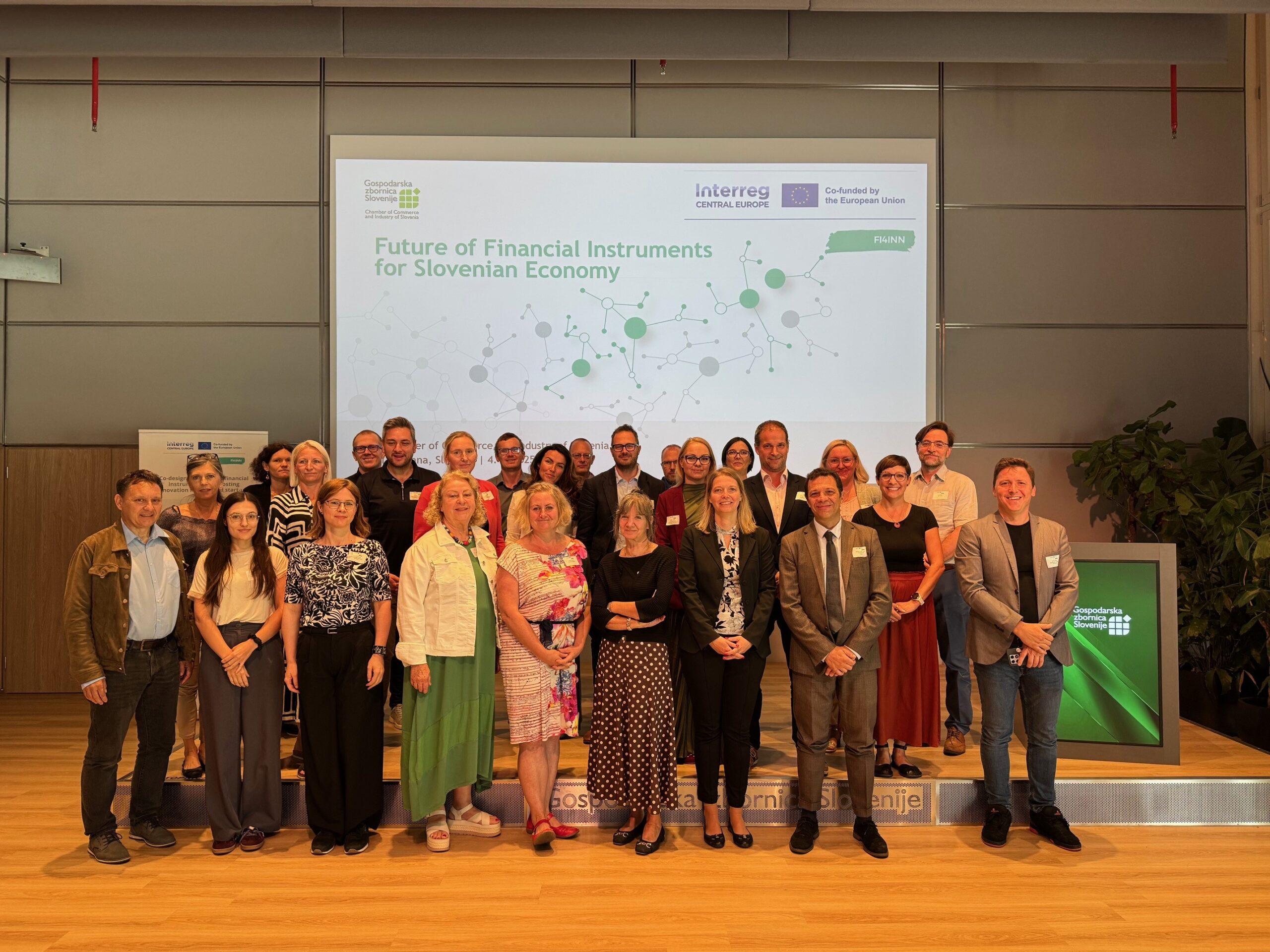
Bringing Key Stakeholders to the Same Table
The audience brought together representatives from national ministries, ERDF Managing Authorities, public financial institutions and development banks, regional development agencies, Strategic Research and Innovation Partnerships (SRIPs), universities and research organisations, as well as FI4INN project partners. This diversity ensured a rich exchange between policymakers, financial actors and innovation stakeholders, creating a setting where strategic vision and operational experience could meet.

The event opened with an introduction to the FI4INN project and its objective of strengthening innovation capacities in Central Europe through the co-design and dissemination of impactful financial instruments. Particular attention was given to the FI4INN Virtual Knowledge Center, presented as a long-term policy-learning tool designed to support public authorities and financial actors in improving the design, monitoring and evaluation of innovation-focused financial schemes.
The most dynamic part of the event unfolded during the interactive workshop and policy dialogue session, where participants engaged in open discussions on the challenges and opportunities facing financial instruments in Slovenia. Conversations addressed regulatory bottlenecks, coordination gaps and the evolving needs of the innovation ecosystem. The exchange resulted in shared conclusions and policy-oriented recommendations that will feed into future FI4INN activities and contribute to the development of pilot actions aimed at strengthening the national framework.
Learning from Central European Best Practices
International experience played a central role in the programme. Speakers from Austria, Italy, the Czech Republic and Hungary shared concrete case studies of innovative and blended financial instruments, offering insights into governance models, funding structures and implementation mechanisms. These examples provided inspiration for adapting successful approaches to the Slovenian context, while also illustrating the diversity of solutions being tested across Central Europe.

Looking Ahead
Beyond the discussions held in Ljubljana, the event forms part of FI4INN’s broader mission to foster transnational knowledge exchange and promote more effective, impact-oriented financial instruments across Central Europe. By combining dissemination, international best practice sharing and structured policy dialogue, the regional event reinforced the importance of aligning funding tools with the real needs of innovators. The insights generated have informed future activities under FI4INN and will support Slovenia in shaping a more strategic and forward-looking approach to financing innovation.