
What does it take to measure the environmental impact of a home care visit? How do you calculate the carbon footprint of a meal delivered to an elderly resident, or a care worker’s journey across a mid-sized European city? These are not questions that urban mobility research has traditionally asked — and that is precisely why Green LaMiS brought them to the 8th Conference on Sustainable Mobility (CSuM2026) in Skyros, Greece.
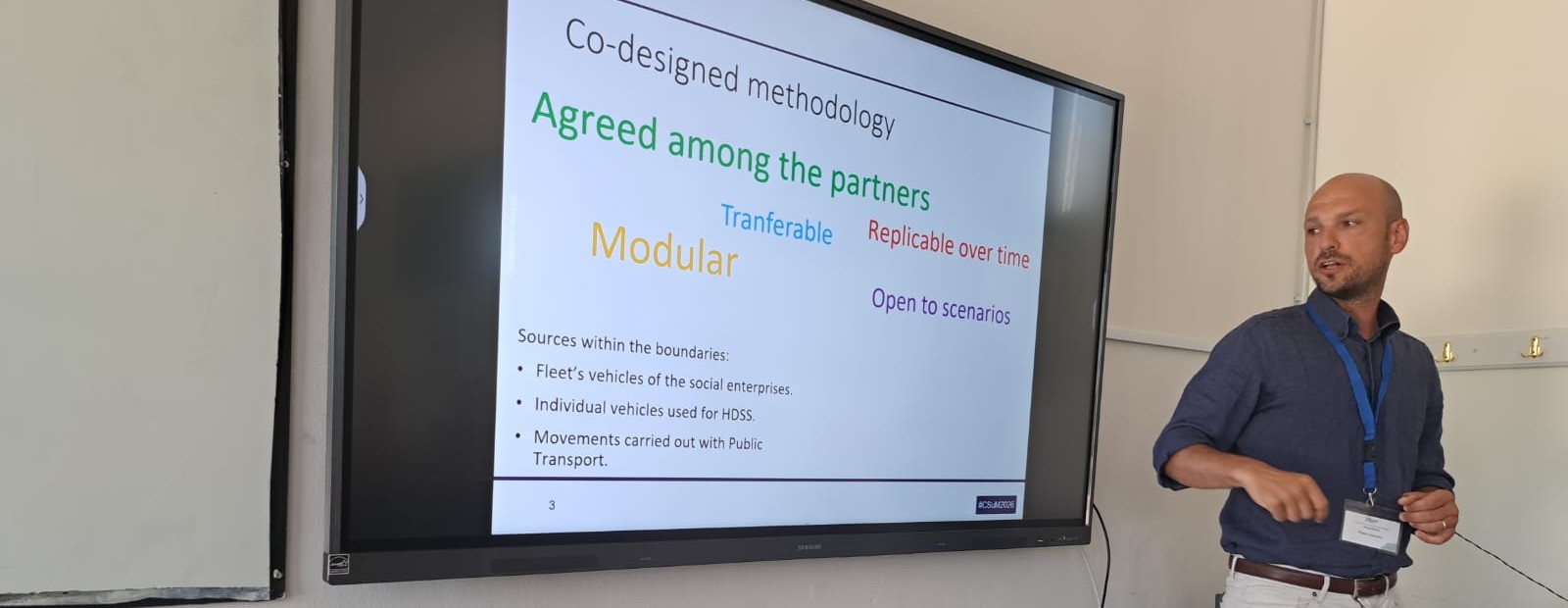
On 2 July 2026, Paolo Gandini (Mobility and Transport Laboratory, Politecnico di Milano) presented the paper “A co-design tool for carbon footprint estimation and reduction: application to the mobility of home delivery social service in the Green LaMiS project” (co-authored with Giovanna Marchionni, Lucia Coletti and Luca Studer) in the session on Decarbonisation Strategies and Electromobility Policy.
The tool and its methodology
At the heart of the presentation is the carbon footprint assessment tool developed by Green LaMiS — a practical, replicable instrument built on the GHG Protocol and co-designed with the three partner municipalities. Unlike generic emissions calculators, this tool was designed specifically for Home-Delivered Social Services (HDSS): the care visits, meal deliveries, and mobility support provided to elderly, disabled, and vulnerable citizens by social enterprises on behalf of local authorities.
The methodology accounts for vehicle fleets operated by social enterprises, individual vehicles used by care workers, and movements carried out with public transport. It produces both absolute emission figures and carbon intensity KPIs — indicators that normalise emissions against service volume (per service user, per operator, per kilometre) — allowing fair comparisons across different cities and over time, regardless of fluctuations in demand.
Crucially, the tool was designed for autonomy: local authorities and service providers can run annual updates without external technical support. Usability was a design requirement, not an afterthought.
Results from the pilot cities
The first real-world results confirm the potential of the approach. In Bergamo, emissions from social transport services fell by 25.2% between 2024 and 2025, following the introduction of an electric vehicle and improved route management. In Klis, household assistance services achieved a 21.7% reduction over the same period, supported by the integration of an electric vehicle into daily operations and the systematic logging of mileage data by care workers. Baseline data from Szombathely provides the reference point for evaluating the impact of interventions currently underway.
These are not marginal gains. They represent a measurable shift in the environmental footprint of services that operate invisibly in our cities every day — and they were achieved by small municipalities, working with limited resources, using a tool they themselves helped to design.
What comes next
The Green LaMiS tool is built to grow. Planned developments include its extension to additional service types and urban contexts, the integration of more transport modes into the public transport module, and the addition of decision-support features to help municipalities prioritise interventions.
The paper will be published in the CSuM2026 conference proceedings, making the methodology and findings available to the wider sustainable mobility research community.
Green LaMiS closes in November 2026. By then, the tool, the data, and the lessons from three European cities will be ready for anyone who wants to ask the same question we started with — and do something about the answer.